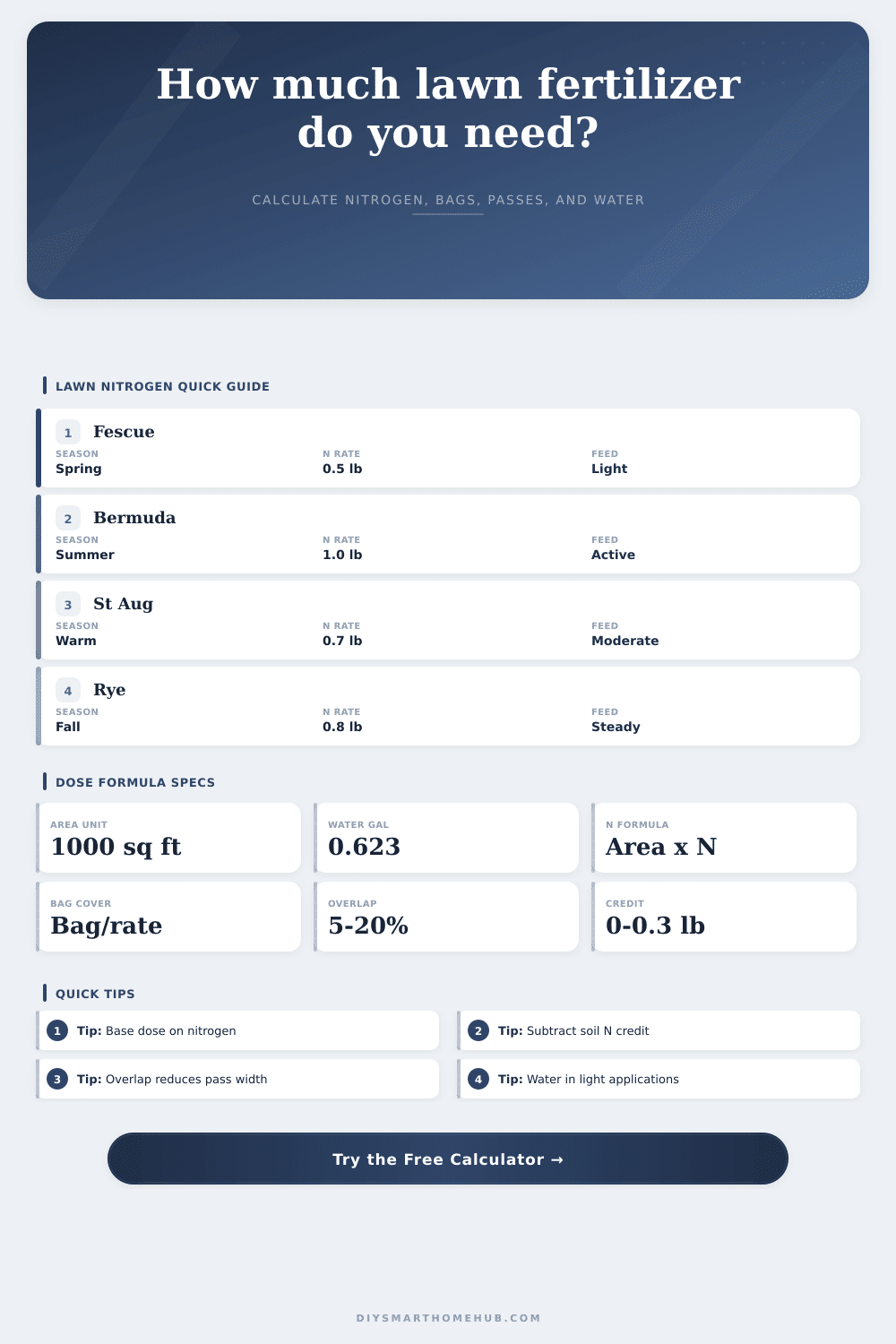
Lawn Fertilizer Dose Calculator
Estimate the fertilizer weight, nitrogen delivery, bag coverage, spreader passes, watering-in volume, and slow-release split for a measured lawn.
🏡Real lawn presets
Loaded preset: Cool-season Spring 5,000 sqft. Adjust the nitrogen rate, N-P-K analysis, and spreader geometry to match the product label and your lawn.
📐Lawn area and fertilizer inputs
📊Fertilizer dose results
🧪Formula reference grid
🌱Grass nitrogen rate reference
| Grass and timing | Typical single-application N rate | Season notes | Calculator use |
|---|---|---|---|
| Cool-season spring | 0.25 to 0.75 lb N per 1,000 sq ft | Light spring feeding avoids excessive top growth. | Use 0.50 as a conservative spring preset. |
| Cool-season fall | 0.75 to 1.00 lb N per 1,000 sq ft | Fall feeding supports recovery and density. | Use stronger rates when the lawn is actively growing. |
| Bermudagrass summer | 0.75 to 1.00 lb N per 1,000 sq ft | Warm-season turf responds during active summer growth. | Use product label limits and local blackout windows. |
| St Augustinegrass | 0.50 to 0.75 lb N per 1,000 sq ft | Moderate rates reduce burn risk on coarse warm-season turf. | Start at 0.60 to 0.70 for routine feeding. |
| Zoysiagrass | 0.40 to 0.75 lb N per 1,000 sq ft | Dense turf often needs less nitrogen than bermuda. | Use lower values unless recovery is needed. |
| Centipedegrass | 0.25 to 0.50 lb N per 1,000 sq ft | Low fertility grass can decline from heavy nitrogen. | Use low-N maintenance settings. |
| New sod or seed starter | 0.50 to 0.75 lb N per 1,000 sq ft | Starter blends may also supply phosphate and potash. | Match soil test and product label for P and K. |
📦N-P-K product examples
| Fertilizer analysis | Product lb for 1 lb N | Nutrients also delivered per product lb | Best calculation use |
|---|---|---|---|
| 32-0-4 synthetic lawn food | 3.13 lb product | 0.32 lb N and 0.04 lb K2O | High-analysis routine nitrogen feeding. |
| 24-0-6 slow-release blend | 4.17 lb product | 0.24 lb N and 0.06 lb K2O | Balanced lawn feeding with modest potash. |
| 15-5-10 starter blend | 6.67 lb product | 0.15 lb N, 0.05 lb P2O5, 0.10 lb K2O | Establishment where soil test supports phosphorus. |
| 10-0-10 low-N maintenance | 10.00 lb product | 0.10 lb N and 0.10 lb K2O | Low nitrogen with potassium support. |
| 6-4-0 organic-style product | 16.67 lb product | 0.06 lb N and 0.04 lb P2O5 | Low-analysis products needing higher product weight. |
| 46-0-0 urea | 2.17 lb product | 0.46 lb N only | High-analysis nitrogen source needing careful calibration. |
🚧Spreader overlap and application notes
| Spreader setup | Common swath width | Useful overlap | Pass-count effect |
|---|---|---|---|
| Small handheld spreader | 3 to 5 ft | 10% to 20% | Many short passes, useful on small strips and irregular edges. |
| Drop spreader | 2 to 3 ft | 0% to 5% | Precise bands, high pass count, lower drift beyond the wheel path. |
| Walk-behind broadcast | 6 to 10 ft | 10% to 20% | Effective width equals spreader width multiplied by one minus overlap. |
| Tow-behind broadcast | 10 to 14 ft | 15% to 25% | Large lawns need fewer passes but benefit from measured swath checks. |
| Two-direction half rate | Same spreader width | Use two crossing routes | Apply half the product each direction to reduce streaking. |
💧Watering-in guidance
| Watering depth | Gallons per 1,000 sq ft | Typical use | Calculator formula |
|---|---|---|---|
| 0.10 inch | 62 gallons | Very light rinse for dust and leaf pickup. | 0.10 x 1,000 x 0.623 |
| 0.25 inch | 156 gallons | Common watering-in depth after granular fertilizer. | 0.25 x 1,000 x 0.623 |
| 0.50 inch | 312 gallons | Deeper watering when soil surface is dry. | 0.50 x 1,000 x 0.623 |
| 1.00 inch | 623 gallons | Full irrigation depth, more than many label rinse needs. | 1.00 x 1,000 x 0.623 |
🔍Fertilizer scenario comparison grid
✅Actionable calculation tips
Use label directions, local fertilizer restrictions, and soil-test recommendations where they apply. This calculator estimates material and water quantities from entered product analysis and lawn measurements.
Fertilizing the lawn can feel like alchemy: You open up the bag, dip out some “something,” and scatter it about in hopes it’ll do the job. But its really about precision and chemistry. Nitrogen isn’t magic; it is chemistry. What you’re doing with fertilizer are applying exactly one particular nutrient, nitrogen, to your soil at the proper rate.
Too much? Grass burn. Too little? Money wasted, plus splotches of brown. Knowing exactly how many square feet each application will cover, and how much of the correct product that amounts to, is the difference between a lush lawn and an expensive science project.
How to Use Fertilizer the Right Way
Once you’ve got the product information and the lawn area entered, the calculator do the math for you. No more wondering if a thirty-two pound bag will be enough for half the lawn or the entire one.
Fertilizer bags are expressed as percentages, not pounds, which requires a little education: a bag marked twenty-four percent nitrogen mean three-quarters of that weight is filler material like limestone or potassium. That’s why the rest of the package may say zero percent nitrogen. All those numbers tell you how much something contribute to plant growth. Nothing else. It either corrects the soil pH or promotes root health. Knowing that will help you select the right product for each task.
Timing is everything. For cool-season grasses such as fescue, springtime finds those guys awake but with a light appetite. Don’t feed them a heavy meal; they don’t want one right now. Start them off with a half-pound of nitrogen per thousand square feet which won’t force to much top growth (the enemy of a healthy lawn). Save your big show for fall for cool-season grasses, while warm-season grasses like Bermudagrass flip the script by sleeping in spring and demanding fuel in the heat of summer. Feeding them in April doesn’t do any good, the grass just can’t process it then.
Account for existing “nitrogen bank.” If there’s fresh compost in the soil, or if recent rains left some residual nitrogen, you’ll want to take a credit. Over-applying because you forgot about that credit isn’t good. The tool let you subtract that existing credit… So you’re only buying what your lawn truly requires. Those little bag-of-fertilizer savings add up season by season. They also help protect local waterways from runoff, this is a major responsibility for all homeowners.
It’s not just a matter of dose, it’s also a matter of application technique. Practical constraints include how wide the spreader is. What is degree of overlap? While some broadcast spreaders say they cover an eight-foot swath, real-world conditions (uneven terrain, wind) make for less precision. To avoid stripe-like patterns in your lawn, overlap each pass by ten to twenty percent. Sounds tedious, but avoids those burn spots caused by the fertilizer piling up. Enter your desired overlap percentage and spreader width, and the calculator tell you how many times you’ll have to go out and make another walk up and down the yard. It turns a physical chore into a manageable plan, you know exactly how many times you have to do it.
The last thing: Water it in. When you apply granular nitrogen, it doesn’t dissolve; it stays on top of the leaf until water washes it off in the soil. Generally about a quarter inch of water is all that’s needed to wash it onto the blades and push it downward. Don’t do too little or you’ll waste money on brown patches. Don’t do too much, more than what the roots actualy need, or you’ll wash the food away before the roots can take it up. To help you make sense of how deep to water, the tool shows you in gallons how much water to apply so you can plan out a run of your irrigation system. It’s a little detail, but it is the difference between a greening lawn and a scorched one.
Feed the biology. Don’t throw stuff on the ground. Apply it evenly, get the rate right, and time it to coincide with the season. It is not just about growth, but also color and density; your lawn will reward you. Buying exactly what you need (not a penny more). Will save you money.