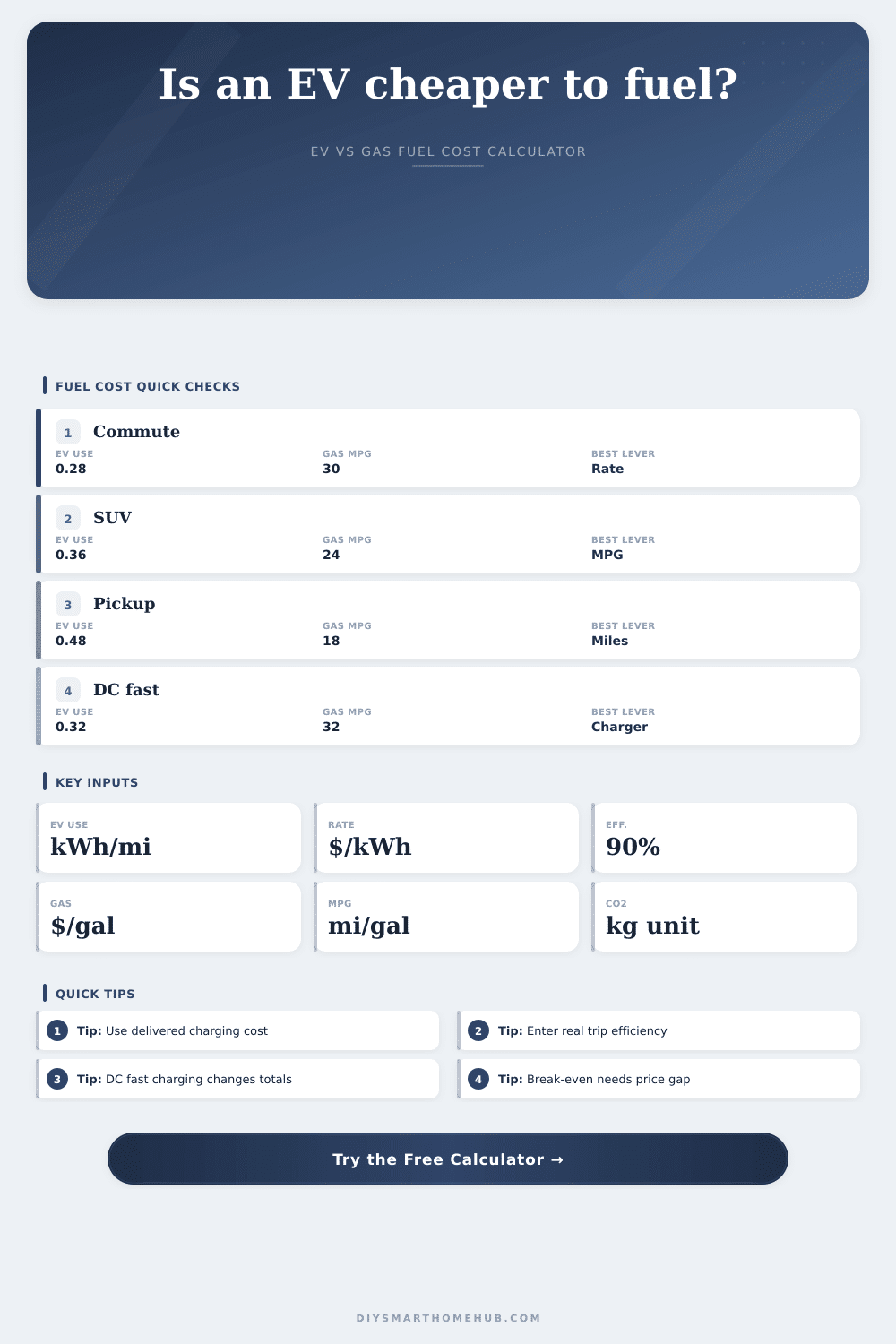
EV vs Gas Fuel Cost Calculator
Compare EV charging cost per mile against gasoline cost per mile, then estimate annual fuel totals, break-even miles, break-even years, and optional CO2 emissions.
🚗 Driving presets
⚡ Calculator inputs
Fuel cost comparison
📊 Current scenario grid
🔍 Sensitivity table
| Case | EV $/mi | Gas $/mi | Annual EV | Annual gas | Annual savings |
|---|---|---|---|---|---|
| Base | $0.050 | $0.100 | $597 | $1,200 | $604 |
📘 Reference efficiency ranges
| Vehicle type | EV energy use | Gas MPG range | Cost lever |
|---|---|---|---|
| Compact commuter | 24 to 30 kWh/100 mi | 32 to 42 MPG | Electric rate and charging losses |
| Crossover or small SUV | 30 to 38 kWh/100 mi | 24 to 32 MPG | Annual miles and gas price |
| Pickup or large SUV | 42 to 55 kWh/100 mi | 15 to 23 MPG | Efficiency gap and towing mix |
| Highway-heavy driving | 32 to 45 kWh/100 mi | 27 to 38 MPG | Speed, weather, and charger rate |
🧮 Formula checks
| Output | Formula | Example input | What changes it |
|---|---|---|---|
| EV cost per mile | kWh/mi x rate / efficiency | 0.28 x $0.16 / 0.90 | Efficiency, charger loss, rate |
| Gas cost per mile | fuel price / MPG | $3.50 / 35 MPG | Gas price and real MPG |
| Annual cost | cost per mile x annual miles | $0.05 x 12,000 mi | Driving distance |
| Break-even | price gap / annual fuel savings | $5,000 / $604 | Price gap and fuel spread |
| CO2 estimate | energy x factor or gallons x factor | kWh x kg/kWh | Grid factor and gasoline use |
🛠 Practical calculator tips
When you purchase a car, there’s more to consider beyond the pump price sticker. For decades, you’ve bought cars based off their miles per gallon rating because that one number appeared to encapsulate how efficient they were. Well, electricity doesn’t go in a gas tank so that model isn’t working anymore. When you drive an EV, there are more complex factors at play that determine how much it will cost to move around: powertrain efficiency, charging loss and kilowatt-hours. It is a minor mental adjustment, but one that completely changes the ownership calculation.
The sticker price gets most folks stopped. But day-to-day use is where savings really occur. An electric vehicle is not just a car, it’s a new type of relationship with the energy infrastructure.
How to Calculate EV Costs
This calculator takes the abstract units of electricity and converts them into cents-per-mile. Then it sits that number side-by-side with how much gas you spend. It forces you to see it as a per-delivery rate. That is what shows up on your utility bill: the rate for delivering power plus generating it.
Folks often make mistake of using a lower rate based solely on their electricity generation costs. The generation-only rate makes the electricity seem like a better deal then it really is. For that you must have whole picture.
The battery hits the pavement, where efficiency is key. An electric SUV eats up more electricity than a compact sedan. A large truck guzzles gas faster then a hatchback. You can enter in kilowatt-hours per hundred miles. That’s the new normal metric that shows up on today’s dashboards. It accounts for your real-world driving (including your typical speed), and climate control habits. Efficiency takes a beating if you spend a lot of time in cold weather. Your battery has to works even harder to keep you cozy. The numbers account for that fact. And it doesn’t rely only on the advertised ideal range for sunny weather conditions. Efficiency is lost.
Many people forget about hidden costs of charging. Yes: you lose electricity from the wall into your car. And some of that electricity gets converted to heat. The calculator accounts for that. Home charging is typically assumed to have 90% efficient rate. So you’re paying a little bit more for every kilowatt-hour of electricity that goes into your car. Sounds trivial. But over time, over fifty thousand miles, all of those lost kilowatt-hours turn into actual dollars. It is difference between theoretical savings and actual dollars.
A break-even analysis can be helpful for those considering making the leap to an electric vehicle (which requires a bit more money up front). How quickly do I make back my investment from lower fuel costs? The tool tells you: simply divide the difference between cars (the price) by your yearly fuel savings. Now strip out the noise, the insurance, maintenance, etc. Those will be all over the map. Focus only on energy economics. Does the switch pay off financially? Maybe it’ll take three years before you drive enough to recoup the cost. Maybe ten. The math doesn’t lie.
That said, the decision to electrify isn’t just about tech enthusiasm or environmental guilt anymore. It’s also about understanding the value of output compared to the cost of inputs. So what does that mean? You should know your driving habits. You should know actual efficiency of whatever vehicles you’re considering. You should know your local energy rates.
And there’s a handy sanity check in the form of reference tables that come along with the calculator. These demonstrate which vehicle classes performs best (and worst) when it comes to using energy, and where the various cost factors fall for each class. Knowing that electricity is cheaper than gas in most areas doesn’t cut it; you have to know whether that applies to you. This again depends on your driving habits. Get all that down, then it’s simply a matter of preference from there.