Driveway Sealant Coverage Calculator
Estimate driveway sealer gallons, pail count, crack filler volume, and drying windows from area, surface condition, coats, coverage, waste, and crack dimensions.
🏠 Quick presets
📏 Driveway and sealant inputs
🔧 Crack filler inputs
Sealant estimate
📊 Coverage and material grid
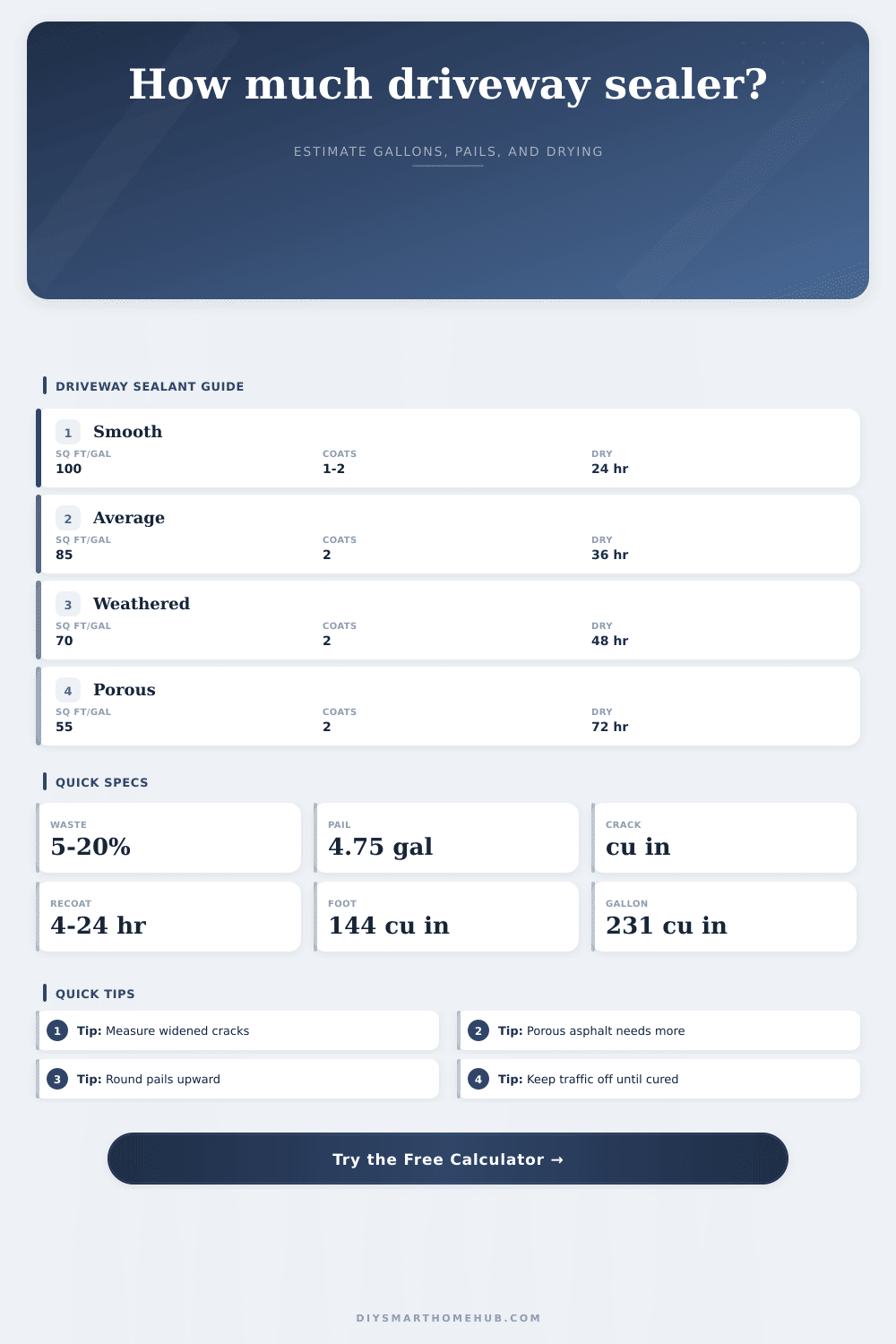
📋 Surface condition reference
| Surface condition | Default coverage | Suggested coats | Drying adjustment |
|---|---|---|---|
| Smooth or recently sealed asphalt | 100 sq ft per gallon | 1 to 2 thin coats | Baseline drying |
| Average residential driveway | 85 sq ft per gallon | 2 coats | Add about 10% |
| Weathered or oxidized asphalt | 70 sq ft per gallon | 2 coats | Add about 25% |
| Very porous or rough asphalt | 55 sq ft per gallon | 2 to 3 coats | Add about 45% |
🧪 Sealant type reference
| Sealant type | Base recoat window | Foot traffic | Vehicle traffic |
|---|---|---|---|
| Latex asphalt sealer | 6 to 12 hr | 12 to 24 hr | 24 to 48 hr |
| Asphalt emulsion | 8 to 16 hr | 18 to 24 hr | 36 to 72 hr |
| Fast-dry sealer | 4 to 8 hr | 8 to 12 hr | 18 to 36 hr |
| Filler-sealer blend | 12 to 24 hr | 24 to 36 hr | 48 to 72 hr |
📐 Common driveway examples
| Project | Area | Typical gallons | Pails at 4.75 gal |
|---|---|---|---|
| Single-car apron | 240 sq ft | 5.6 to 7.6 gal | 2 pails |
| Two-car driveway | 600 sq ft | 14.1 to 18.9 gal | 3 to 4 pails |
| Long narrow drive | 1,000 sq ft | 23.5 to 31.5 gal | 5 to 7 pails |
| Porous large drive | 1,400 sq ft | 58.2 gal | 13 pails |
💡 Calculation tips
Before purchasing any type of sealant, figure out how much is necessary. There are several types: sprays, tubes, and even five-gallon pails available at the hardware store. Knowing how much you’ll need will prevent you from wasting product or running short.
Estimate your needs so you can purchase the right amount. First, measure it, because most folks do not know how to accurately estimate their driveway size. They usually guess wrong. Only include asphalt, ignore unsealed edges and grass.
How to Calculate How Much Driveway Sealer You Need
Next, assess the pavement condition, because a new driveway require less sealcoat than older, weathered asphalt. This is what calculator factors in. It takes into account porous surfaces which will absorbs more. Assume high coverage for older drives.
The texture of surface impacts your usage. You get one-hundred square feet per gallon on a smooth driveway. You get only fifty-five square feet on a rougher driveway. Fail to account for this variation and you’ll be short on sealer.
The tool allows you to pick the condition of the surface. It adjust the coverage automatically. Also factor in some additional allowance for wastage. Edges don’t go on as well as the middle, and spills do occur. To get a proper coating requires overlap. Use more so that it goes further.
Another variable is cracks. These are big holes you can’t pour sealer in. You have to fill void first. If not, the sealer will dissapears down the crack. This tool figures out how much filler you need by calculating length x width x depth.
Fillers and sealers is two different products. Fillers stay pliable so they can manages the stress. Sealers form a protective skin. Use wrong product and it fails prematurely.
Buy containers: Once you know how many gallons of sealer you need, buy that amount. Most sealers are available in four-and-three-quarter gallon pails. No buying half-pails or anything like that. The calculator rounds up to the full pail which tells you exactly what to purchase.
And it gives you a window of when to expect drying. That’s important for scheduling purposes. Will I be able to drive over this tomorrow? How about latex versus coal-tar emulsion sealers? Latex dries quicker than others. The same is true for heat versus cold, and so on. Drying time depends on your product type and the weather.
There are tables with reference lines. Some say you can drive on it. Others say you can walk on it. But you can’t drive on it before you can walk on it. Knowing that prevents tire tracks in a newly sealed driveway.
It’s not all science but logistics. Measure space and fill the crack. Buy enough of product and consider the texture. Wait for it to dry. Do the math ahead of time and the rest make sense.
Sealing your driveway provides protection. Your driveway will last longer. The pavement is good. Water stays away. But, you should of have enough product. Don’t just guess how much. Do the math. Everything is dark again.