Tire Pressure Temperature Calculator
Estimate how a cold tire pressure changes when air temperature, tire temperature, or altitude changes using the quick 1 psi per 10°F rule and the ideal gas absolute pressure formula.
P2 = (P1 + 14.7) x T2 / T1 - 14.7, with absolute temperature in Rankine.
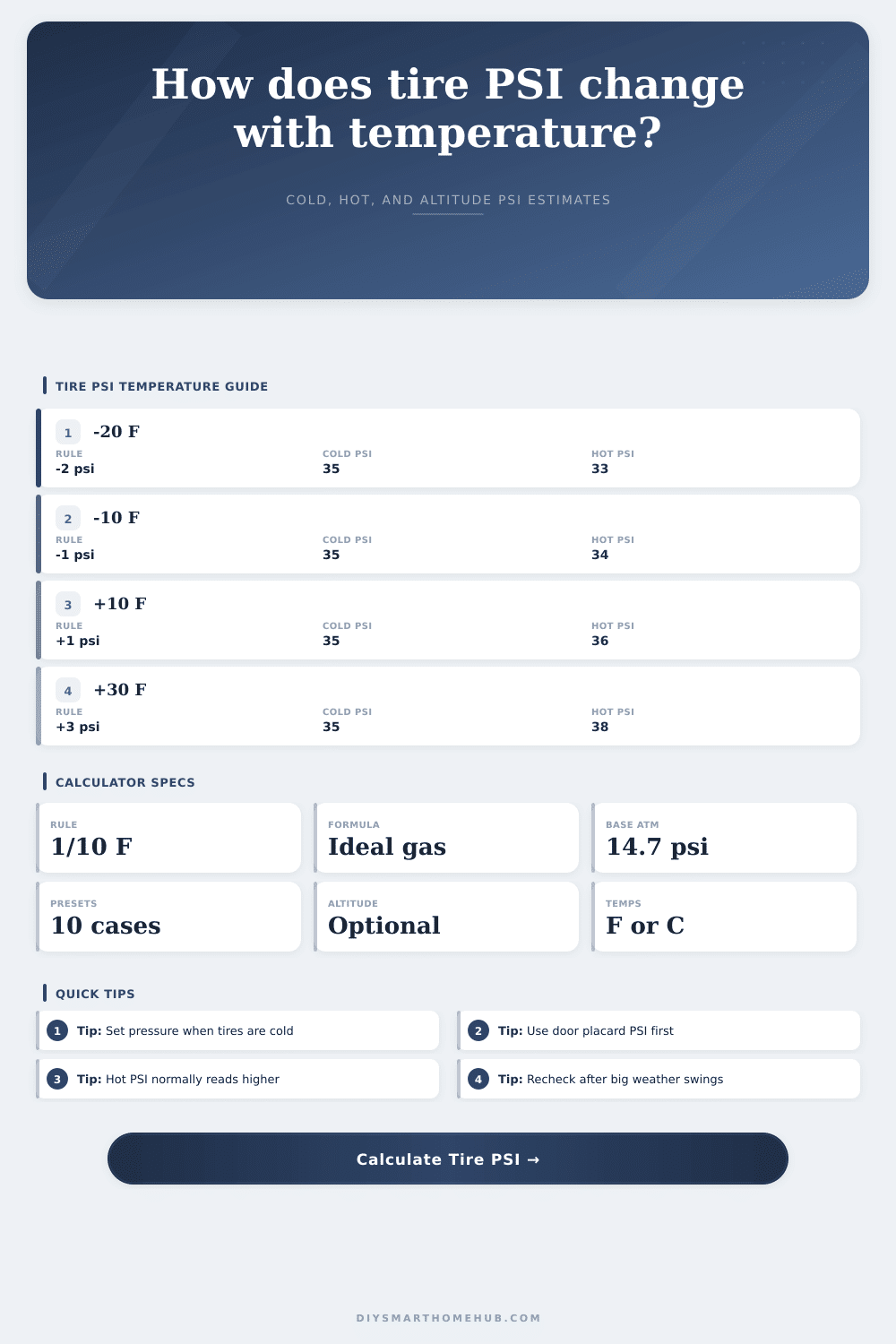
Most passenger tires change roughly 1 psi for every 10°F air temperature change.
Gauge PSI is converted to absolute pressure before applying the temperature ratio.
A gauge reads about 0.49 psi higher per 1000 ft climb if tire absolute pressure is unchanged.
| Temperature change | Quick PSI shift | 35 psi ideal gas estimate | What it usually means |
|---|---|---|---|
| -40°F | -4 psi | 30.9 psi | Major cold front can trigger TPMS on a tire that was fine yesterday. |
| -20°F | -2 psi | 33.0 psi | Common seasonal drop from warm garage checks to winter mornings. |
| -10°F | -1 psi | 34.0 psi | Small enough to watch, but enough to matter near the TPMS threshold. |
| +10°F | +1 psi | 36.0 psi | Mild warming after sun exposure or warmer afternoon air. |
| +30°F | +3 psi | 38.1 psi | Normal hot reading after driving can be a few psi over cold placard. |
| +60°F | +6 psi | 41.2 psi | Track, heavy highway, or trailer tires can show larger warm pressure rise. |
| Use case | Typical cold PSI | Typical hot rise | Calculator note |
|---|---|---|---|
| Passenger sedan | 32 to 36 psi | 2 to 4 psi | Check against the door placard after the vehicle sits several hours. |
| SUV or crossover | 34 to 38 psi | 3 to 5 psi | Higher weight can make warm pressures climb faster on long highway runs. |
| Light truck load | 40 to 65 psi | 4 to 8 psi | Load tables and axle weight matter more than a generic passenger-car rule. |
| Trailer tire | 50 to 80 psi | 5 to 10 psi | Use the specified cold pressure for the loaded trailer tire rating. |
| Performance driving | 28 to 36 psi | 6 to 12 psi | Target mode helps estimate the lower cold setting needed for a hot target. |
| Altitude climb | Gauge shift | Same tire would read | Practical use |
|---|---|---|---|
| 1000 ft | +0.5 psi | 35.5 psi from 35 | Small enough for most daily checks. |
| 3000 ft | +1.5 psi | 36.5 psi from 35 | Noticeable on mountain trips if temperature is unchanged. |
| 5000 ft | +2.5 psi | 37.5 psi from 35 | Useful when comparing valley and pass gauge readings. |
| 8000 ft | +3.9 psi | 38.9 psi from 35 | Large enough to separate altitude effect from heat effect. |
After a cold front drops temperatures, you noticed that your tire pressure monitoring system light come on. You grabbed a gauge, checked your tires and discovered they is low. You topped off your tires with air. Good move, but why does it make people confused?
Here’s what drivers don’t understand: Air pressure changes depending off the weather. Inside your tires, air expand during heat and contracts during cool conditions. So if you check your tire pressure first thing in the morning, chances are it won’t match what you see later in the day. Knowing about this dynamic will keep you from over-inflating cold tires and under-inflating warm tires.
Why Tire Pressure Changes with Weather
While it seems counterintuitiv, the physics is simple enough. Gases behave in predictable ways regarding temperature. Enter your ambient conditions and starting pressure into the calculator and let it do the math. It will provide you with a range of pressures.
There are two method. One uses the ideal gas law, which is more accurate because it considers absolute atmospheric pressure. The other simply calculates that every 10 degree F rise or fall equals about a one pound per square inch change. Close enough may not be good enough when you’re at or around the warning light threshold or you’re attempting to tweak the handling balance.
What’s not wrong: Most folks check their tires after a few miles of driving. Pressure is above what the placard on their door says; they’ll bleed some air off until it’s even. Trap! That’s the wrong pressure. What the placard indicates (cold pressure) is the right pressure, and it’s where your tire should be when it’s been parked at least three hours. Bleed air off of a hot tire to meet the cold spec and you’re going to have less in there when it cools back down, meaning you’ve underinflated the tire.
Use this tool to help you visualize it. Enter a start temp, a final temp, then hit go. Simulate a cold start, then a highway drive. See how much the pressure increase automatically? Four pounds? Totally normal! When you know that a tire with four pounds on it looks like a healthy tire you won’t be tempted to mess with it.
Another part of the equation that a lot of owners don’t consider is altitude. As you climb higher on a mountain pass, there is less air pressure outside the tire. Even though amount of air in the tire hasn’t increased or decreased, it will register a higher number on your gauge because it’s reading a lower air pressure by comparison. That’s why they call it a relative measurement.
There is a field you can optionally fill out in the calculator to remove the effect of altitude so you can see the difference between what heat did versus what altitude does. Let’s say you live down in a valley and drive up into the Rockies. Your tire pressure could be much higher when you get to the top. Don’t worry about deflating them. They aren’t overinflated. What happened is that the gauge reacted to the reduced atmospheric pressure. Keep it constant and it will handle consistantly regardless of the road grade.
Tires are a closed system interacting with their environment. So here’s the practical lesson: check ’em (when they’re cold), set ’em (to what your car recommends), and trust the physics. Drive around and let the pressure increase; leave them parked and let the pressure decrease. Within some reasonable tolerance around that starting point, you don’t need to worry about each individual pound change.
As long as the tire is pressurized and performing according to how it was made to work at all times, then the light on the dash exists to alert you to actual issues, not to babysit subtle changes in temperature. Knowing how pressure, altitude and heat are related helps you move from treating symptoms to managing the cause. The thin layer of ice on the windshields doesn’t indicate that your tires is busted; it just indicates that air inside is doing what it’s supposed to do.