Downspout Drainage Calculator
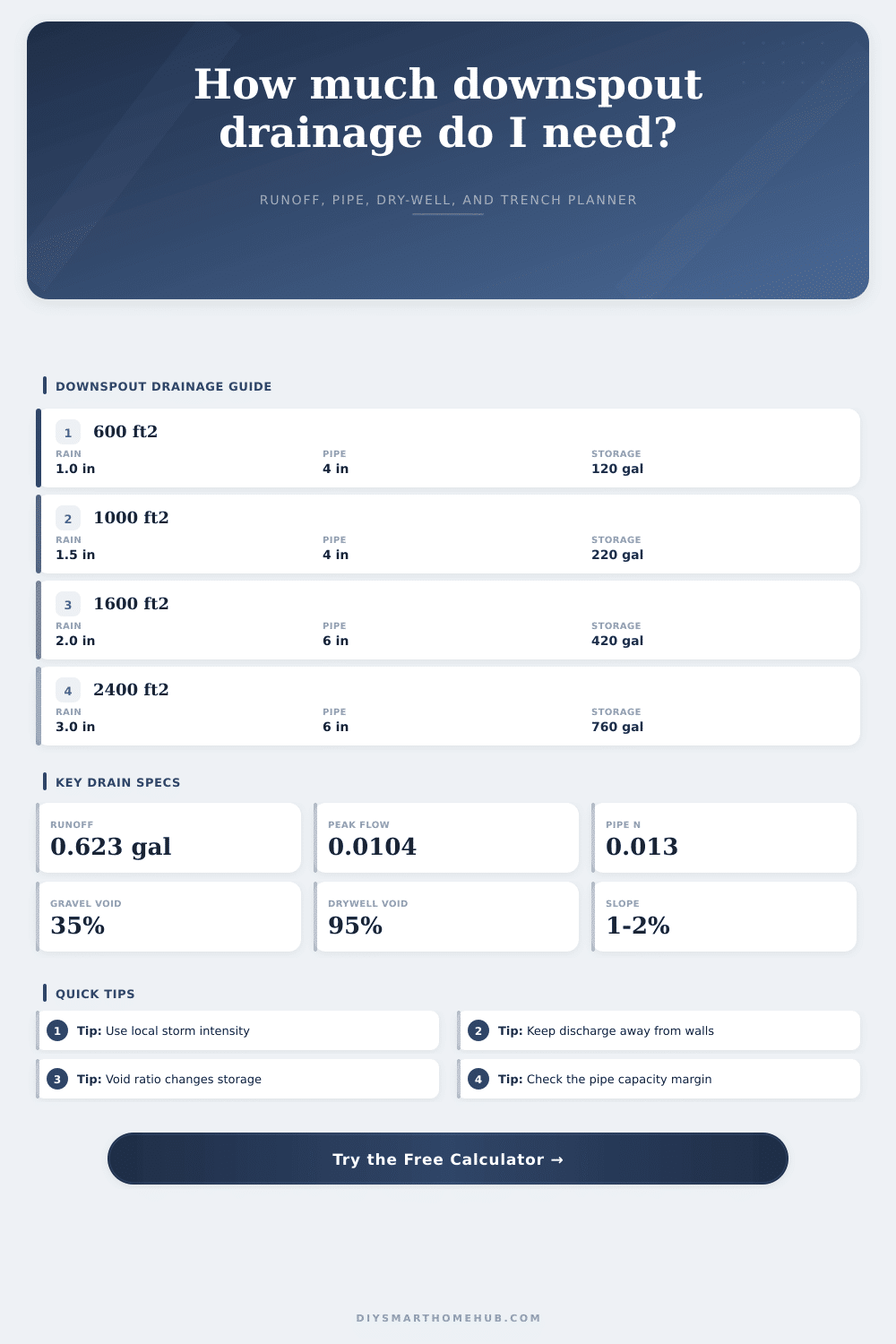
Estimate roof runoff gallons, peak drain flow, pipe capacity, dry-well void storage, trench gravel capacity, and discharge slope drop for a downspout drainage plan.
Downspout Drainage Results
| Pipe profile | Estimated capacity | Best use | Planning note |
|---|---|---|---|
| 3 in at 0.5% | About 46 gpm | Small roof face | Use only with modest peak flow. |
| 4 in at 1% | About 154 gpm | Most homes | Good balance for downspout extensions. |
| 4 in at 2% | About 217 gpm | Steeper yard | More slope adds pipe capacity. |
| 6 in at 1% | About 536 gpm | Large roof face | Use for combined leaders or high intensity. |
| Storage option | Gross size | Void ratio | Usable gallons |
|---|---|---|---|
| Small chamber | 24 cu ft | 95% | About 171 gal |
| Stone dry well | 45 cu ft | 40% | About 135 gal |
| Chamber dry well | 45 cu ft | 95% | About 320 gal |
| Trench 30 x 1.5 x 1.5 | 67.5 cu ft | 35% | About 177 gal |
| Run distance | Yard slope | Required drop | Use case |
|---|---|---|---|
| 10 ft | 1% | 1.2 in | Short extension |
| 20 ft | 1% | 2.4 in | Typical splash move |
| 35 ft | 2% | 8.4 in | Long buried run |
| 75 ft | 1.5% | 13.5 in | Remote daylight |
The landscaping budget does not apply to rain. Rain happens. It lands. It puddles on level areas. And then it need somewhere to go. Homeowners will typically consider a drainage issue when the foundation move or their basement floods. Wrong time for that plan. You want to control the water BEFORE there’s an issue. This means knowing how much water we are talking about and whether my landscape can handle it quick.
You enter the size of your roof and intensity of rain, and the calculator do all the math for you (above). No more trying to guess at unit conversion or coefficients. No more ignoring the actual weather event. The tool translates it into concrete gallons. It measures gallons per minute. That makes a difference, because there’s one challenge (total volume) and another (peak flow). Peak flow is determining how large the pipe needs to be so it doesn’t back up during the heaviest five minutes of a storm. Total volume is fine. However, if this water can’t leave property fast enough, how much space do I need to store it? You want both those numbers. You want them if you’re going to design something that will work.
Why Your Garden Needs Good Drainage
First thing: Consider the contributing roof area. It is not total square footage of your home. Rather, consider the part of the roof draining to each downspout. Maybe there’s a huge flat roof dumping all its water in one corner. That’s a lot of concentrated peak flow, too much even for a typical four-inch pipe. The tool provides a default runoff factor (a “coefficient”) which adjusts square feet and inches of rain to gallons. Why? Because not all of the rain falls; some gets sucked up by gutters or simply evaporates. Most just runs off. Underestimating this number will result in under-sizing the pipe. Result? Water overflows at the head of the downspout. See what people do wrong here? Fix the outlet but never the input.
Then there is matter of slope and pipe capacity. Your drainage system run on gravity, but it requires some initial pressure. Based off Manning’s equation, the calculator calculates the rough maximum volume of water which can flow through a pipe of a certain diameter and slope. For example, a three-inch pipe sounds like plenty. But if you live in a flat yard, then even though the pipe itself isn’t full, the water won’t flow fast enough to get anywhere. Increasing the slope to two percent dramatic increases pipe capacity. Now the same pipe can hold much more water. Now if your yard’s slope cannot be raised, then you have to raise the size of the pipe. And here’s where the table on the page makes things clear: A six-inch pipe with a one percent slope move about 850 gallons a minute. That’s over five times as much as a four inch pipe at the same slope.
How much do you want to store? That depends on how fast your soil will absorb the water. You’ll need storage if the ground can’t handle it. How long does it take to soak into the ground? That’s where dry well trenches or gravel come in to temporarily hold the water. By doing this, they holds the maximum amount the storm brings, then release it gradually back into the ground. In other words, how much can the hole hold? That’s the gross volume. And how much of that is usable for storing water? That’s the void ratio. The void ratio determines how much of the hole can hold water. For example, a dry well filled with stones has a lower void ratio. Because of all the rock, it only holds some of the volume. A plastic chamber system, on the other hand, has a high void ratio. It provides more storage for the same footprint.
Your soil type matters. If your soil is clay, you’d better have more storage because the water take longer to soak into the ground. If your soil is sandy, it drains faster, so maybe you don’t need as much. Also consider what kind of space youve got.
One last item: Look at the slope of the discharge drop. You want the water to run AWAY from the foundation. A little grade, especially if it’s run along a long ways, makes a lot of difference. Over fifty feet, a two percent slope equals almost a foot drop in the pipe. That’s typically plenty of drop to push the water out and far away from house. If there isn’t any drop, then the water will sit near the footing. That tool figures the drop for you. So it knows your plan is doable.
Good drainage doesn’t mean stopping the rain. It means providing somewhere for it to go. With the right combination of slope, storage volume and pipe size, what could of been a flood becomes a controlled flow. Yes the water still comes down. But it goes now. And it takes nothing with it.