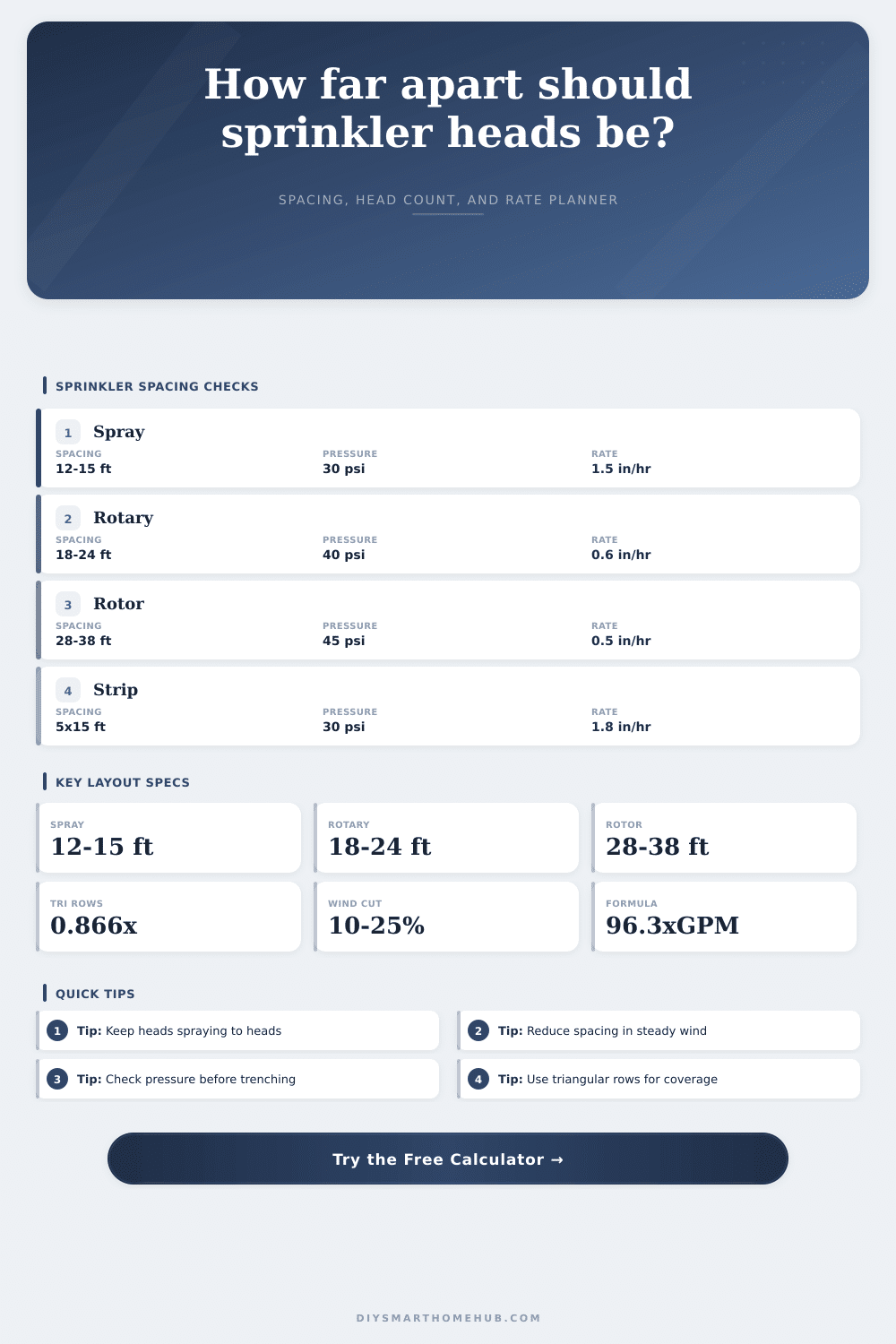
Sprinkler Head Spacing Calculator
Estimate head-to-head sprinkler spacing, adjusted spray radius, square or triangular row layout, total head count, zone flow, and precipitation rate for a smart irrigation zone.
| Head profile | Nominal radius | Nominal pressure | Typical spacing use |
|---|---|---|---|
| Fixed spray, 12 ft pattern | 12 ft at 30 psi | 30 psi | Small turf, parkway strips, and tight side yards. |
| Fixed spray, 15 ft pattern | 15 ft at 30 psi | 30 psi | Common residential lawns with compact rectangular zones. |
| Rotary nozzle, 18 ft pattern | 18 ft at 40 psi | 40 psi | Retrofits where spray heads apply water too quickly. |
| Rotary nozzle, 24 ft pattern | 24 ft at 40 psi | 40 psi | Medium zones needing lower precipitation and better wind behavior. |
| Gear rotor, 32 ft pattern | 32 ft at 45 psi | 45 psi | Larger open turf with longer throw and lower application rate. |
| Gear rotor, 40 ft pattern | 40 ft at 45 psi | 45 psi | Wide turf zones where pressure and flow are sufficient. |
| Side strip spray pattern | 5 ft by 15 ft at 30 psi | 30 psi | Narrow rectangular strips where standard circles overspray. |
| Design condition | Calculator factor | Spacing effect | Planning note |
|---|---|---|---|
| Calm or sheltered | 1.00 wind factor | Uses full adjusted radius | Good for courtyards, fenced side yards, and protected turf. |
| Light breeze | 0.95 wind factor | Trims spacing by 5% | Useful default when sprinklers occasionally run in mild air movement. |
| Moderate wind | 0.90 wind factor | Trims spacing by 10% | Helps reduce dry edges and weak overlap across exposed lawns. |
| Windy open area | 0.82 wind factor | Trims spacing by 18% | Conservative setting for open corners and wide unprotected turf. |
| Low pressure | sqrt pressure ratio | Reduces radius and flow | The calculator flags pressure below 75% of nominal rating. |
| Example zone | Dimensions | Likely head type | Layout signal |
|---|---|---|---|
| Small front panel | 24 ft by 16 ft | 12 ft fixed sprays | Three columns by three rows often gives clean overlap. |
| Standard front lawn | 36 ft by 24 ft | 15 ft fixed sprays | Four columns by three rows is common with head-to-head spacing. |
| Medium smart retrofit | 48 ft by 28 ft | 18 ft rotary nozzles | Lower rate makes controller cycle-soak easier to tune. |
| Open backyard | 72 ft by 45 ft | 32 ft gear rotors | Square grids use fewer heads; triangular grids improve overlap. |
| Narrow side strip | 60 ft by 8 ft | Side strip sprays | Use rectangular strip coverage instead of circular spacing. |
| Head family | Typical rate | Spacing sensitivity | Smart controller note |
|---|---|---|---|
| Fixed sprays | 1.2 to 2.2 in/hr | Small spacing errors change rate quickly | Often needs shorter starts on clay or compacted soil. |
| Rotary nozzles | 0.35 to 0.80 in/hr | More forgiving than fixed sprays | Useful when smart schedules need slower watering. |
| Gear rotors | 0.30 to 0.75 in/hr | Depends on pressure and nozzle tree | Longer runtimes are normal for larger turf zones. |
| Strip sprays | 1.2 to 2.4 in/hr | Depends on true strip width | Check narrow rectangles because area per head is small. |
Standing on the edge of your lawn with a tape measure, you do the math…and it all seems so daunting: How should you water the lawn? The grass is starting to go brown here and there; the soil has dried up. But how do you water correctly; how far apart should the sprinkler heads be? Turns out this isn’t guesswork at all. It’s a bit like a geometry problem. You have to factor in wind, pressure, and nozzle design.
Irrigation: Most homeowners view their sprinkler system as an on-off switch; the grass will be sprayed wet, or it won’t. Such thinking result in wasting water and creating bald spots. For real uniformity, you must overlap your spray pattern. Make sure each head reaches the next one. This is called head to head spacing. It is the golden rule of turf management. If you fail to follow the rule, you’ll develop dry lines between your rows. These look bad today. And scar up permanently tomorrow.
How to Space Your Sprinklers Correctly
Luckily, the calculator does all that tricky math for you. Simply feed it the nozzle specs and lawn dimensions, and it spits out a detailed grid. All you have to do is know why you’re inputting those numbers.
Start with pressure: pressure is the silent killer of an irrigation plan. If your pressure is lower than what the nozzle says it’s rated for (for example: a nozzle that’s rated for 30psi and a 15ft radius), it’ll get smaller. Big time. The throw distance shrinks with the square root of the pressure change. Twenty psi may be close enough to feel like thirty, but it cuts your radius down noticeably. What you thought was covered, isn’t. That’s where the tool comes in. It automatically adjusts to the reality of your actual home pressure instead of the rosy picture promised on the box. No more buying additional heads because you were confused, not knowing why the sprinkler wasn’t doing its job.
And then there’s that thing called wind. Does your yard border a broad open field? Sit in a canyon? Wind will grab your water, depositing drops on the driveway while leaving the turf in the middle bone dry. There is an option for wind exposure in the calculator. Choose the windy profile and you get a tighter grid… Less spacing between heads. Sounds wasteful, right? But what it prevents is the annoying process of watering and not noticing any difference. You’re paying for a few more heads…but you’re trading them for actual wet soil. A good trade.
Don’t forget the rate of precipitation. How quickly does the water hit the ground? Too fast, and the soil can’t soak it in. Water just runs off. There are puddles on top and dry ground beneath. Fixed sprays apply water faster than do rotary nozzles and gear rotors. The latter apply at a slower rate, so the ground drinks deep and doesn’t run off. The page’s reference table explains this clearly. It shows that rotors; which need more heads as the area increases, frequently work best on clay soils or on slopes. This is because they let the ground catch up with them.
Besides, how you lay things out depends on the shape of your lawn. With a classic rectangular one, a good old square grid are perfectly acceptable. For more staggered triangular designs (which fill in more smoothly than squares because there are no gaps in the center as there are with squares), it adds a bit of complexity to the installation. It makes the install a little less simple, but it means better coverage. You’ll be able to tell, because come summertime, your lawn will be a solid emerald green.
Lastly, you need a head count. How many sprinkler heads will you need? The tool rounds up the number of rows and columns needed to fully cover the space; plus, it adds one for each edge so they’re included in the watering routine, too. A little thing, but it can save the dry corners that reason seems to have no power over. Every inch should be covered. Edges should do as well as everything else.
It does require a little more planning up front. Some measurement. A bit of thought about pressure and wind. But after that first day, every day thereafter is pay-off. Your lawn looks better. Maybe your water bill is lower since you’re not watering as much to make up for bad spacing. You won’t have to guess anymore. No more questions like “Why is my south side so lush while the north side is yellow?”
It’s all about spacing. Space it correctly and everything else falls into place. Grass grows evenly. The system hums along silently. You come out, see the beautiful lawn and don’t have to worry about how or why it happened.