Deep Cycle Battery Charge Time Calculator
Estimate how long a flooded, AGM, or gel deep-cycle battery bank needs to move from starting SOC to target SOC while accounting for bank Ah, charger current, efficiency, Peukert effect, and finishing taper.
🔋Deep-cycle presets
⚙Battery bank and charger
Calculation breakdown
⚒Lead-acid, AGM, and gel spec grid
Common for serviceable deep-cycle batteries, with longer equalization and water maintenance needs.
Lower internal resistance supports faster bulk charging when the charger voltage is matched.
Usually needs conservative voltage and current settings to protect the electrolyte structure.
Above this point, charge acceptance falls and absorption taper starts to dominate the clock.
📊Deep-cycle preset table
| Preset | Bank layout | Capacity | Charger | Typical result |
|---|---|---|---|---|
| RV group 27 | 1 x 12 V flooded | 100 Ah | 10 A | Overnight full recharge from 50% SOC |
| Marine pair | 2 x 12 V flooded parallel | 210 Ah | 20 A | Useful dock recharge from half-full |
| Golf cart bank | 2 x 6 V flooded series | 225 Ah | 30 A | Strong bulk stage with long finish |
| AGM cabin bank | 4 x 12 V AGM mixed series/parallel | 200 Ah at 24 V | 35 A | Faster mid-SOC recovery window |
| Home backup gel | 4 x 12 V gel series | 180 Ah at 48 V | 25 A | Conservative current and taper |
🔌Charger current guide
| Battery type | Gentle current | Common current | Upper planning current | Calculator setting |
|---|---|---|---|---|
| Flooded lead-acid | 0.08 C | 0.10 C to 0.15 C | 0.20 C | Use lower efficiency and longer taper |
| AGM deep cycle | 0.10 C | 0.15 C to 0.25 C | 0.30 C | Higher bulk efficiency is reasonable |
| Gel deep cycle | 0.05 C | 0.08 C to 0.15 C | 0.20 C | Keep absorption conservative |
| Older lead-acid bank | 0.05 C | 0.08 C to 0.10 C | 0.15 C | Add age multiplier and taper time |
⏱SOC stage reference
| SOC window | Main stage | Acceptance behavior | Formula emphasis | Practical reading |
|---|---|---|---|---|
| 0% to 50% | Recovery bulk | High current if voltage allows | Ah replaced divided by net charger amps | Battery condition matters most |
| 50% to 80% | Normal bulk | Best use of charger output | Bulk efficiency and Peukert overhead | Fastest part of the recharge |
| 80% to 90% | Early absorption | Current begins falling | Absorption efficiency and taper multiplier | Plan extra clock time |
| 90% to 100% | Finishing taper | Low current acceptance | Taper multiplier dominates | Small Ah gain can take hours |
📐Common bank examples
| Bank | Formula | Nominal Wh | 50% to 100% Ah | Good charger range |
|---|---|---|---|---|
| Single 12 V 100 Ah | 100 Ah x 1P | 1,200 Wh | 50 Ah | 10 A to 20 A |
| Two 12 V 100 Ah parallel | 100 Ah x 2P | 2,400 Wh | 100 Ah | 20 A to 40 A |
| Two 6 V 225 Ah series | 225 Ah x 1P | 2,700 Wh | 112.5 Ah | 20 A to 45 A |
| Four 12 V 100 Ah 24 V | 100 Ah x 2P | 4,800 Wh | 100 Ah | 25 A to 50 A |
💡Charging tips
The lights is running all night, the fridge is humming along, and then your house bank dies and won’t get you started. You crank up the charger, see the red light turn green, and think it’s good to go. Then you attempt to crank engine and nothing happens. Your battery appears full; you just can’t put any muscle behind it anymore.
This is the danger of deep-cycle charging. Too many people focus on chasing speed, destroying their battery’s chemistry, and not enough on amperage (looking only at numbers), or time.
Why You Must Be Patient When Charging Batteries
Plug in output of your charger and the size of your bank into the calculator above. Let it do the work. No more guesswork with unseen losses. The calculator figures in taper times and efficiency drops that simple division can’t sees.
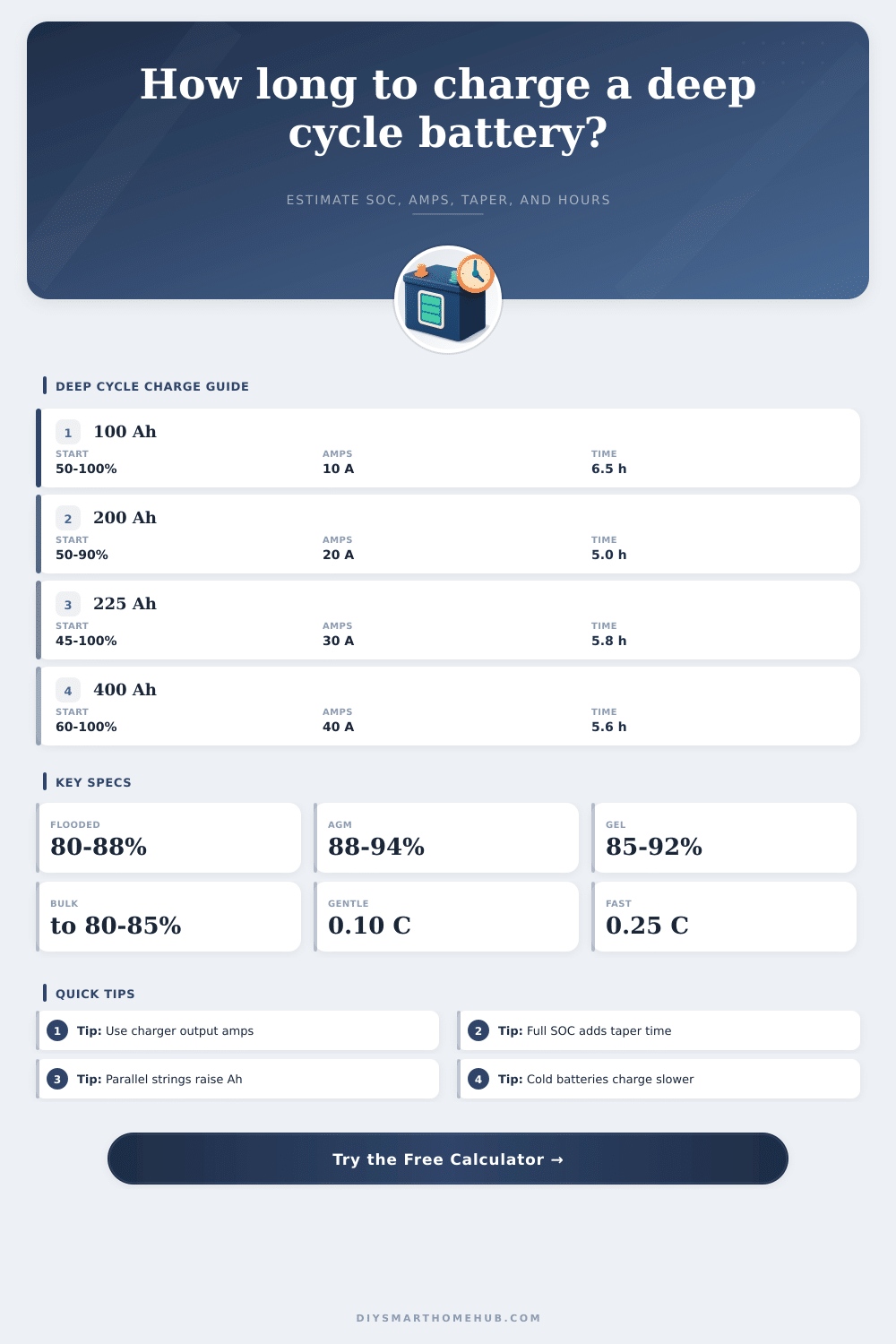
Charging isn’t a straight line. It’s a curve that tapers off as battery fills up. Current flows freely until you reach about eighty percent state of charge. At this point, the battery begin to resist. If you continue charging, the battery will try to gas or boil. To avoid this, the charger lowers its voltage. This portion is called the absorption phase. It lasts longer than most people realize, espesially when trying to reach one hundred percent.
Flooded lead-acid are slow but forgiving. Give ’em time, and they’ll deliver the juice. But not on the last push because that’s when they exhale as gas and heat. Push too hard, and you tear up their plates.
AGM means less resistance equals a tighter pack. They take current more greedily than flooded cells because they have less internal resistance. They can also handles faster charging and discharging without cooking themself.
The gel battery is the most sensitive. Gel batteries HATE high voltage above all others. Push a gel cell too hard and you break down structure of the electrolyte, permanently. What you end up with is a dead unit in a swollen case.
The other thing to remember: Temperature is HUGE. A cold battery doesn’t take charge as fast and holds less. It will take longer to charge if it is cold outside and you are charging in a cold garage or on a cold morning dock. The warmer it is, the faster it charges but also the faster it ages. That’s why the tool allows you to adjust based off environmental conditions. This isn’t just “charging a box of chemicals.” You’re manipulating a physical reaction and it depend on the environment.
Every battery has its tale to tell. Over time, sulfation accumulates, creating internal resistance. Older banks requires greater patience and less current. When you crank it with a high-speed charger, the voltage may climb rapidly, yet that rise can be nothing more than surface charge. Give the current some time to dig down deep into the cells.
That’s when the Peukert effect becomes important. The “Peukert” value relates to reduced capacity during high-load conditions. The faster the discharge, the worse the impact; therefore, the recharge must account for that stress.
The common error here, most folks plan their charging according to convenience, not chemistry. Buy a larger charger so you can have it done in time for morning. That’s rarely good with lead-acid systems. You’re better off sizing the charger to the limits of batteries. Better to gently top up overnight than to run like hell for two hours. Running like that generates heat and reduces capacity and longevity. Gently running all night preserves plate integrity.
If you examine the reference tables on this page, you’ll see that suggested current remains low. Like less than ten percent of the battery’s capacity. Ten to fifteen. That doesn’t sound like much speed until you consider what happens if you push it harder. You risk serious damage and gain very little time by doing so.
Frequently, the last ten percent of charge often takes half the total time. It is a tradeoff. Take your boat up to eighty-five percent and save a few hours, or sit there waiting for perfection and watch the afternoon slip away. No wrong answer there, just different priorities.
Once you grasp the phases, you know what to do with that power. No longer is the battery something mysterious, something like a black box. It’s now alive; a breathing system. It is a thing that heats up, gets bigger, cools down, gets smaller, and requires downtime after strenuous activity. Those digits on the device become signs that encourage respecting how that life works.
Next time you plug in after a long day, consider what’s going on in there. Are you nurturing that battery or are you rushing it along? A nurtured battery will quietly power your nights away from the grid and serve you for years. A mistreated one will fail on you at just the wrong moment. Usually it all boils down to how patient you were during those quiet charging hours.