18650 Battery Charge Time Calculator
Estimate lithium-ion 18650 pack charge time from cell capacity, series and parallel layout, charger voltage, charger current, BMS limit, state of charge, and CC/CV taper behavior.
Calculation breakdown
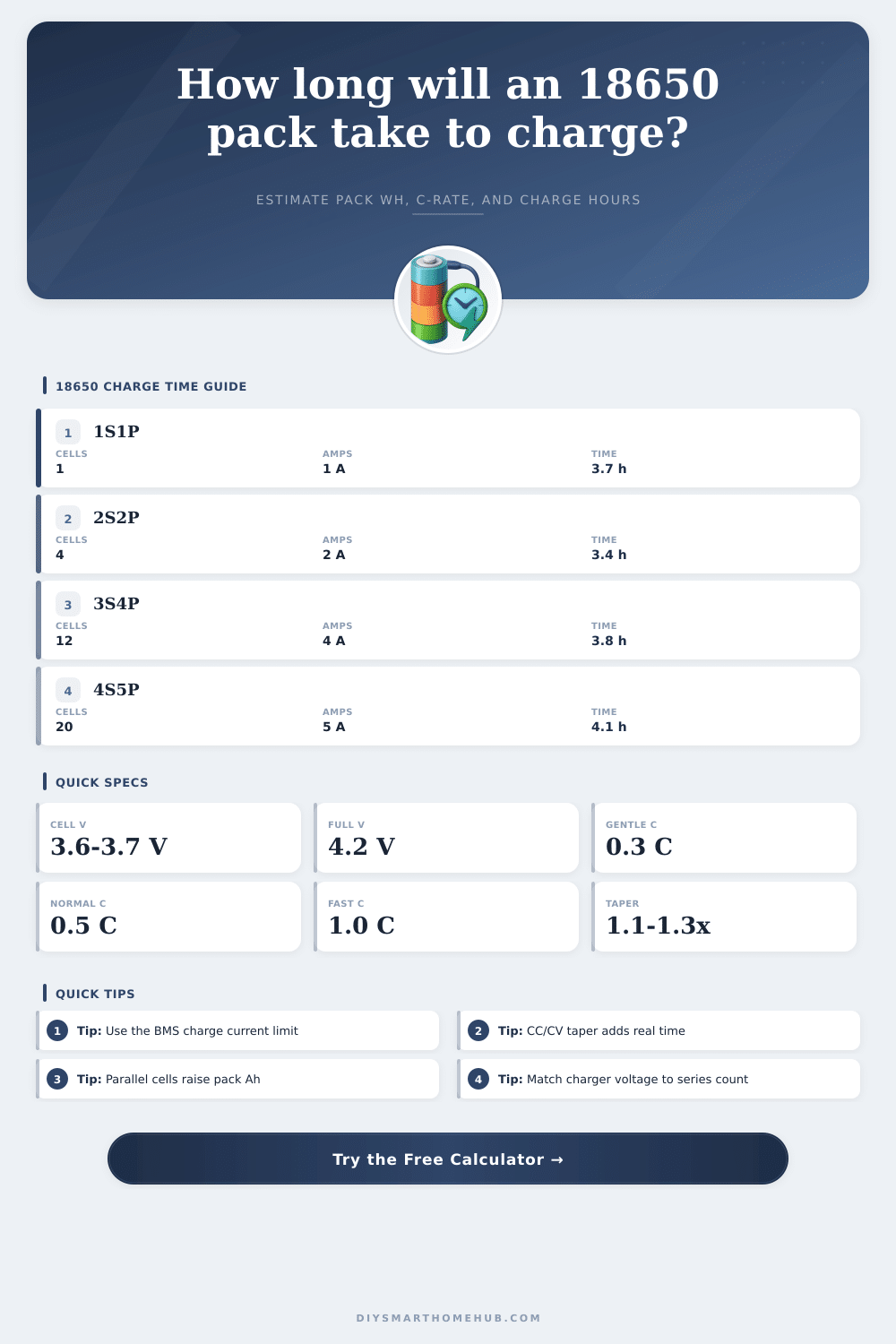
| Per-cell C-rate | Current on 3000 mAh cell | CC estimate before taper | Typical use |
|---|---|---|---|
| 0.2 C | 0.60 A per cell | About 5 hours from empty | Very gentle charging and low heat. |
| 0.3 C | 0.90 A per cell | About 3.3 hours from empty | Long-life packs and compact enclosed builds. |
| 0.5 C | 1.50 A per cell | About 2 hours from empty | Common normal charge target for many cells. |
| 1.0 C | 3.00 A per cell | About 1 hour before taper | Only for cells and thermal designs rated for it. |
| Pack layout | Nominal voltage at 3.7 V/cell | Full charger voltage at 4.2 V/cell | Common pack examples |
|---|---|---|---|
| 1S lithium-ion | 3.7 V | 4.2 V | Flashlights, USB bank cores, small sensors. |
| 2S lithium-ion | 7.4 V | 8.4 V | Small tools, cameras, compact UPS packs. |
| 3S lithium-ion | 11.1 V | 12.6 V | Router backups, LED packs, hobby packs. |
| 4S lithium-ion | 14.8 V | 16.8 V | 12 V class power banks and equipment packs. |
| 10S lithium-ion | 37.0 V | 42.0 V | 36 V class e-bike and scooter batteries. |
| Example pack | Cell count | Capacity effect | Charge-current reading |
|---|---|---|---|
| 1S1P single cell | 1 cell | Pack Ah equals one cell Ah. | 1 A on a 3000 mAh cell is 0.33 C. |
| 1S4P power bank core | 4 cells | Pack Ah is four times cell Ah. | 4 A pack current is 1 A per cell. |
| 3S2P tool pack | 6 cells | Voltage triples, Ah doubles. | 3 A pack current is 1.5 A per cell. |
| 4S8P backup pack | 32 cells | Voltage quadruples, Ah is eight times cell Ah. | 8 A pack current is 1 A per cell. |
| Step | Formula | What it means | Calculator output affected |
|---|---|---|---|
| Pack Ah | cell mAh x P / 1000 | Parallel cells increase capacity. | Charge hours and C-rate. |
| Pack Wh | cell mAh x S x P x nominal V / 1000 | Series raises voltage and total energy. | Pack energy card. |
| Effective current | min(charger A, BMS A) | The lower limit controls charging. | Usable current card. |
| Total time | Ah needed / A / efficiency x taper | Adds charge losses and CC/CV top-off. | Estimated charge time. |
A 3S pack needs a 12.6 V lithium-ion charger, while a 4S pack needs 16.8 V. Current only matters after the charger voltage matches the series count.
Many BMS boards advertise a high discharge current but a lower charge current. The lower charge limit should cap the calculator current input.
It’s all a bit of a guessing game when it comes to charging your 18650 pack. Plug ‘er up, wait for the indicator light to change, and hope you guessed right about how many hours to leave it on. The lithium-ion chemistries is finicky little things that require certain current limits and step-wise increases in voltage for safe operation. Guess those values incorrectly and you’ll either overheat the thing or fry capacity of your cells. It happens fast.
If you’re aware of your pack layout (series/parallel), this page will do the math for you in the calculator. The main thing I see DIY builder get hung up on is total watt hours without considering how series and parallel cell layouts affect charge time. Series cells determine the voltage requirement, which means your charger must match that exact stack height. Parallel cells adds capacity but slow down charging. You need more current or it’s going to take longer. It’s a balance of speed vs. Safety.
How to Charge 18650 Batteries Safely
As the tables illustrate, the math vary based off pack geometry. Charging one cell at normal rates will take about three to four hours. To increase capacity, you can add multiple cells wired together in parallel. In this case, you’ll have four times the energy storage, but it requires that your charger has the necessary amperage output. Often the BMS limitation is bottleneck since the protection boards will prevent an overcurrent event from damaging the lithium chemistry.
The third phase is the Constant Voltage Taper. A lot of folks skip right over this step. It’s the stage where the battery reaches maximum voltage. Then, charger begins trickling what little power is left into it to top off the rest. The first half can actualy be quicker than the last ten percent, so the tool tapers the estimate to account for that. When estimating how long something will take to charge, most people miss that part and overestimate how long things should of take.
C-rate matters too, higher rates like a 1C fast charge will shorten its lifespan. The cell stress itself by creating more heat and moving lithium ions around faster then a low rate of 0.2C or 0.3C. High current creates more resistance inside and causes the ions to plate. While you’ll gain an hour now, you’ll lose cycles later. Think about how much convenience is worth sacrificing for long-term dependability. Four hours? Two hours?
The other hard-and-fast rule is to voltage-match. Don’t try charging a four-cell pack on a three-cell charger or bad things will happen. You’ll probably blow up management board and possibly start a thermal runaway. Always check that your charger output matches the nominal voltage multiplied by the series count. In this case, the calculator actualy breaks it down for you visually. The first screen shows the watt hours of the charge and then shows how much of that is lost through inefficiency. Some of that input energy goes to heat, which we don’t want, we want to assume 100-percent efficient, but that results in underestimating charge time.
Creating a pack is not just about connecting cells with snaps. You must consider the thermal environment, balance leads, wire gauge, and other factors. When you build a good pack, each branch in parallel takes its fair share of the load. Imbalance occurs when there are poor connections where some cells try to hog current and others lags behind. This imbalance is what the BMS has trouble correcting. Although the taper phase will help equalize the difference somewhat, it can’t resolve basic wiring issues.
Know your battery: Know when to push it and know where its boundaries are. The calculator and tool gives estimates under perfect circumstances. In reality, variables such as cell age, ambient temperature, etc. Impact the way batteries charges. Older batteries have increased resistance that results in wasted energy as heat, making them hotter at the same amperage. A gentle charge generates less heat and lasts longer. Use common sense with your plans.
When you get how voltages, capacities, and phase tapers work, you replace that uncertainty with knowledge. That’s just a bunch of guessing until they click off. The science cuts out all that wondering; it makes everything clear. You’ll prolong battery life, make sure your projects don’t fizzle out, and be able to leave your batteries on the charger overnight without worry. It’s a little mindset change that rewards itself each time you hit the charge button.