Cold Plunge Chiller Sizing Calculator
Estimate cold plunge chiller size from water volume, target temperature drop, BTU removal, rated chiller BTU per hour, ambient heat gain, insulation factor, cooldown hours, and maintenance load.
❄Choose a Cold Plunge Preset
🌡Enter Chiller Sizing Inputs
🧊Your Chiller Sizing Estimate
⚙Cold Plunge Formula Constants
📊Chiller Class Comparison
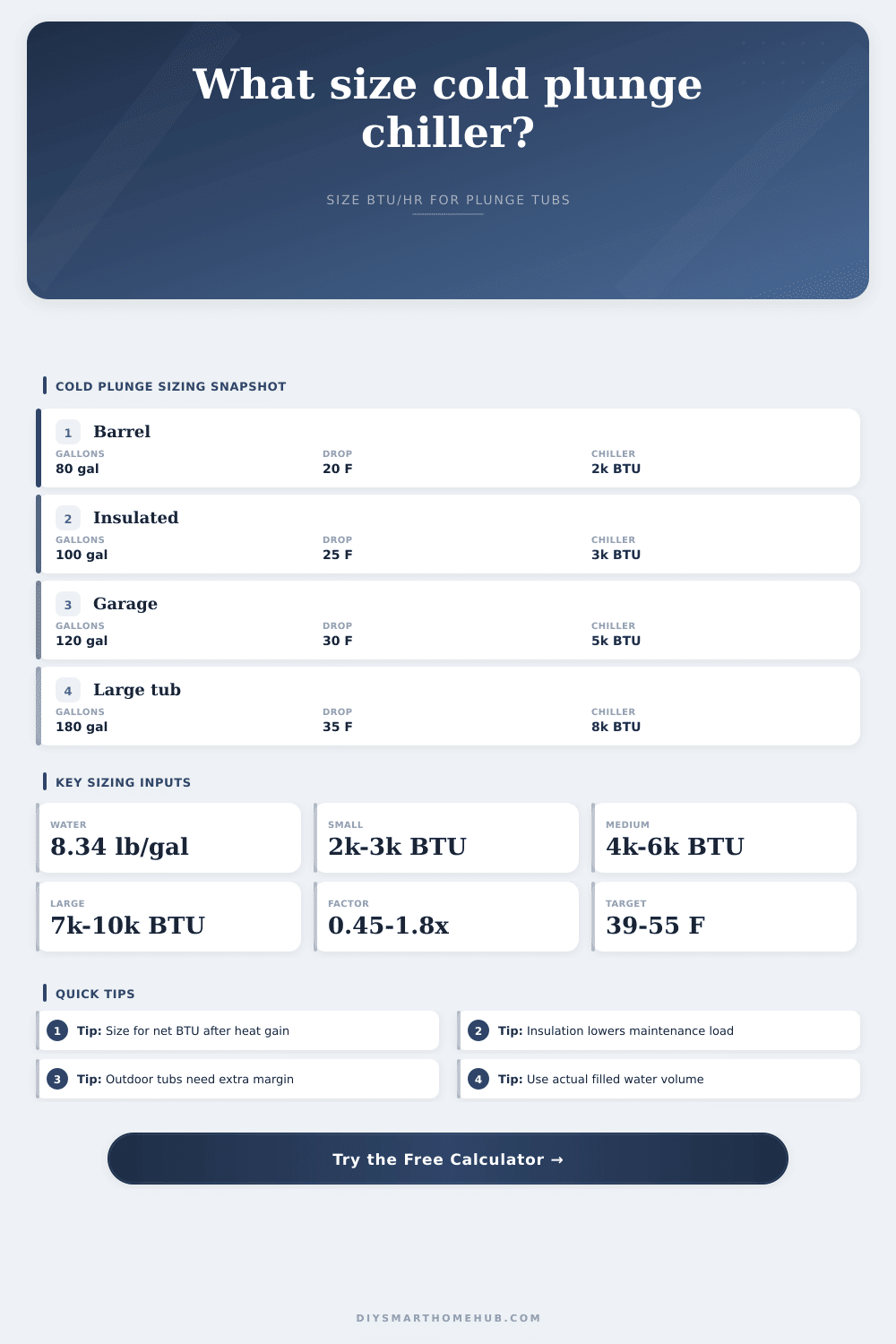
Compact 2,000 to 3,500 BTU/hr
- Best for small insulated tubs and moderate target temperatures.
- Cooldown can be slow when ambient heat gain is high.
- Maintenance duty cycle should stay well below full output.
Mid-size 4,000 to 6,000 BTU/hr
- Good fit for many 90 to 140 gallon plunge tubs.
- Handles a deeper temperature drop with reasonable pull-down time.
- Insulation still determines the hold load after cooldown.
High-output 7,000 to 10,000 BTU/hr
- Useful for large water volume, outdoor exposure, or fast recovery.
- Net BTU/hr matters more than headline capacity in hot spaces.
- Oversizing improves cooldown margin when use load is frequent.
📐BTU Removal Formula Reference
| Formula | Inputs used | Calculator expression | Result role |
|---|---|---|---|
| Temperature drop | Starting and target water temperature | Starting °F - target °F | Defines the pull-down load. |
| BTU removal | Gallons and deltaF | Gallons x 8.34 x deltaF | Total heat that must leave the water. |
| Adjusted heat gain | Ambient heat gain and insulation factor | Ambient BTU/hr x factor | BTU/hr subtracted from the chiller. |
| Cooldown hours | BTU removal and net BTU/hr | BTU removal / net BTU/hr | Estimated time to reach target. |
🧊Typical Cold Plunge Sizing Ranges
| Plunge setup | Typical volume | Common chiller range | Use in the calculator |
|---|---|---|---|
| Compact barrel or pod | 60 to 90 gal | 2,000 to 3,500 BTU/hr | Low volume but often limited insulation area. |
| Insulated home plunge | 90 to 120 gal | 3,000 to 5,500 BTU/hr | Common home range with a sealed cover. |
| Large stock tank conversion | 130 to 200 gal | 5,000 to 8,500 BTU/hr | Water mass makes cooldown hours the key check. |
| Shared or studio plunge | 140 to 220 gal | 7,000 to 10,000 BTU/hr | Frequent lid-open periods raise maintenance load. |
🌡Heat Gain And Insulation Factors
| Condition | Factor | Best use | Calculator effect |
|---|---|---|---|
| Vacuum lid plus thick insulated shell | 0.45x | High-efficiency indoor or shaded tubs. | Lowest adjusted heat gain. |
| Foam insulated tub with sealed lid | 0.65x | Purpose-built cold plunge tanks. | Reduces hold load and duty cycle. |
| Average tub indoors | 1.00x | Baseline model for normal rooms. | Uses entered ambient heat gain as-is. |
| Outdoor heat exposure | 1.80x | Hot patios, direct radiant heat, and breezy tanks. | Can greatly extend cooldown time. |
📋Preset Scenario Reference
| Preset | Volume | Temperature drop | Why it matters |
|---|---|---|---|
| Compact barrel | 75 gal | 20°F | Small water mass, but insulation can vary widely. |
| Garage recovery tub | 120 gal | 25°F | Warm air reduces net BTU/hr during pull-down. |
| Large stock tank | 180 gal | 32°F | High BTU removal makes chiller output critical. |
| Shared studio tub | 160 gal | 18°F | Daily use heat load may dominate maintenance sizing. |
💡Calculator Tips
The tub’s installed, the hole dug, the pump put in place, you realize what you really need is to keep the water cold. A cold plunge chiller isn’t an on switch for winter… It’s a fight with thermodynamics that begins as soon as you lift lid.
Unfortunately most folks make mistake of looking at the headline BTU number on the box and sizing their chiller accordingly. But that number presumes perfect conditions that never happen in a real basement, patio or garage. You want to know what your machine can absorbs when battling heat gain… Not simply what it says it does in the lab. Use the calculator above to have the numbers done for you, putting aside marketing specs for actualy performance.
How to Pick the Right Chiller Size
What I think most folks don’t realize is just how much heat are contained in a mere 100 gallons of water. To cool down a hundred gallons of water from warm to cool will remove thousands of BTUs of heat from that water. But here’s the deal, it continues to return. It could be sunlight, the air temperature in the room, your body heat, or even heat from the pump motor. It returns that energy into the tank.
This is where insulation factor on these tools comes into play. A sealed vacuum lid with a thick foam shell may reduce that ambient gain by over half. While a thin metal stock tank exposed to direct sun can double it. It makes a huge difference in duration the compressor must run.
The other mistake I see people make: thinking bigger is always better. Yes, size does matter, but so does efficiency. A unit that’s too big runs in a rapid on-off cycle, which is bad for both equipment and your comfort. Meanwhile, a unit that’s too small won’t catch up and will run constantly. It will probably wear itself out before the end of summer. You want something with enough raw power to pull the water down to your desired temp (say, forty-five degrees) and keep it there in steady state, without having to work overtime. It calculates the surrounding heat gain and deducts it from the net cooling capacity, helping you identify that sweet spot.
What’s the daily use load? Many people forget about this one until they get their bill. Opening the lid and jumping in invites warm air inside while letting cold air out every time. You dump heat into the water, and your entry stirs things up too, bringing warmer surface water to the bottom. Each time you hop in a solo user add a thousand BTUs a day. Multiple athletes using the same studio and jumping in every hour adds thousands more. To estimate the maintenance load accuratley, the calculator needs that usage pattern. That’s the hidden cost of convenience.
As a general rule, you need to size your BTU based off how much heat your tub is fighting to gain. This page has a handy reference table that shows typical ranges for various tub sizes, but again these are starting points, not rules. For instance, if your tub is very well insulated and sits in a cool room, even a small barrel may use only a two-thousand BTU unit. Conversely, a large outdoor tank may require eight thousand BTUs just to keep up with a hot afternoon.
Bottom line: Look at the result of the cooldown time. If the tool indicates it’ll take twelve hours to lower the temp, you’ve got trouble. Ideally, that number should of been reasonable given your schedule, typically no more than four or five hours.
Add insulation: Insulating will also help lower your ambient heat gain, which has a huge impact on lowering the load on your chiller. This is far more cost-effective, easier and cheaper than purchasing a bigger compressor. Adding some sort of better lid/foam is much cheaper and more effective different than purchasing a bigger compressor.
Think of it this way: you aren’t just buying cooling capacity. You are buying how fast you can remove heat from the system compared to how much heat enters it. So if there’s a leak in your boat, you’ll want a bigger bucket to outpace the leak. Save yourself the headaches and the money, size for the leak, not necessarily for amount of water. Let the chiller take care of the rest. Insulate the walls, keep the lid on.