Sauna Warm Up Time Calculator
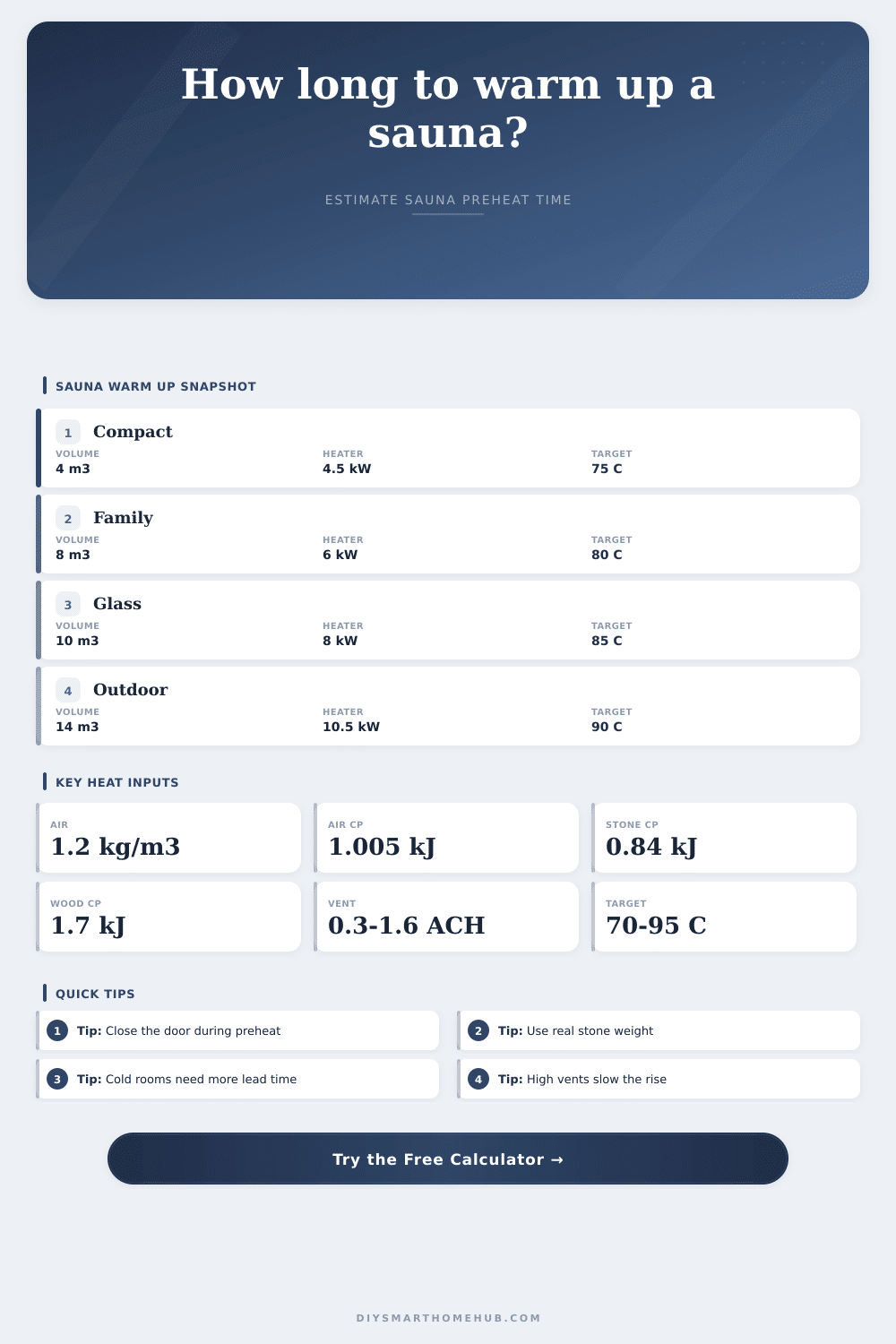
Estimate sauna preheat time from room air volume, stone and bench thermal mass, heater output, starting temperature, target temperature, insulation loss, and ventilation rate.
♨Choose a Sauna Preset
🌡Enter Warm-Up Conditions
⏱Your Sauna Warm-Up Estimate
⚙Thermal Constants Used
🔍Warm-Up Driver Comparison
Air heats quickly
The room air volume usually needs only a small share of the total kWh. It sets the visible temperature rise, but it is not the main storage mass.
Stone load adds lag
Large stone towers make the sauna feel steadier later, but they absorb meaningful energy during warm-up before the thermometer stabilizes.
Losses trim output
Ventilation and envelope losses are treated as a continuous kW draw, so the usable heater rate can be lower than the nameplate rating.
📐Formula Reference
| Formula step | Inputs used | Calculator expression | Result role |
|---|---|---|---|
| Room air heat | Volume, air density, deltaC | m³ x 1.2 x 1.005 x deltaC / 3600 | Energy to lift the air temperature. |
| Stone heat | Stone kg, deltaC, response factor | kg x 0.84 x deltaC x factor / 3600 | Energy absorbed by heater stones. |
| Wood heat | Wood kg, deltaC, response factor | kg x 1.7 x deltaC x factor / 3600 | Energy absorbed by benches and lining. |
| Warm-up time | kWh required, heater, losses | kWh / (heater kW x efficiency - loss kW) | Loss-adjusted preheat estimate. |
🏠Typical Sauna Room Examples
| Sauna type | Typical volume | Common heater | Warm-up behavior |
|---|---|---|---|
| One to two person indoor room | 3.5 to 5.5 m³ | 3.5 to 5 kW | Fast air rise, modest stone and bench lag. |
| Family home sauna | 6 to 10 m³ | 6 to 8 kW | Usually controlled by stone mass and target temperature. |
| Large custom room | 10 to 16 m³ | 9 to 12 kW | Needs careful heater match and low door leakage. |
| Outdoor or barrel sauna | 7 to 14 m³ | 6 to 10.5 kW | Outdoor shell losses raise cold-start lead time. |
🌬Insulation And Ventilation Profiles
| Profile | Envelope loss | Ventilation rate | Best fit |
|---|---|---|---|
| Tight insulated room | 0.75 W/m²K | 0.35 ACH | Well-sealed indoor rooms with short duct paths. |
| Standard home sauna | 1.10 W/m²K | 0.60 ACH | Typical insulated wood-lined residential sauna. |
| Glass door or window | 1.45 W/m²K | 0.85 ACH | Rooms with a glass face or more exposed surfaces. |
| Leaky older room | 2.20 W/m²K | 1.60 ACH | Drafty doors, loose vents, or weaker insulation. |
📋Preset Scenario Reference
| Preset | Volume | Thermal mass | Reason it changes time |
|---|---|---|---|
| Compact apartment sauna | 4 m³ | 35 kg stones, 70 kg wood | Small air volume heats quickly when the room is tight. |
| Glass door upgrade | 9 m³ | 70 kg stones, 150 kg wood | More envelope loss reduces the useful heater rate. |
| High stone tower | 8 m³ | 120 kg stones, 135 kg wood | Stone energy can dominate the warm-up requirement. |
| Commercial-style room | 18 m³ | 160 kg stones, 280 kg wood | Ventilation and mass both become major terms. |
💡Calculator Tips
The wooden box is shut. Outside it, you wait for the tempurature of the air within it to rise until it hits eighty degrees. You’ve turned on the heater. You’ve read the instructions. Through cracks in wood, you see the glow of embers and know the heater’s running.
But the thermometer rise at an annoying crawl, and you begin to suspect you’re not using a right heater. What few realize is that the heater is usualy not the problem. The problem is the physics happening silent, invisibly, the struggle between your heater’s input power and heat retention of the space.
Why Your Sauna Takes So Long to Heat Up
People imagine that air warms rapidly. They are mistaken on this point. Air is light. It try to get hot. Everything else in the room doesn’t warm up as fast than the air.
After plugging in your mass and volume, calculator will do all that math for you. You don’t need to worry about figuring out conversions and coefficients. To understand how it’s doing its thing, though, it help to look beyond thermostat.
Imagine your sauna as a thermal sponge. The water in the air? That’s the moisture on the surface. The rock? That’s the hard, dense center; the wood benches? That’s the thick fabric lining. Fire up a six kilowatt heater and where does all that energy go? Sure, it goes into the air, but so much of it get sent toward the task of heating sixty or seventy kilograms of stone.
Those rocks has a certain capacity for heat, and they’re stubborn with it. But they do this by absorbing energy. They borrow this energy by taking heat from surrounding air to prevent the thermal shock that would kill them. That’s what makes a huge stone tower warm up a room: Same temperature as before, but deeper, heavier warmth. This is because it have taken time to get there.
In the same way, wood is often overlooked when making rough estimate, but it performs a similar function. Not only is it a thermal mass, but cedar and hemlock in particular is excellent insulators. Depending on what you consider a “typical” family-sized sauna, there could easily be one-hundred-fifty kilograms of furnitures just in the walls and benches! Before the sauna environment realy settles down and feels right, all that wood need to go from room temperature to sauna temperature. Neglecting the mass of the wood will make your estimate optimistic.
By including a response factor for the wood and stone (as well as other materials), the calculator recognize that not all the energy immediately becomes air temperature. Some gets stored. That’s the lag time (the wait).
Another factor that isn’t obvious is ventilation. Yes, a tightly sealed room retains its heat more efficient; however, it also tends to make the air inside stale and makes uneven heat distribution more likely. To compensate, many people will prop their door open or just keep all the vents open while warming up, to allow air circulation. This is wrong. For every cubic meter of cool air pulled into the room, a cubic meter of hot air has to go out. It serves as a constant heat sink, pulling down your heater’s overall efficiency.
That’s why the tool take into account the type of insulation you choose. A solid wood door, for example, doesn’t leak heat through air movement and radiation like a beautiful glass one does. An outdoor barrel sauna with a lot of breeziness may only take twenty minutes to preheat, whereas a nice tight indoor room could take an hour, and that’s the difference.
People tend to underestimate where they start. For example, if you have an outdoor shed or a sauna in an unheated basement, in winter, maybe the starting temp will be five degrees? In that case, the delta makes a difference. You’re not just trying to get to eighty. You’re trying to go from five to eighty, which means heating the wood, the stones, and the air against heat loss.
To account for this, the calculator factors in both starting temp as well as the target rise. So it tells you what a realistic time frame is given the net heater rate, minus the losses. It gives you a window based off the net heater rate.
Plan your morning around it. Get out of bed early enough to turn on the heater before taking a shower. Let the stones absorbs the heat. And then you get to slip inside and forget about the waiting part once everything has warmed up enough and the rocks are ready to throw steam. Because it’s not so much a temperature as it is a level of balance; wait your turn, and enter.
You should of waited for the right moment.