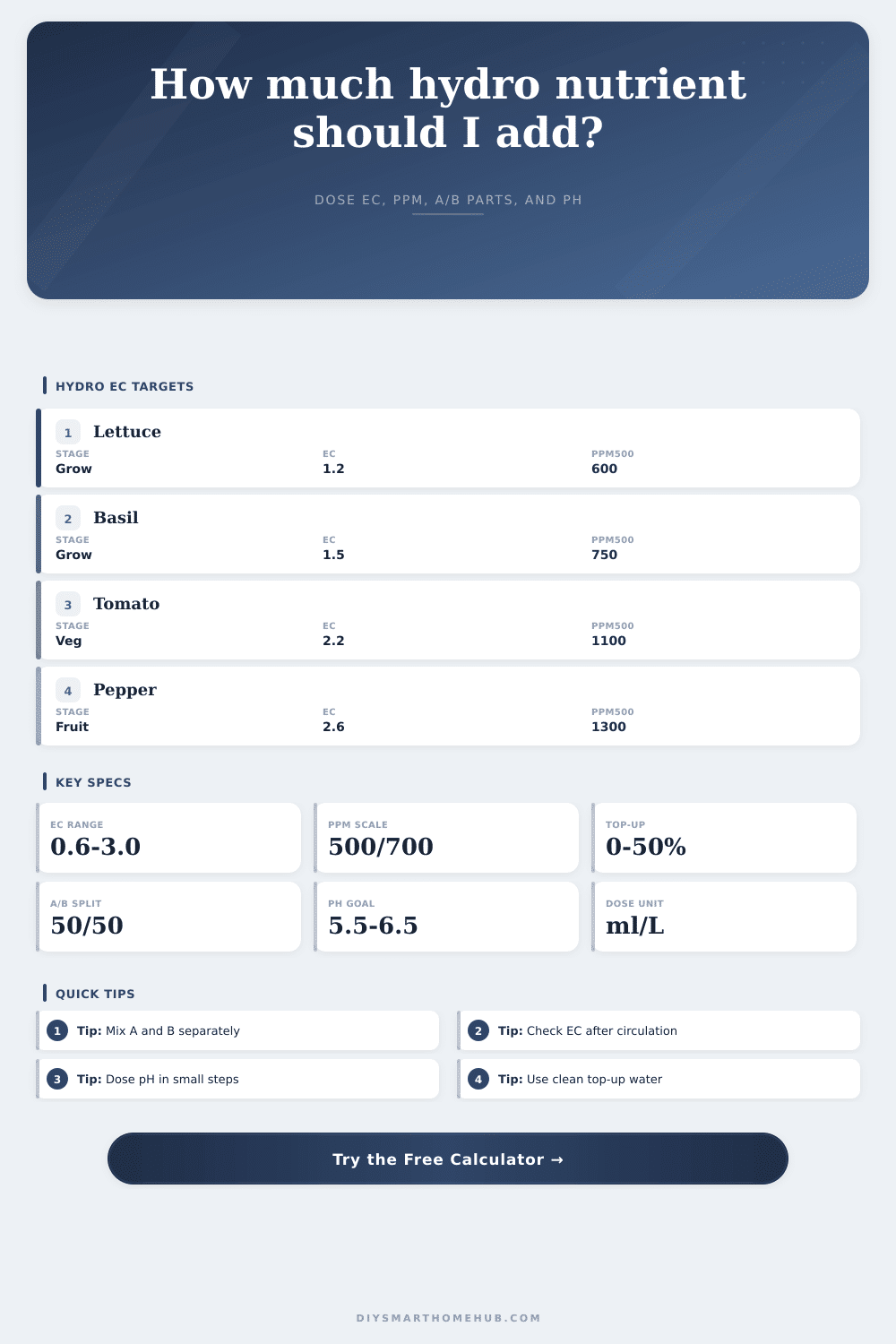
Hydroponic Nutrient Dose Calculator
Estimate reservoir dose, top-up dilution, EC and PPM target gap, two-part A/B nutrient split, crop stage adjustment, and pH correction for a hydroponic system.
Nutrient Dose Results
Calculation Breakdown
| Crop or stage | Typical EC | PPM 500 | PPM 700 |
|---|---|---|---|
| Seedlings and clones | 0.4 to 0.8 | 200 to 400 | 280 to 560 |
| Lettuce and leafy greens | 0.8 to 1.4 | 400 to 700 | 560 to 980 |
| Basil and culinary herbs | 1.0 to 1.8 | 500 to 900 | 700 to 1260 |
| Tomato vegetative growth | 1.8 to 2.4 | 900 to 1200 | 1260 to 1680 |
| Tomato or pepper fruiting | 2.2 to 3.2 | 1100 to 1600 | 1540 to 2240 |
| Nutrient type | Input to use | Split setting | Best calculation note |
|---|---|---|---|
| One-part liquid | Label ml/L per EC | 50/50 shown as total | Use total dose only |
| Two-part A/B | Combined ml/L per EC | 50/50 common | Add A, mix, then add B |
| Grow-heavy A/B | Calibrated ml/L per EC | 60/40 or 55/45 | Useful for leafy growth |
| Bloom-heavy A/B | Calibrated ml/L per EC | 45/55 or 40/60 | Useful during fruiting |
| Top-up share | Example reservoir | Dilution effect | Dose approach |
|---|---|---|---|
| 0% | No refill | No dilution | Correct current EC |
| 10% | 40 L plus 4 L | Small EC drop | Dose after refill |
| 25% | 30 L plus 10 L | Moderate EC drop | Use mixed EC gap |
| 50% | 20 L plus 20 L | Large EC reset | Recheck before plants |
| Project | Volume | Target EC | Typical use |
|---|---|---|---|
| Seedling tray | 10 L / 2.6 gal | 0.6 EC | Clones and starts |
| Small DWC bucket | 19 L / 5 gal | 1.2 to 2.4 EC | Greens or peppers |
| NFT rail reservoir | 40 L / 10.6 gal | 1.2 to 1.8 EC | Lettuce and herbs |
| Tomato tote system | 75 L / 19.8 gal | 2.0 to 3.0 EC | Heavy feeders |
It’s that moment where you hold a meter similar to an electrician’s multimeter. You also holds a bottle of liquid fertilizer and look into your hydroponic reservoir. And then you’re standing there: oh crap, what do I do now? If I feed too little, I starve my plants. Don’t do that. If I feed too much, I burn them from salt stress. Avoid doing that, to! How do I know when I’m in the wrong range? Salt stress appears as drought damage, making it impossible for me to tell until it’s too late.
The margin can be slim between good feeding and burning plant roots. Getting the math correct is critical. It’s more important then buying an expensive nutrient brand. Yet most folks goes by charts or guess work, and neither takes into account your own water chemistry. That’s why a calculator is useful, one that allow you to get it right.
Why You Need a Hydroponic Calculator
How much salt (i.e., how many dissolved salts) is there in my water? That’s what EC, electrical conductivity, is used to measure. Plants require those dissolved salts, and don’t care where they’re sourced: nutrients or tap water. Each time you make a new solution, you add the fertilizer plus whatever amount of water you are already using to top it off. Because that will change things, dilution shifts starting point.
The tool I use above lets you enter what amount of existing solution you have in your tank, and how much topup water you’ll add. Why is that important? Because your actual dose will vary depending on what your baseline is. Someone whose tap water is relatively low-EC will get a higher dose then someone else who uses well water with high minerals, even though both might be growing the same crop, at the same stage.
The target EC is set by choosing the appropriate crop preset. A seedling tray needs small amount of nutrient; a fruiting tomato plant need a large amount. To avoid having to learn a whole series of charts, the calculator takes this into account with each stage, including part A and part B nutrients.
Part A and Part B nutrients are stored separately for a chemical reason: Phosphates or sulfates in Part B and calcium in Part A will becomes solid salts if combined when concentrated. By mixing them into a large volume of water, they won’t lock up key elements. The calculator divides the volumes so that you can pour them in the right sequence without doing any mental arithmetic.
Another mistake people make is ignoring pH adjustments. Plants can’t uptake nutrients when pH is outside their ranges, even when the nutrients are properly balanced. Ideal pH for most hydroponic crop is between five and six point five. Based off the difference between your starting pH and where you want it, the calculator estimates how much pH adjuster you may require.
This is just an estimate; different regions have water with differing levels of alkalinity. Water with high alkalinity resist change (resists adjusting). Low-alkalinity water swings wildly with minimal acid additions. The tool doesn’t take the place of measurement after dosing, but it does provide you with a safe starting point, no more guesswork.
Consistency is where this stuff realy shines. Stop guessing and get into calculating. Get variables out of your growing environment. Plants aren’t stupid, and they love consistency. It’s not your intention that matters, what matters to them is what’s in the water. Treating each reservoir change as a planned event provides consistent conditions that your plants appreciates.
This isn’t some “laboratory, I’m-a-scientist” thing. It’s getting precise enough to eliminate avoidable mistakes. You should of been using it.
The measured dose gets poured. The meter gets checked. Wait for the water to circulate to even it out. Watch your plants grow… just like they’re supposed to.