Wind Chill Calculator
Estimate the official NWS wind chill temperature, gust-adjusted feel, frostbite timing, and weather-station correction from air temperature, wind speed, sensor height, exposure time, and sun condition.
🎯Cold Weather Presets
⚙Wind Chill Inputs
📊Current Station Snapshot
📘Wind Chill Reference Tables
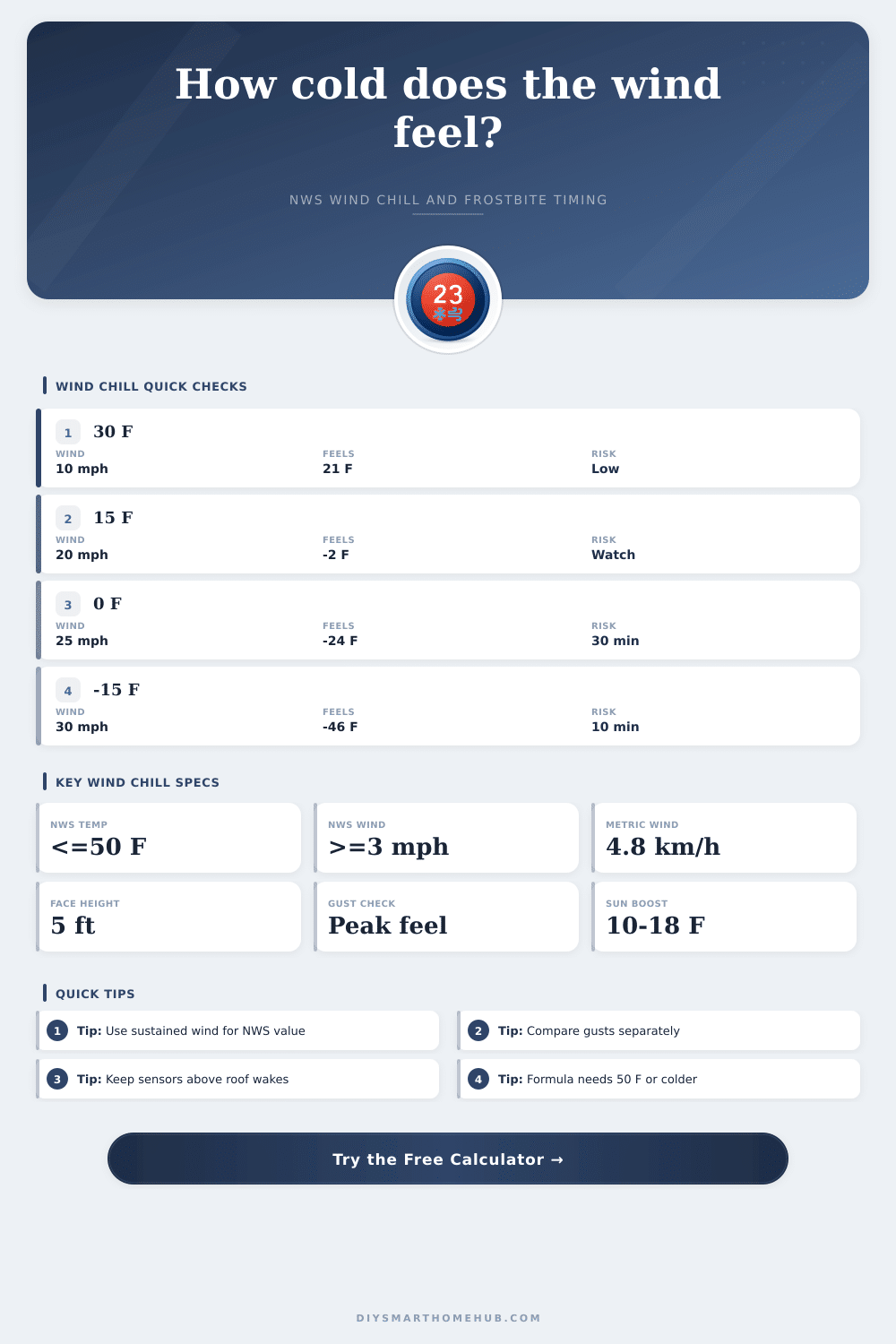
| Air temperature | 10 mph / 16 km/h | 20 mph / 32 km/h | 30 mph / 48 km/h | 40 mph / 64 km/h |
|---|---|---|---|---|
| 40 F / 4.4 C | 34 F / 1 C | 30 F / -1 C | 28 F / -2 C | 27 F / -3 C |
| 30 F / -1.1 C | 21 F / -6 C | 17 F / -8 C | 15 F / -9 C | 13 F / -11 C |
| 20 F / -6.7 C | 9 F / -13 C | 4 F / -16 C | 1 F / -17 C | -1 F / -18 C |
| 10 F / -12.2 C | -4 F / -20 C | -10 F / -23 C | -12 F / -24 C | -15 F / -26 C |
| 0 F / -17.8 C | -16 F / -27 C | -22 F / -30 C | -26 F / -32 C | -29 F / -34 C |
| -10 F / -23.3 C | -28 F / -33 C | -35 F / -37 C | -39 F / -39 C | -43 F / -42 C |
| Wind chill range | Frostbite timing | Exposure message | Calculator label | Typical automation trigger |
|---|---|---|---|---|
| Above -18 F / above -28 C | Not chart-limited | Cold stress still possible with long exposure | Low / watch | Normal cold alert |
| -18 to -35 F / -28 to -37 C | About 30 minutes | Limit exposed skin and shorten outdoor tasks | 30 min | Outdoor task warning |
| -36 to -55 F / -38 to -48 C | About 10 minutes | Very short exposure window for bare skin | 10 min | High-risk push alert |
| Below -55 F / below -48 C | About 5 minutes | Extreme risk for exposed skin | 5 min | Critical alert |
| Measurement profile | Height / exposure | Face-height factor | Best use | Watch point |
|---|---|---|---|---|
| Handheld face-height reading | About 5 ft / 1.5 m | 1.00x | Direct outdoor task reading | Keep clear of body shielding |
| Roof or mast at 10 m | Open rooftop standard | 0.75x | Home weather station correction | Roof edges can accelerate wind |
| Porch wall sensor | Sheltered wall pocket | 1.35x | Doorway comfort checks | Shelter may under-read true wind |
| Garden pole / fence | About 6 ft / 1.8 m | 0.95x | Backyard station estimate | Fence turbulence can swing readings |
| Open field 10 m station | Flat open exposure | 0.70x | Rural property or farm alerts | Usually higher than a yard reading |
| Moving bike / vehicle | Apparent wind | 1.00x | Commute feel comparison | Use combined travel plus headwind |
| Weather sensor / spec profile | Wind accuracy | Temp accuracy | Response behavior | Wind chill fit |
|---|---|---|---|---|
| Basic home weather station | +/-2 mph | +/-1.0 F | Moderate averaging | Good for household alerts |
| Shielded smart weather station | +/-1.5 mph | +/-0.5 F | Stable outdoor trend | Best default for home automation |
| Ultrasonic roof anemometer | +/-1 mph | +/-0.4 F | Fast gust capture | Strong for roof and open exposure |
| Handheld vane anemometer | +/-1 mph | +/-1.0 F | Spot measurement | Useful at face height |
| Nearby airport / ASOS style | +/-1 mph | +/-0.5 F | Open exposure average | Reliable but may not match yard |
| Weather app estimate | +/-4 mph | +/-2.0 F | Modeled or remote station | Use wider margin for decisions |
💡Wind Chill Planning Tips
Wind chill is a measurement of how fast heat leave the body. Wind chill isnt the same thing as the actual air temperature. Air temperature is the measurement of how warm or cold the air is.
Wind chill, however, is the temperature that describes how cold the skin feel due to the movement of the air over the skin. When the wind moves over the body, the wind remove heat from the body. As a result, the body feels more cooler than the actual air temperature.
Wind Chill: What It Is and How the Calculator Works
A wind chill calculator can be used to calculate the wind chill value for a set of conditions. To calculate the wind chill value, the user enters the air temperature and the wind speed into the calculator. The height of the sensor that measure the wind and the type of sensor is also adjusted for within the calculator.
Based off these variable, the calculator displays the official wind chill value, a separate gust-adjusted wind chill value, and calculates the amount of time that skin will be exposed to the air before developing frostbite. Each of the variables entered into the calculator represent a different part of the physical environment. For instance, the air temperature is one of the variables that must be entered.
The wind speed is another variable that must also be made accurately. The official wind chill equation is based on air temperature that are recorded at a height of five feet from the ground. Therefore, if the sensor is located on a rooftop, the wind speed will be higher at the rooftop then five feet from the ground.
Therefore, a wind chill calculator incorporates a correction factor for this potential difference in wind speeds. The wind speed that is entered into the calculator is the sustained wind speed. Sustained wind is the average wind speed over a two-minute period.
A gust of wind is a temporary increase in wind speed over a short period of time. Therefore, the wind chill equation uses the sustained wind speed rather than the gust speeds. However, the wind chill calculator also displays a separate value that calculate the impact of the gusts on the body.
The difference between these two value is useful in displaying the impact that gusts will have on an individual’s body. The quality of the sensor that measure the wind and the accuracy of that sensor can impact the measured wind chill value. Each sensor has a margin of error.
A professional weather sensor will have a very small margin of error in comparison to a sensor in the home. The uncertainty band within the calculator account for the potential error in the sensor measurements. Therefore, the uncertainty band should be used to make a decision about the safety of an activity for an individual.
Light from the sun is not accounted for in the official equation for calculating the wind chill value. However, exposure to sunlight can make an area feel warmer than it should according to the wind chill value. An adjustment for sunlight exposure isnt included in the official wind chill value, but is provided in the calculator as a means of providing context regarding how an exposure to sunlight may impact the official calculation of the wind chill.
The time that it will take for an individuals skin to experience frostbite is calculated based on the wind chill value. Estimates for the amount of time it will take for an individuals skin to experience frostbite are based upon observations of skin temperatures. These times are not guarantees as to when an individual may experience frostbite.
Individual factors such as the moisture of the skin and the fit of the clothing will change the bodys reaction to the cold temperatures. Therefore, these estimates should of be used as a guide for individuals in making decisions regarding their safety from frostbite. Different locations will have different wind chill value with the same air temperatures.
For instance, a sensor in an open field will register higher wind speed than a sensor behind a fence. An individual that is moving will experience lower wind chill values because movement will lead to the creation of apparent wind. The wind chill calculator treats moving wind and standing wind the same in regard to the bodys reaction to the perceived wind speeds.
In order to calculate an accurate wind chill value, certain mistake should be avoided. For instance, the wind gust should be avoided in favor of the sustained wind value. Additionally, the height correction should be made for the sensor measurement of the wind.
If the sunlight boost is treated as part of the official wind chill calculation, the result will be incorrect. The calculated value can then be compared to the frostbite risk values and the exposure time to determine if any action needs to be taken to protect the skin of an individual.