Whole Home Humidifier Water Usage Calculator
Estimate evaporated gallons per day, capacity-limited runtime, whole-home moisture deficit, air-change load, and seasonal humidifier water use from one winter RH profile.
Humidifier water formula breakdown
| Outdoor condition | Typical target RH | Water demand effect | Condensation signal |
|---|---|---|---|
| Mild winter above 35°F | 35% to 45% | Higher target can be comfortable | Watch cold window edges |
| Normal winter 20°F to 35°F | 30% to 40% | Moderate daily water use | Lower target if glass sweats |
| Cold weather 0°F to 20°F | 25% to 35% | Lower target reduces gallons | Use the lowest clear-window RH |
| Very cold below 0°F | 20% to 30% | Demand remains high from dry air | Window frost means target is too high |
| Home leakage profile | Estimated ACH | Effect on gallons/day | Best use in calculator |
|---|---|---|---|
| Very tight new construction | 0.10 to 0.20 ACH | Low replacement-air moisture load | Use 0.15 when ventilation is controlled |
| Typical maintained home | 0.25 to 0.45 ACH | Moderate ongoing humidifier demand | Use 0.35 as a first estimate |
| Drafty older home | 0.60 to 1.00 ACH | High load from repeated dry-air changes | Use 0.75 when drafts are noticeable |
| Open flue or frequent door use | 1.00+ ACH | Very high demand; capacity may limit RH | Model separately from normal occupied hours |
| Whole-home humidifier type | Common rated output | Runtime behavior | Calculator note |
|---|---|---|---|
| Bypass evaporative pad | 12 to 18 GPD | Runs with furnace airflow | Rated output assumes warm supply air |
| Fan-powered evaporative pad | 18 to 24 GPD | Can evaporate more at lower airflow | Use higher runtime when calls are frequent |
| Steam whole-home unit | 24 to 34+ GPD | Independent moisture production | Output may exceed air-change demand |
| Undersized or low-water setting | 6 to 12 GPD | Often capacity-limited | Compare required runtime to 100% |
| Scenario | Volume and ACH | RH move at 70°F | Expected calculator result |
|---|---|---|---|
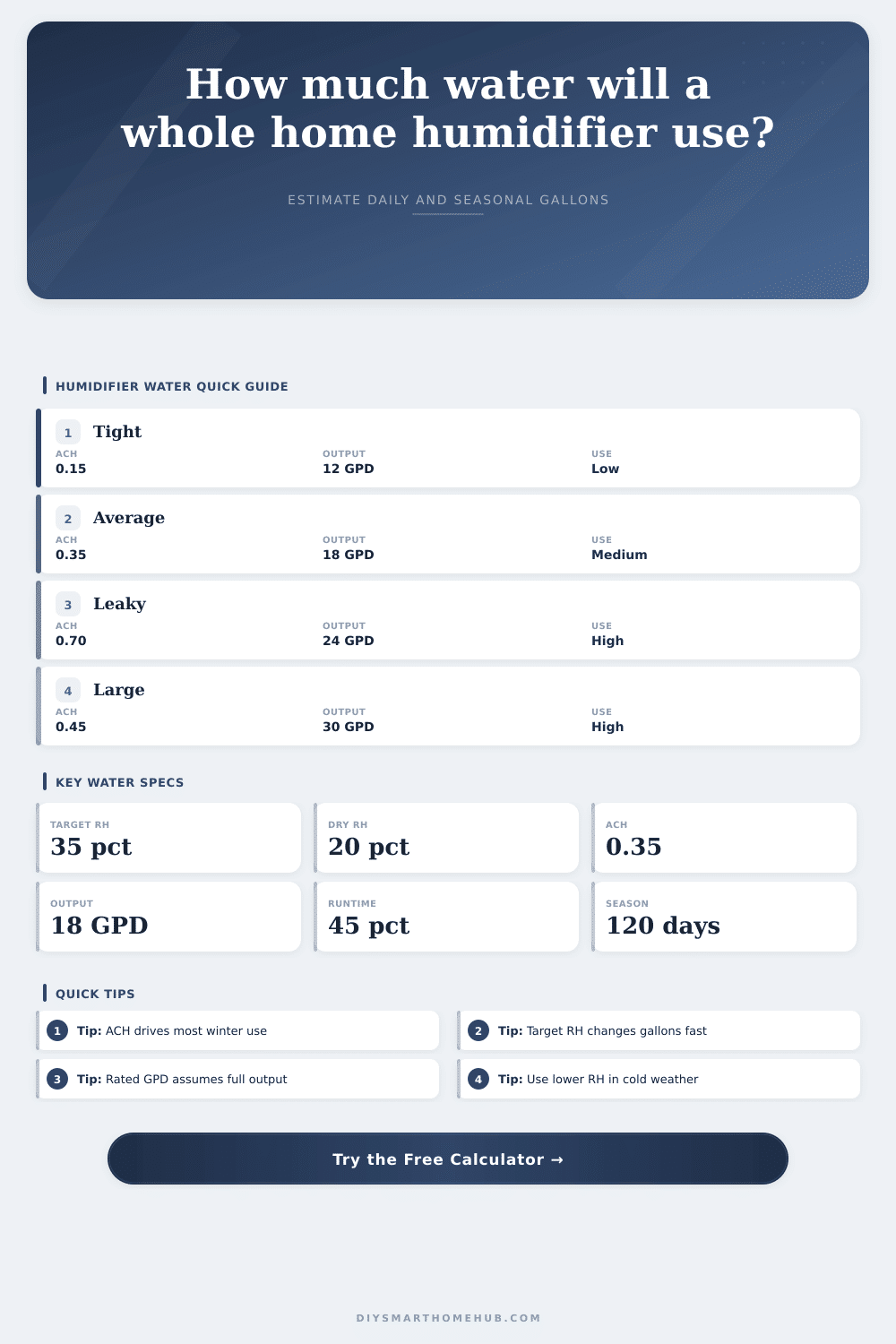
| Tight 1,800 sq ft home | 14,400 cu ft at 0.15 ACH | 25% to 35% | Low daily maintenance demand |
| Average 2,000 sq ft home | 16,000 cu ft at 0.35 ACH | 25% to 35% | Moderate daily evaporated gallons |
| Large 3,500 sq ft home | 30,000 cu ft at 0.45 ACH | 22% to 35% | High demand and longer runtime |
| Drafty older house | 18,000 cu ft at 0.75 ACH | 20% to 32% | Air changes may exceed output |
| Steam humidifier profile | 22,000 cu ft at 0.30 ACH | 20% to 38% | Capacity usually exceeds demand |
A poorly sealed home wastes humidity, which is something you can feel during winter. Your wood floors begin to groan as moisture shrink them. Your skin turns dry and your throat scratchy.
It doesn’t have to be like this. Besides being uncomfortable, your home’s unseen breathing demand water. Most homeowners never bother to measure it until they check their utility bill or spot some window condensation. To get an idea of what kind of water a whole-home humidifier will use, look beyond its marketing specs, and into physics of your own envelope.
How Much Water Your Humidifier Uses
The starting point is always the volume of heated air you are trying to manage: How much heated air do you have? It’s not as simple as ‘square footage,’ either; ceiling height make a big difference here. For example, a single-story ranch house will contain far less air volume than a two-story home. In order for that relative humidity sensor to sense a change, you’ll also need to add additional moisture into the system… and that take more total moisture in the system. Enter the calculator above (which does the math for you when you enter in your room sizes) so you don’t have to guess at how many cubic feet you’re converting.
Do you know whether or not your humidifier will be able to keep up with size of the room it’s trying to cover? Most estimates also break down here: We think the humidifier’s doing all the heavy lifting, while forgetting we’ve got leaky ducts, drafty windows, etc. These suck in bone-dry outdoor air at all times. That dry air has to get moistened and warmed before it’ll feel comfortable inside, so every time some outside air leaks into our houses, we have to add moisture to make it feel comfy again.
The air-change load often exceed the amount of moisture needed just to bring the place up to our target humidity level. If you have an older house with high air changes per hour (thanks to bad sealing), unless your humidifier put out a fair bit of water, you’re basically fighting a losing battle against Mother Nature. That is why having an estimate for your leakage rate is more important than what kind of unit you buy.
But we must also adjust our targets for relative humidity according to the calendar. If it’s twenty degrees outside and you keep your house at forty percent relative humidity, that could make that coldest piece of glass in your windows condense… And then you get a water problem and mold. Best bet: reduce your target as things go cold. Thirty percent in January is not failing at comfort; it’s taking care of your building envelope. The tables on the page explain the tradeoff well. By adjusting your expectations depending on what’s happening outdoors, you avoid damaging stuff without letting inside air get unhealthfully dry.
Finally, there’s the capacity of the equipment itself, a factor that outweighs any desire. Bypass humidifiers operate based off the airflow of the furnace, so they are “on” whenever the heat is operating. The thermostat is happy, the humidifier is off. Steam and fan-powered units is more constant in their output but also require more maintenance and consume more energy. Calculate how much water your house needs each day, then check the output rating of your unit to see if it can absorbs. No matter how long it runs, it won’t fill that void.
Planning for the season helps set your expectations in context. Winter doesn’t just consist of one temperature and humidity level outdoors; it covers several months, each with different conditions. By calculating your overall seasonal use, you can see what care is required (e.g., how many pads to replace, when filters need changing) and how much water will be consumed. That’s a more accurate picture than getting frustrated because things aren’t working perfectly right now while the weather is changing into winter.
And lastly, humidity isn’t a race to max out. More is not always better, too much can be wasted water and cause a condensation risk, while too little makes it uncomfortable for your lungs or your woodwork. So how do you go from guesswork to management? It’s all about balance. Look at your temperatures. Then look at volume to see how much humidity you need. Finally, look at leakage to find where your leaks are.
During the worst of months, there is only so much air in your house. Treat it like precious fuel and what was a basic appliance becomes a true preservation and comfort device.