HVAC Short Cycle Prevention Timer Calculator
Calculate compressor minimum off-time, natural temperature-swing off-time, cycle rate per hour, runtime balance, deadband safety, and remaining restart lockout from one HVAC control profile.
Short-cycle formula breakdown
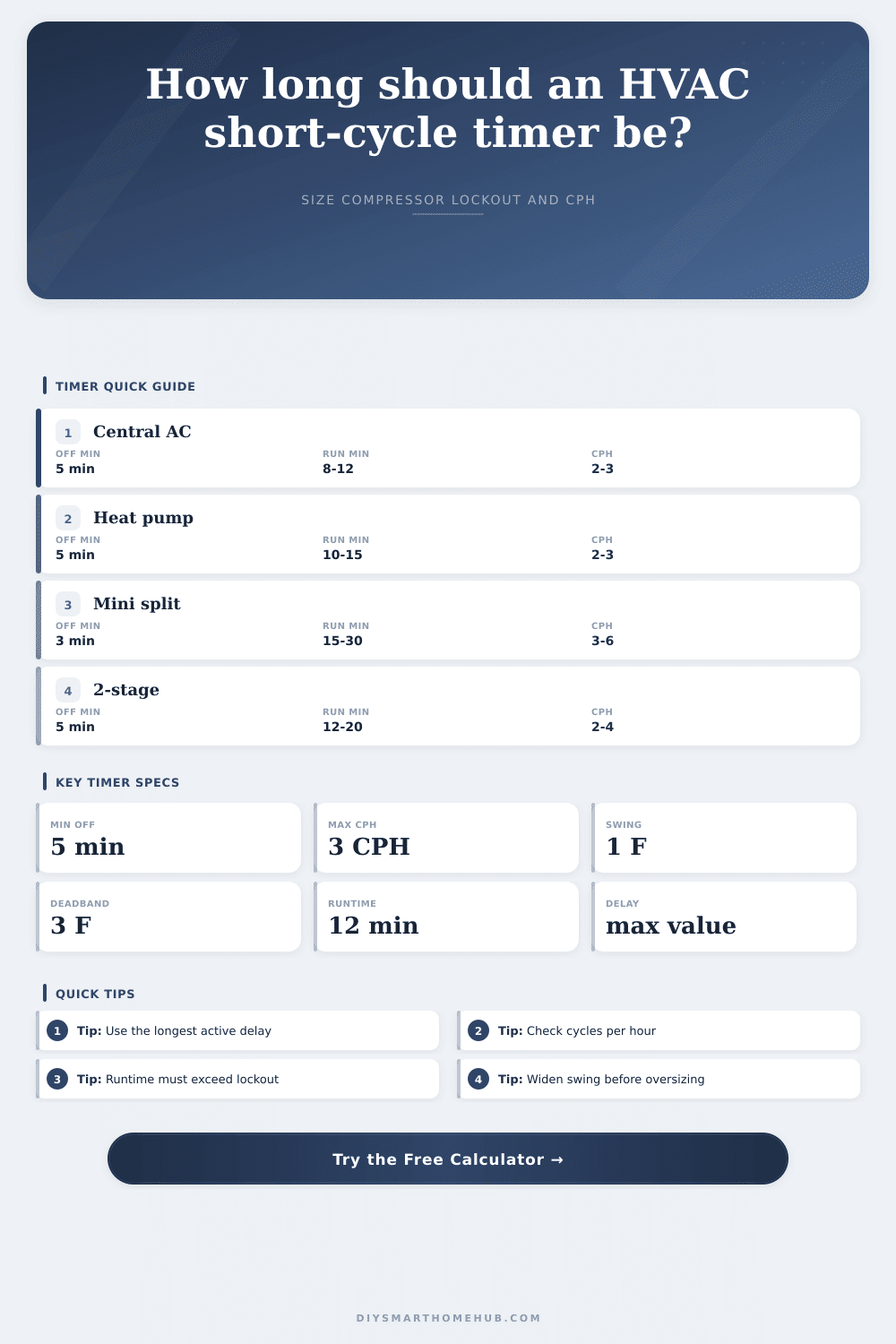
| Equipment profile | Typical minimum off-time | Runtime target | Cycle-rate target |
|---|---|---|---|
| Single-stage central AC | 5 minutes is a common compressor protection setting | 8 to 15 minutes in normal load | 2 to 3 CPH for many homes |
| Air-source heat pump | 5 minutes protects compressor restarts and reversing-valve transitions | 10 to 20 minutes when outdoor load is steady | 2 to 3 CPH for conventional staging |
| Two-stage compressor | 5 minutes, with staging logic often extending low-stage operation | 12 to 25 minutes when low stage carries load | 2 to 4 CPH depending on thermostat setup |
| Inverter mini split | 3 minutes is common, but long modulation is usually preferred | 15 to 30+ minutes at low output | 3 to 6 CPH only when cycling cannot be avoided |
| Zoned ducted system | 5 minutes plus zone-panel compressor protection | 8 to 18 minutes with enough bypass or open zones | 2 to 4 CPH, lower for tiny zones |
| Thermostat swing | 1°F/hour drift | 2°F/hour drift | 4°F/hour drift |
|---|---|---|---|
| 0.5°F full swing | 30.0 min natural off-time | 15.0 min natural off-time | 7.5 min natural off-time |
| 1.0°F full swing | 60.0 min natural off-time | 30.0 min natural off-time | 15.0 min natural off-time |
| 1.5°F full swing | 90.0 min natural off-time | 45.0 min natural off-time | 22.5 min natural off-time |
| 2.0°F full swing | 120.0 min natural off-time | 60.0 min natural off-time | 30.0 min natural off-time |
| Scenario | Observed runtime | Timer focus | Adjustment signal |
|---|---|---|---|
| Normal central AC cooling | 10 to 15 minutes | 5 minute compressor off delay, 3 CPH limit | Hold settings if natural off-time is longer than the timer |
| Oversized AC on mild day | 4 to 8 minutes | Wider swing and lower CPH target | Short runtime remains a sizing or airflow warning |
| Small damper zone | 6 to 10 minutes | Zone-panel delay and open-zone minimums | Watch pressure, bypass behavior, and rapid repeats |
| Heat pump defrost season | 10 to 20 minutes | Compressor lockout plus outdoor board logic | Avoid manual timer settings that fight equipment controls |
| Humidity-control cooling | 15 to 25 minutes | Longer runtime with reasonable off-time | Prefer controlled longer cycles over frequent quick starts |
What does a finicky HVAC system sound like? Here’s one tell: First, there’s a deep hum of the outdoor condenser when the compressor engages; then (almost instanty), it goes silent. A few minutes later, it tries again. On, off, on, off. This kind of quick-start-and-stop action is known as short cycling.
It is one of most frequent complaints we hear from customers who feel something isn’t right with their system, even if they aren’t even halfway through its lifespan yet. The problem: Starting current is much greater than running current, which mean tremendous stress on the electrical parts while delivering very little heat or cool air to you, the human being livig in the house.
Why Your AC Turns On and Off Too Often
Setting your thermostat to a narrow band such as seventy-two degrees may seem accurate, but accuracy without patience is simply a recipe for trouble in an HVAC system. What most folks miss is that the mechanical protection vs. Comfort is really just tip of the iceberg. These days nearly all central AC/heat pump units has internal delay mechanisms meant to stop them from restarting immediately (typically about 5 min).
This is because it would make the compressor pump liquid against a solid barrier if there weren’t at least a few moments for the refrigerant pressures to balance out in the line. So if you add another external timer without first knowing what’s already going on, you may end up accidentally blocking airflow, or simply causing a different set of comfort problems instead of solving them. That’s why it’s helpful to think through these overlaps with the calculator above, it lets you visualize these various delays and identify what component is really controlling the restart period.
You need to know the delay set on your thermostat. You also need to know if the board itself are locking it out for a certain amount of time before allowing a restart. Finally, account for any timers you’ve added to the mix. What matters is that adding a timer that is less than whatever is already installed doesn’t do anything, and adding a timer that’s too long only results in additional temp swings you don’t like.
The other key variable is the amount of natural off time created by your thermal mass. The compressor won’t logically restart until the room temperature have drifted upward enough to re-trigger the thermostat, even if the electrical lockout is cleared in as little as five minutes. How fast it drifts will depend on how much swing is set into your thermostat, plus the drift rate dictated by things like insulation quality and air infiltration.
So a well-insulated house with limited air infiltration may find its temperature drifting just one degree per hour. This would naturaly cause the system to remain off for half-an-hour at minimum…regardless of what timer settings is made. A sunny room or an older drafty house could see its temperature jump by two degrees per hour, narrowing that natural interval considerably. It also helps explain why on some days your system responds different than others: is it a humid day, or a clear sunny afternoon?
The other half of the equation for over-cycling prevention also has to do with how the thermostat is set up. Many customers try to solve short cycling by increasing the fan run time or narrowing the deadband. However, this can backfire if you have an oversized unit that cools the space so fast that it shuts off too soon and satisfies the thermostat. More often than not, longer but less frequent starts are not the answer. Longer but fewer runs is.
Also, allowing a larger swing (of say one degree or sometimes even two) in the differential will give the air conditioning time to get rid of the latent heat while dehumidifying adequately. This helps avoid premature compressor failure and prolongs the life of the contactors while not being uncomfortably noticeable.
Another factor is that not every system operates by the same set of rules. For example, a mini-split equipped with an inverter compressor have a different type of timing profile than a traditional single-stage central AC system (because the former can modulate its output instead of turning completely off and back on again). It’s possible to throw off the modulating behavior of this kind of variable-speed equipment if you apply strict five-minute rules across the board.
Likewise, a zoned system adds another problem; when the zone dampers shuts, it may meet the demand at the local thermostat even though the main unit keeps humming along to service other spaces. That results in what appear to be short cycles but are really normal operating sequences.
It all comes down to keeping your h-vac investment safe while making it work well in real life. As a rule of thumb, the reference table on the page shows the generally accepted minimums for various equipment types and provides a baseline for what constitutes healthy operation. But as we know, reality isn’t always text book. You might be finding yourself adjusting timers every other day and if so, maybe it should of been time to investigate airflow restrictions, refrigerant charge, or even whether your system is correctly sized for your house.
When everything is humming along it settles into a routine and doesn’t need much attention anymore. You hardly notice the system is operating until the thermostat says it’s just how you like it.