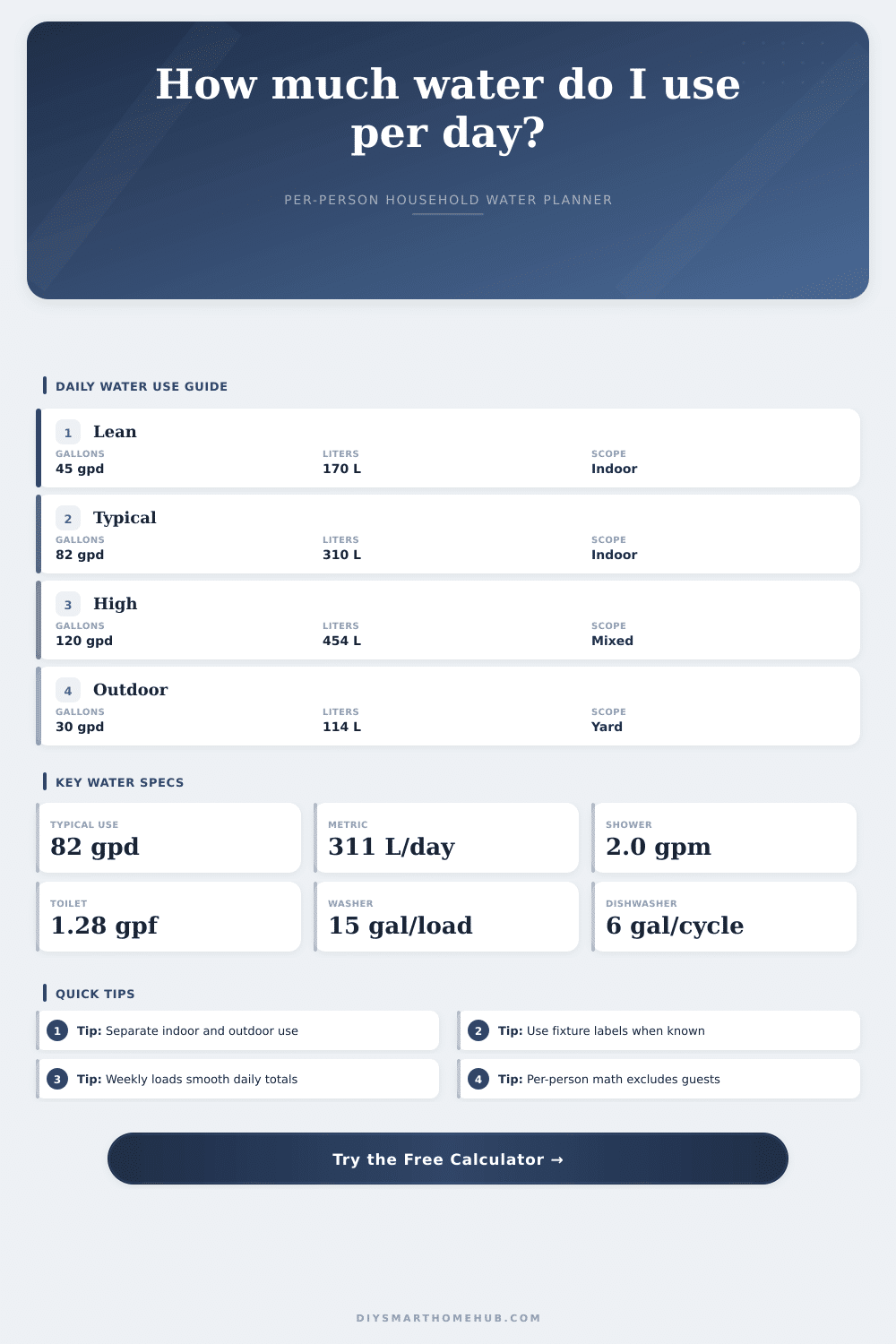
Water Usage Per Person Per Day Calculator
Estimate household and per-person water use from showers, toilet flushing, faucet minutes, laundry, dishwasher cycles, and outdoor water in gallons and liters per day.
Detailed water-use breakdown
| Fixture or appliance | Efficient reference | Standard reference | Calculator use |
|---|---|---|---|
| Showerhead | 1.5 to 2.0 gpm / 5.7 to 7.6 L/min | 2.5 gpm / 9.5 L/min | Profile flow multiplied by shower minutes per person |
| Toilet | 1.1 to 1.28 gpf / 4.2 to 4.8 L/flush | 1.6 gpf / 6.1 L/flush | Flush volume multiplied by flushes per person |
| Bathroom or kitchen faucet | 0.8 to 1.5 gpm / 3.0 to 5.7 L/min | 1.8 to 2.2 gpm / 6.8 to 8.3 L/min | Flow multiplied by active faucet minutes per person |
| Clothes washer | 12 to 18 gal/load / 45 to 68 L/load | 19 to 30 gal/load / 72 to 114 L/load | Weekly loads divided across seven days |
| Dishwasher | 3.2 to 5 gal/cycle / 12 to 19 L/cycle | 6 to 10 gal/cycle / 23 to 38 L/cycle | Weekly cycles divided across seven days |
| Outdoor hose or irrigation | Manual entry by household day | Often seasonal and schedule-based | Added after indoor fixture totals |
| Daily level | Gallons per person | Liters per person | Typical profile |
|---|---|---|---|
| Very efficient indoor use | 35 to 50 gal/day | 132 to 189 L/day | Short showers, efficient toilets, full machine loads |
| Efficient to typical indoor use | 50 to 82 gal/day | 189 to 310 L/day | Low-flow fixtures with average daily routines |
| High indoor use | 82 to 120 gal/day | 310 to 454 L/day | Long showers, older toilets, extra faucet time |
| Outdoor-heavy day | 120+ gal/day | 454+ L/day | Irrigation, hose use, or pool top-off added to indoor demand |
| Machine profile | Laundry assumption | Dishwasher assumption | Daily household average |
|---|---|---|---|
| Compact | 4 loads/week at 14 gal/load | 5 cycles/week at 3.5 gal/cycle | 10.5 gal/day / 39.8 L/day |
| Efficient family | 7 loads/week at 15 gal/load | 7 cycles/week at 4 gal/cycle | 19.0 gal/day / 71.9 L/day |
| Standard family | 8 loads/week at 19 gal/load | 7 cycles/week at 6 gal/cycle | 27.7 gal/day / 104.9 L/day |
| Large family | 12 loads/week at 22 gal/load | 10 cycles/week at 6 gal/cycle | 46.3 gal/day / 175.2 L/day |
| Laundry heavy | 14 loads/week at 20 gal/load | 5 cycles/week at 6 gal/cycle | 44.3 gal/day / 167.7 L/day |
| Scenario | People | Daily household volume | Per-person reading |
|---|---|---|---|
| Single apartment, compact machines | 1 | 48 to 70 gal/day | Indoor profile dominates the number |
| Efficient couple, no outdoor water | 2 | 95 to 130 gal/day | Usually 48 to 65 gal/person/day |
| Family with standard fixtures | 4 | 260 to 390 gal/day | Machine loads spread across people |
| Garden watering day | 3 to 5 | Indoor total plus entered outdoor water | Outdoor share can push totals high |
Per-person fixtures
Showers, toilets, and faucets scale directly with the household people count because the calculator treats those activities as personal daily use.
Shared machines
Laundry and dishwasher water are entered as weekly household profiles, converted to a daily average, then divided by people for the per-person result.
Outdoor water
Outdoor water is a household-day entry. It can be included for whole-property use or set to zero when checking indoor-only water demand.
We don’t realize just how many gallon of water we consume until the bill comes in. Outdoor watering, doing laundry, taking a shower, flushing the toilet, all of these add up and appears as a single confusing number on the bill.
The calculator takes away that guesswork and do the math for you. Just input information about your fixtures and the total will be broken down into liters (or gallons) per person per day to make numbers easier to understand.
How to Use the Water Calculator
The trick is to know what you’re measuring. Using water isn’t just one single action, it’s a combination of lots of small (but frequent) actions. There are also some big (but infrequent) ones. For example, your showering happen only occasionally, but when you do, it takes a lot of water. Your toilet flushing happens regularly, but with newish toilet, each flush requires very little water. That’s why they break out the activities. You’ll know how much each one account for.
Installing a low flow shower head doesn’t mean much if you haven’t replaced your old toilet. Many people make this error. They patch up an obvious leak, but they fail to notice inefficient appliances that waste water all along.
But then there’s dishes and laundry: common chores around the house. For laundry, the tool ask for weekly loads because most people don’t wash every day. It takes an average of what you put in a week and divides it into seven. That figure is divided further among number of people who live in your house. Why? If you’re a single person, your per-capita laundry usage is higher then a family of four. Using this per-person measure levels that out. You are comparing yourself to your actual living circumstances. You are not comparing yourself to national average.
Watering outdoors differs dramatically. Twice as much in a dry summer can double your indoor bill. You can enter outdoor usage separate from indoors on the calculator. Why? Because if it suddenly spikes up your daily usage, then what’s the reason? Long shower? Long run of the sprinklers? Separate the two and you’ll find out which one it really is. Turning off the hose won’t help a leaky faucet.
Your inputs get put into context with the reference tables. How does your shower compare? The reference tables shows you what a typical efficient shower looks like compared to a standard one. The source doesn’t specify a gallon amount for an efficient shower. What’s normal? On average people use about eighty gallons a day indoors. Are you above that? Is your number high? Are your appliances old? Are you below that? Do you have a simple routine? Do you have high-efficiency fixtures?
It’s not a plumbing tool; it’s not for people who know plumbing. It’s for anyone who will tell the truth about their own habits. How long are you in the shower? Do you run half loads of dishes in dishwasher? This stuff’s easy input. But when you see the output, think. High numbers aren’t moral failures. They’re data. And they tell you where to look first.
The biggest uses is indoors, in showers and toilets. Fixing those gives you the most immediate impact. Next are the machines: Run the dishwasher only when it’s full and wash full loads. That reduces your per-person impact without altering daily life one bit. Last is outside. Is the irrigation on the right schedule? Is the irrigation scheduled correctly, or is it just on a timer that doesn’t care about the rain?
Conserving water isn’t about going without; it’s about doing more with less. And how do you do less? By knowing how much you use. That’s what this calculator provide: your baseline. Before, your worry was vague. Now it’s quantified. Now you have a number to go by. This number tells you where to start. The rest becomes a decision rather than a guess. And decisions requires action.