Water Heater Flush Interval Calculator
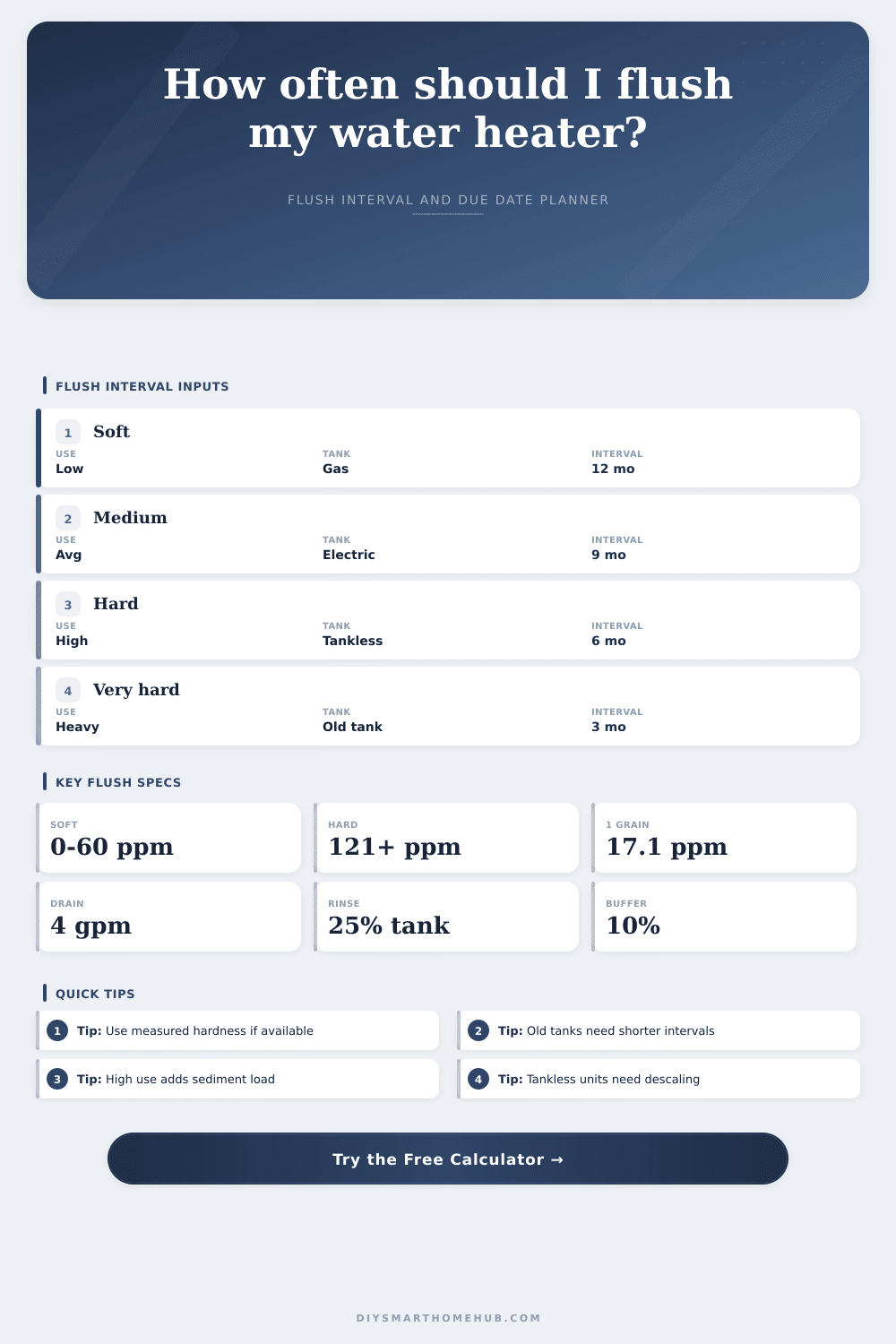
Estimate a practical water heater flushing interval from water hardness, tank type, hot-water use, sediment risk, and your last service date, then size the flush water and time needed.
Medium hard water shortens the base interval.
Daily hot gallons divided by tank capacity measures turnover pressure.
Visible grit, rust, and well water pull the flush date earlier.
Main drain plus rinse water sized from the selected tank capacity.
| Hardness class | ppm as CaCO3 | Grains per gallon | Typical starting interval |
|---|---|---|---|
| Soft | 0 to 60 ppm | 0 to 3.5 gpg | 12 months before heater and usage adjustments |
| Moderately hard | 61 to 120 ppm | 3.6 to 7.0 gpg | 10 months before heater and usage adjustments |
| Hard | 121 to 180 ppm | 7.1 to 10.5 gpg | 8 months before heater and usage adjustments |
| Very hard | 181 ppm and up | 10.6 gpg and up | 6 months before heater and usage adjustments |
| Heater type | Interval factor | Flush water logic | Best use in calculator |
|---|---|---|---|
| Gas storage tank | 0.95x | Bottom heat and burner area can collect scale. | Most standard residential gas heaters |
| Electric or hybrid tank | 0.90x to 0.95x | Minerals can settle around lower elements. | Homes with storage tanks and element heating |
| Indirect storage tank | 1.05x | Flush like a tank, but scale pressure is often gentler. | Boiler-connected storage systems |
| Tankless heat exchanger | 0.75x | Small drain volume; service is usually a recirculated flush. | Use for descaling interval planning |
| Scenario | Inputs | Expected interval | Water to move |
|---|---|---|---|
| Soft water small home | 40 gal tank, 45 gpd, low risk | About 11 to 12 months | 50 gal with standard rinse |
| Average city family | 50 gal tank, 80 gpd, normal risk | About 7 to 9 months | 63 gal with standard rinse |
| Hard water heavy use | 50 gal tank, 120 gpd, high risk | About 4 to 6 months | 75 gal with heavy rinse |
| Very hard well water | 80 gal tank, 150 gpd, very high risk | About 3 to 4 months | 120 gal with heavy rinse |
The typical homeowner views his/her water heater as some sort of magic black box, something that simply emits hot water. Then one day it no longer does so off comes the plug, in goes time, and soon we ask why did this happen? Why did element burn out? Why did the tank rust all the way through from the bottom?
Usually, it wasn’t a mechanical failure in the traditional sense. It was sediment. Sediment build up on the bottom of the water heater tank; it creates a buffer that insulates the heating element from the water. That sediment forms a barrier between the heating element and the water itself. The element can no longer touch the water directly. It must run hotter than intended to make up for this which increases wear and decreases efficiency over time.
Why You Need to Clean Your Water Heater
Flushing the tank eliminates that sediment, but when exactly do you do it? Checking the calendar alone won’t be enough. Instead, it all depends on several factors: What type of water are you pushing through the system? How hard are you pushing it? You’ll notice the calculator does the math for you (above), but knowing what goes into it will help you believe the output.
Here’s why: Hardness of your water is the major factor in this equation. It controls mineral precipitation from solution (i.e. “scale”). For example, if your water is very hard, you may need it serviced every 6 months; whereas soft water could stretch it to an entire year. This tool automaticly transforms grains per gallon into parts per million (you won’t have to do any algebra). The basic premise is straightforward, more minerals = faster accumulation. Running a water softener dramatically reduces your effective hardness and thus extends the time between service. Many folks forget this variable, or just stick with whatever a generic “maintenance schedule” tells them to do.
This equation actualy has a pretty significant factor for household use, too. Sediment settles nicely when a tank is sitting relatively still with most of its volume filled. On the flip side, if a tank is being turned over several times a day, it keep particles suspended. It also processes much larger volumes of water overall. This means it pulls in more mineral content. Running laundry, showers, dishwashers, etc. Using it all the time will put far more volumetric and thermal strain on the heater… Particularly in a large household.
The calculator takes this into account, varying the base interval according to how much hot water you pull versus the size of your tank. For example: if you’ve got a 50 gallon tank but you’re pulling 80 gallons of hot water through it every day, then you’re churning your water supply at a quicker rate then normal. That churn will carry more sediment with it which needs to be cleared out regularly so it doesn’t gum up the dip tube or wear away at the anode rod.
The same general physics apply here but with some differences by tank type. For gas heaters, you’ll find most scale accumulates around the bottom of the tank, near the burner. That can lead to that irritating popping sound from water in the scale layer evaporating into steam. For electric tanks, mineral coatings on the heating element will cause overheating and early failure. Tankless units are another animal altogether: they depend upon a small heat exchanger that narrows quickly if calcium deposits builds up inside it. Tankless units use much less water per flush, but problems happen faster and feel more urgent because you lose all your hot water instead of just having a less efficient tank.
It outputs an estimation of what volume should be flushed. This is useful if you want to plan out how much actual work is involved in the job. It also suggests an interval between flushes. It’s not like you can open the drain and there goes a full fifty gallons. That wouldn’t of happen unless you have sufficient water to displace the sludge. Most of the heavier stuff stays put even with a quick 10% rinse. To properly flush, you need to drain a decent amount of the tank’s volume and then run clean water through until it clears up.
The flush time depends on the size of your drain, the length of your hoses, and how plugged up your drain port is. Your actual time will be longer than the tool’s guess if your drain valve is clogged. No big deal. The interval says when to do it. Your hands say when you are finish.
But they don’t take these things into account which shortens their appliance lifespan and increases their energy bill. A heater sucks at being an insulator because scale is a terrible insulator. However, it is good at burning out its elements because scale is great for that. Matching your usage patterns and water quality to your flush schedule helps maintain an efficient, clean system. The machine lives as long as it gets maintained. The math handles the variables. A little water out means a lot of trouble avoided later.