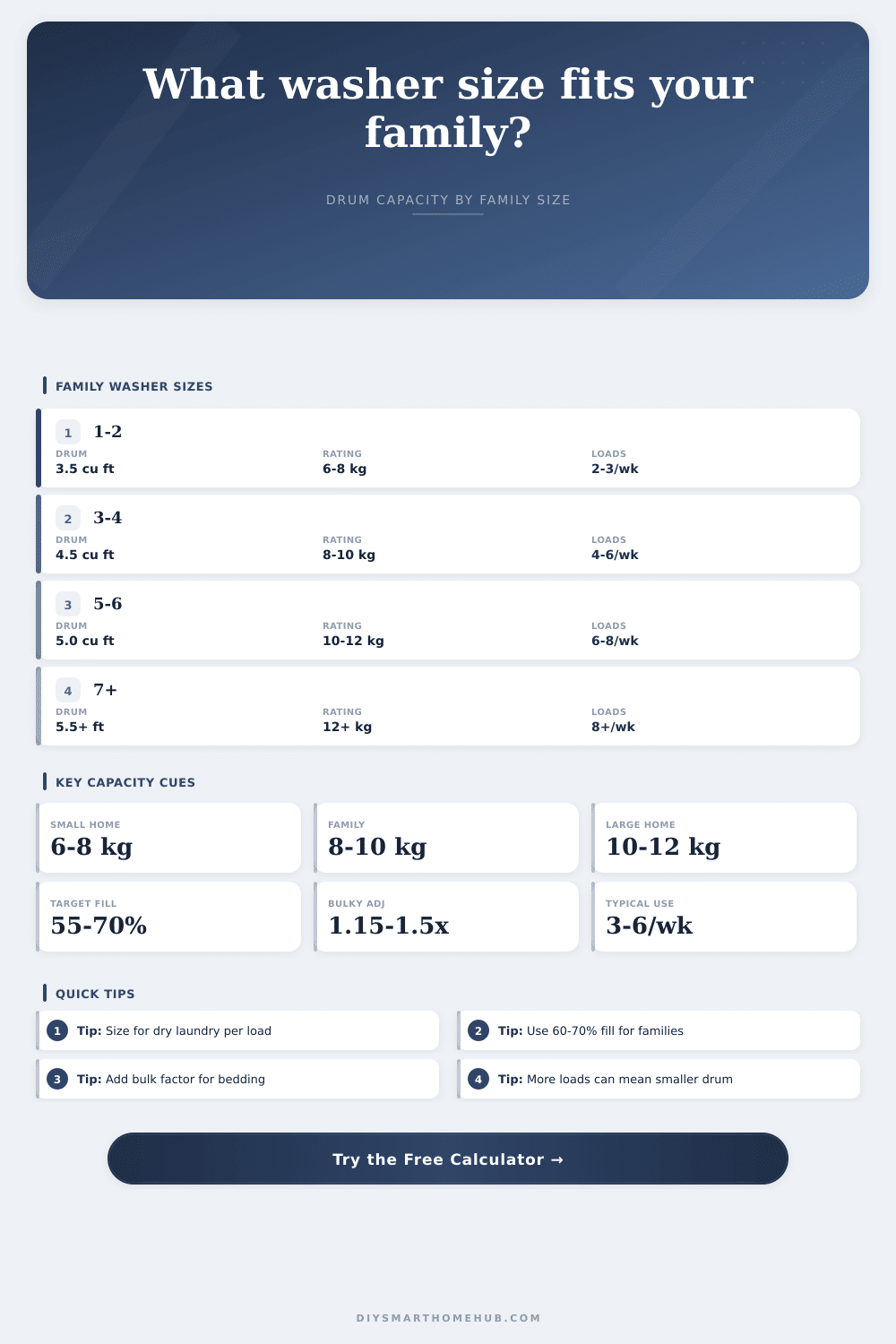
Washer Drum Capacity by Family Size Calculator
Estimate the washer drum volume and dry laundry rating that fit your household by combining family size, weekly laundry weight, target fill, bulky textiles, and load frequency.
🧺Family Laundry Presets
⚙Capacity Inputs
📊Active Capacity Comparison Grid
👥Family Size Planning Reference
| Household | Weekly dry laundry | Typical loads | Common drum target |
|---|---|---|---|
| 1 to 2 people | 7 to 12 kg / 15 to 26 lb | 2 to 3 loads | 3.0 to 3.8 cu ft / 85 to 108 L |
| 3 people | 14 to 18 kg / 31 to 40 lb | 3 to 5 loads | 3.8 to 4.5 cu ft / 108 to 127 L |
| 4 people | 20 to 26 kg / 44 to 57 lb | 4 to 6 loads | 4.2 to 5.0 cu ft / 119 to 142 L |
| 5 to 6 people | 28 to 38 kg / 62 to 84 lb | 6 to 8 loads | 4.8 to 5.5 cu ft / 136 to 156 L |
| 7 or more people | 40 kg+ / 88 lb+ | 8 or more loads | 5.2 cu ft+ / 147 L+ |
📏Drum Volume to Dry Rating Guide
| Drum volume | Metric volume | Approx dry rating | Best planning fit |
|---|---|---|---|
| 2.4 to 3.2 cu ft | 68 to 91 L | 5 to 7 kg / 11 to 15 lb | Singles, compact homes, frequent small loads |
| 3.3 to 4.1 cu ft | 93 to 116 L | 7 to 8.5 kg / 15 to 19 lb | Couples and small families with steady routines |
| 4.2 to 4.8 cu ft | 119 to 136 L | 8.5 to 10 kg / 19 to 22 lb | Most families of three or four |
| 4.9 to 5.5 cu ft | 139 to 156 L | 10 to 11.5 kg / 22 to 25 lb | Large families and towel-heavy weeks |
| 5.6 cu ft and up | 159 L and up | 11.5 kg+ / 25 lb+ | Large bedding, multi-generational households |
🛏Bulky Load Factor Reference
| Bulk factor | Typical laundry mix | Capacity effect | Use when |
|---|---|---|---|
| 1.00x | Mostly shirts, underwear, light clothing | Dry weight drives drum size | No bedding or towel batch in the load plan |
| 1.15x | Normal household clothes plus towels | Adds modest tumble space | Regular weekly family laundry |
| 1.25x | Towels, sheets, hoodies, thicker cotton | Raises recommended drum size | One or two loads each week are bulky |
| 1.40x | Bedding week or many bath towels | Volume limits before weight | Queen sheets, blankets, or towel catch-up |
| 1.55x | Comforters, robes, dense mixed bedding | Needs extra air and balance room | Large textiles are part of the normal load plan |
🗓Load Frequency Tradeoff Table
| Weekly load plan | Per-load dry weight | Drum sizing effect | Best fit |
|---|---|---|---|
| 2 to 3 loads | Large batches | Needs a bigger drum and lower bulky risk | Small households batching laundry days |
| 4 to 5 loads | Moderate batches | Often fits standard family washers | Couples, young families, normal routines |
| 6 to 8 loads | Smaller batches | Can control drum size even with more people | Families with sports, uniforms, or towels |
| 9 or more loads | Frequent small batches | Capacity need falls but time demand rises | Large homes avoiding overloaded cycles |
💡Capacity Planning Tips
A washer is a machine used to get clothes clean when there is big pile to put in the metal cylinder. Most buyers think more is better; they see a shiny front loader and assume bigger is better. They’re forgetting: Fabric requires tumbling room; water requires tumbling room. Stuffed-in-a-drum-to-the-brim washing mean you are simply shoving wet clothes from one end of the drum to the other.
What is the appropriate drum size for your home? Match what you wash (in terms of weight and laundry texture) to drum capacity, not how many people lives there. Family size is a beginning, but this is a blunt instrument. A family of four whose kids are growing teenagers playing sports does far more laundry then a family of four with small kids who can go several days wearing the same thing. Think in dry-weight-per-person, not people. On average, an adult sheds about five or six kilograms of clothes per week; active households increases that number significantly.
How to Choose the Right Washer Size
Plug your household’s weights into calculator and let it do the math (no guesswork required: How many kilos fill a load?). Then it translates those vague pounds into a concrete cubic foot need. Everyone messes this one up. They see what the drum holds at max capacity, as stated by manufacturer, and think it will hold that amount each time. Nope. There must be space in there for air!
Instead of worrying about max capacity, focus on the fill percentage. Sixty to seventy percent are a good rule of thumb. That gives you some wiggle room for spin balancing and water agitation. Heavier items like blankets and towels requires additional headroom. A big chunky towel may not increase the overall load weight, but it take up the same space as multiple smaller loads. The tool accounts for this thickness with bulkiness setting. It increases the recommended size if you’re laundering gym bags, robes, sheets, etc.
This means that there’s a tradeoff between load size and drum size: You get better cleaning with a small(er) drum since it encourages washing more frequently (looser loads), but at the cost of time. By using a large drum, you’ll be able to batch your laundry into fewer but larger loads, saving you time at the expense of potential loss in cleaning efficiency (overfilling the drum). To some extent, this comes down to lifestyle. Do you like doing laundry or not? If you don’t, then you’re going to go for a big machine; if you care about getting your clothes realy clean, then you’ll tolerate a higher number of cycles.
The table below shows this point… It shows how much drum size need to change depending on your load frequency for the same-sized family. Also think about how much room your particular kind of washer take up. A standard top loader can be relatively spacious, leaving some wiggle room and being forgiving if your laundry load isn’t perfectly even. However, high-efficiency washers takes up less space based off the exact same weight because they are dense and compact.
That’s why the calculator factors that in so you don’t under-buy and end up with a washer that can’t handle your habits, or over-buy and get one that’s too big for your cabinet to hold. You should of checked this earlier. Don’t discount what you have now. How does the size of your old machine stack up to the recommended load size? Are you imagining your problems or do they stem from an under-sized machine? Do you find yourself straining during bedding weeks? Or is your machine over-sized and you’re wasting water and energy on tiny loads?
You want balance; you want a machine that feels easy on a busy Saturday and doable on a slow Tuesday. Doing laundry is something you do hundreds of times in your life; doing it efficiently makes this routine easier. It turns a chore into a simple task. Respect the physics of tumbling. Measure your habits. Let those numbers point you toward a machine that will work for you.