Wallpaper Roll Calculator
Estimate rolls from wall width, wall height, ceiling slope, roll dimensions, pattern repeat, matching type, openings, trim allowance, and waste.
📌Wallpaper Presets
📐Wall, Roll, Pattern, And Opening Inputs
Wallpaper Roll Estimate
Roll count is based on vertical drops, pattern-rounded cut length, usable drops per roll, openings, and waste allowance.
🧾Wallpaper Spec Grid
📋Reference Tables
| Roll format | Typical width | Typical length | Calculator input |
|---|---|---|---|
| US single roll | 20.5 in / 52 cm | 16.5 ft / 5 m | Enter the single-roll label length |
| US double roll | 20.5 in / 52 cm | 33 ft / 10.1 m | Most common packaged roll length |
| Wide roll | 27 in / 69 cm | 27 ft / 8.2 m | Reduces strip count on wide walls |
| Euro roll | 53 cm / 20.9 in | 10 m / 32.8 ft | Use metric mode for label values |
| Matching type | Pattern repeat handling | Typical extra waste | Best for |
|---|---|---|---|
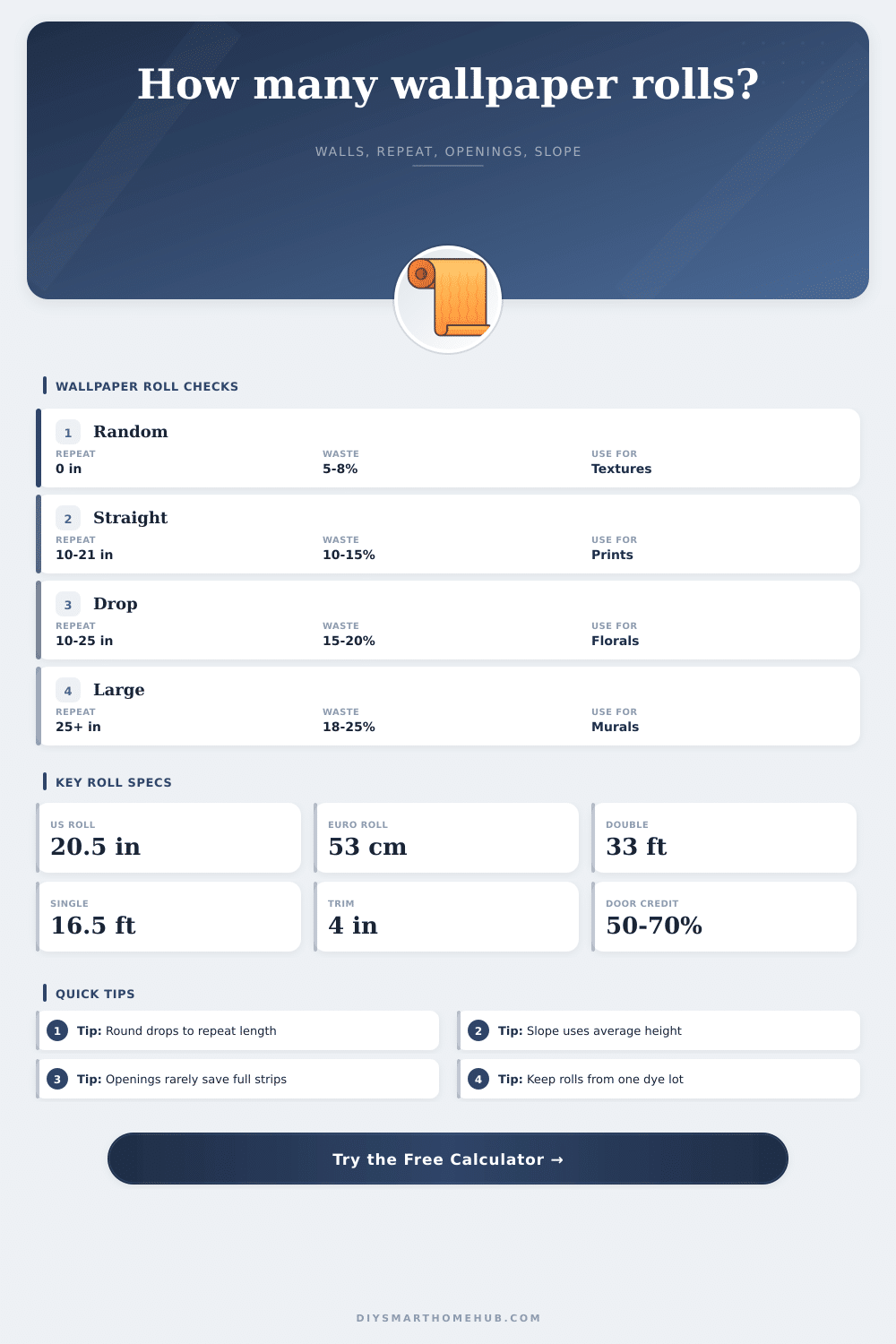
| Random / free match | No repeat rounding unless entered | 5% to 8% | Grasscloth-look, texture, solid paper |
| Straight match | Each drop rounds to the next repeat | 10% to 15% | Repeating motifs aligned at same height |
| Drop / half-drop | Rounds to repeat plus half-repeat allowance | 15% to 20% | Staggered florals, geometrics, large prints |
| Large repeat conservative | Uses repeat rounding plus added repeat risk | 18% to 25% | Oversized motifs and statement walls |
| Room or wall | Common dimensions | Likely strips | Openings note |
|---|---|---|---|
| Powder room wall set | 24 ft x 8 ft total | 15 strips at 20.5 in | Door can create usable short pieces |
| Single accent wall | 12 ft x 8 ft | 8 strips at 20.5 in | Usually no opening credit needed |
| Window wall | 14 ft x 9 ft | 9 strips at 20.5 in | Use 45% to 65% salvage credit |
| Stair or sloped wall | 15 ft x 8 ft plus slope | 9 strips plus slope allowance | High-side mode is more cautious |
| Input | Imperial meaning | Metric meaning | Used in formula |
|---|---|---|---|
| Wall width and height | Feet | Meters | Strip count and gross area |
| Roll width and repeat | Inches | Centimeters | Drop width and pattern rounding |
| Roll length | Feet | Meters | Drops available per roll |
| Openings | Square feet from width x height | Square meters from width x height | Net area and salvage credit |
🛠Calculation Tips
Until we’re all standing in the store looking at a stack of rolls, most homeowners don’t realize just how much wallpaper is needed for their walls. “Oh, it’ll only cover about 1/3 of my wall area, I can buy 2-3 rolls.” That’s assuming you aren’t also planning for gravity, pattern matching, and door geometry. Next thing you know you have a missing strip or, even worse, a bunch that doesn’t match because you ordered extra later from a different dye lot.
Properly accounting for how many rolls you need help you avoid this last minute panic. It makes your guessing game a supply chain problem with an obvious answer. That’s where this wallpaper calculator come in. It does all that math for you when you input your wall dimensions and what kind of pattern you’re using. You don’t have to figure out waste percentages or number of strips needed. Just enter some measurements and let the calculator do its thing.
How to Calculate the Right Amount of Wallpaper
First things first: stop thinking about your walls like a two-dimensional surface area. Think of it as multiple vertical strip. Wallpaper rolls come in standardized widths (typically about 20 inches). One “drop” refers to each vertical stretch from floor to ceiling. Depending on the width of your wall, you may have one drop or you may require eight, ten, etc., running vertically alongside each other. Making that mental adjustment will transform everything. You aren’t measuring square footage, you’re filling up slots.
The part all those estimates fall down on is pattern matching. You can get away with butting strips together if it’s just a plain texture. But if there’s a twenty-inch repeat with flowers in it, then you have to cut some serious length off each drop to line up the patterns. That means the calculator assume each strip is long enough to round up to the next pattern interval. So you’re left with lots of little scraps that can’t be reused anywhere else. A tiny thing, but it adds up to make the final price bigger. If you select half-drop or drop match for how your paper matches, the waste gets even greater since each new strip begins fractionally below the previous one. The reference table on the page tell you what category your paper fits into and which matching method you should enter.
And then there are ceiling slopes. There is stairs. There are vaulted ceilings. One half of your wall is higher than the other? Well, guess what: You can’t just take an average and hope it works for patterned paper. For continuity’s sake (and because you want each strip to be long enough to get all the way up to that highest point), you’d have to take the height from the high side and apply it to everything. That’s conservative but also safe. Taking the average could mean saving yourself a fraction of a roll, but it could also mean running out of paper three drops from the end. The calculator gives you the option of doing it this way. You can also take an average height, depending on if your pattern is forgiving enough or how steep your slope is.
People all too often treat windows and doors like subtraction exercises. If I have a window, I subtract its space from my overall sq ft. This fails to account for the reality that wallpaper goes up vertically. Which means if your window is smack dab in the center of a strip, then you will need to cut out that whole section. And then what happens with all the off cuts? They’re never big or long enough to use for another complete strip somewhere else on the wall. The calculator uses a percentage to estimate how much leftover material you will have (for example, if you cut 4′ from a 30′ drop, how much will be left over). Most people over-credit here. Go conservative so you don’t end up ordering one short because something shifted slightly and ate into your cushion.
Last but certainly not least, don’t neglect the trim allowance. Always allow an inch or two (or more!) at both the top and bottom so you have some room to bleed beneath your baseboards or crown molding. That means you’re adding length to all of your drops. Include extra for pattern matching, and those few inches can really add up fast on a long wall. The calculator includes all of this in the effective height of each strip before it determines the number of drops per roll. Then there’s a general waste percentage included to account for installation errors and corners. Raise that a bit if you are a new hanger. Mistakes happen less frequently with experience, but they will still occur.
Buying the right amount is less about math and more about patience. Measure slow. Examine each box’s dye lot number before exiting the store. If Roll 1 doesn’t quite match the color of Roll 3, that carefully calculated plan comes crashing down. Your eyes are the final judge, while the tool provides a starting point. You should of trusted the process, measure twice, match the lots.