UV Sanitizer Exposure Time Calculator
Estimate UVC exposure time from target dose, measured irradiance, distance derating, lamp aging, soil, shadowing, safety margin, and one-sided or two-sided treatment.
Calculation breakdown
| Target organism or goal | Planning dose | Typical surface | Calculator use |
|---|---|---|---|
| Influenza A style enveloped virus | 3.4 mJ/cm² | Smooth hard surfaces | Low-dose screening value before margins |
| SARS-CoV-2 style enveloped virus | 3.7 mJ/cm² | Glass, steel, plastic | Planning value; claims need validation |
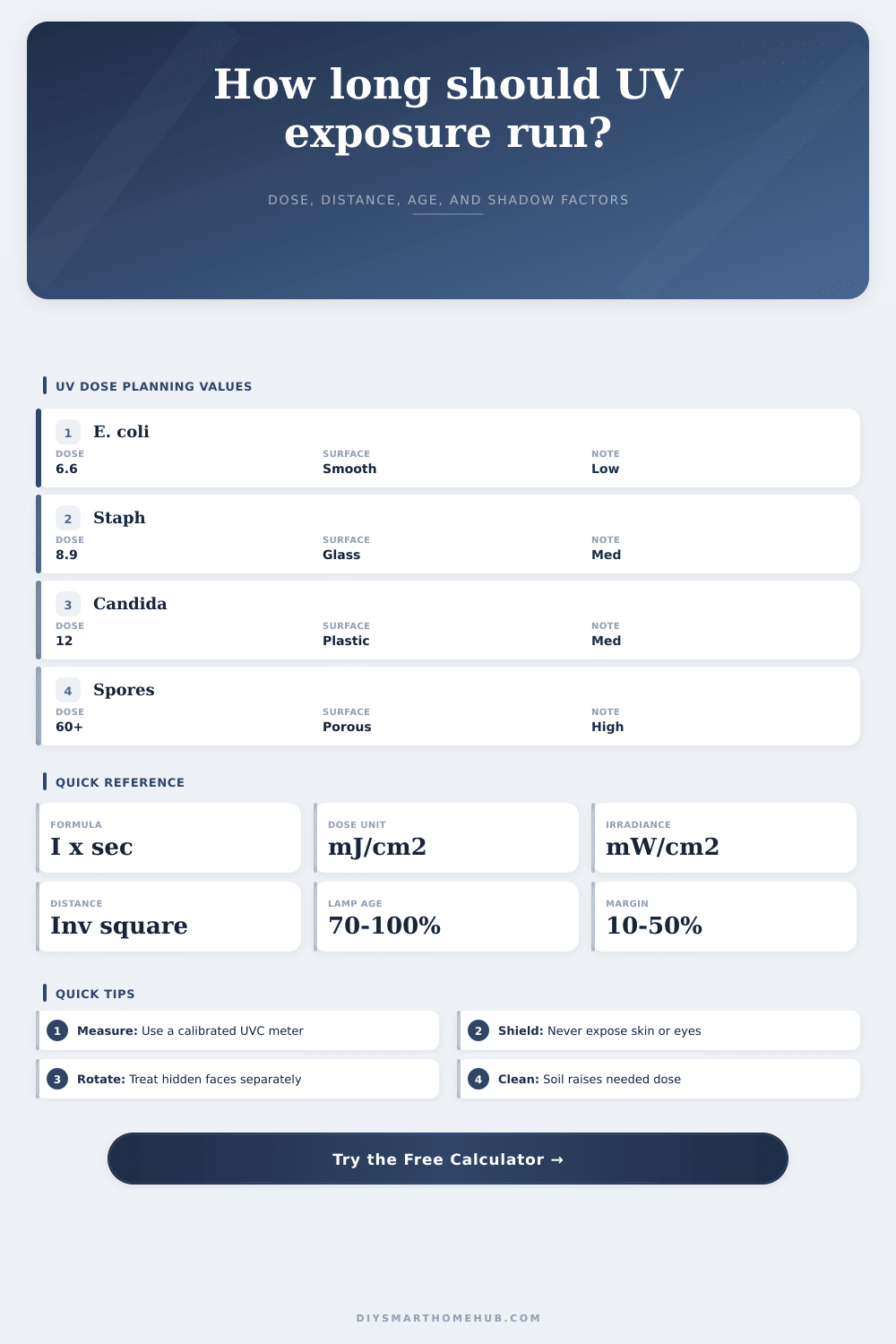
| E. coli vegetative bacteria | 6.6 mJ/cm² | Clean hard surfaces | Common bacterial benchmark |
| Staphylococcus aureus | 8.9 mJ/cm² | Phone glass, plastic, metal | Default high-touch bacteria preset |
| Candida albicans yeast | 12 mJ/cm² | Plastic, glass, ceramic | Higher resistance than many bacteria |
| Conservative high-touch surface | 40 mJ/cm² | Mixed household surfaces | Use when target data is uncertain |
| Bacterial spores | 60 mJ/cm² | Clean hard surface only | Longer exposure planning target |
| Mold spore conservative target | 100 mJ/cm² | Open flat tray or glass | High dose; avoid shadow assumptions |
| Factor | Low setting | Medium setting | High setting | Formula role |
|---|---|---|---|---|
| Distance | Reference equals work distance | Work distance 1.5× reference | Work distance 2× reference | Irradiance × (ref/work)² |
| Lamp aging | New lamp, 1.00 factor | Midlife, about 0.90 | End life, 0.70 to 0.80 | Irradiance × aging factor |
| Surface soil | Clean smooth, 1.00× | Texture or dust, 1.45 to 1.75× | Visible soil, 3.00× | Required dose multiplier |
| Shadow geometry | Flat line of sight, 1.00× | Curve or minor ridges, 1.25 to 1.60× | Deep recess, 2.10× or more | Required dose multiplier |
| Safety margin | 10% | 25% | 50% or more | Required dose × (1 + margin) |
| Two-sided cycle | One face only | Flip item, double cycle time | Opposed lamps, same clock time | Total time adjustment |
| Sanitizer type | Typical irradiance range | Distance sensitivity | Uniformity | Shadow risk | Best calculator setting |
|---|---|---|---|---|---|
| Small phone box with mercury lamp | 0.3 to 1.5 mW/cm² | Medium | Good if mirrored and measured | Low to medium | Two opposed lamps or flip item |
| LED tray or drawer | 0.05 to 0.5 mW/cm² | High near edges | Fair unless mapped | Medium | Use no reflection credit unless verified |
| Handheld UV wand | 0.1 to 2.0 mW/cm² | Very high | Operator dependent | High | Add high margin and shadow multiplier |
| Cabinet sanitizer | 0.5 to 3.0 mW/cm² | Medium | Good after dose mapping | Medium | Use chamber factor only if measured |
| Open bench lamp | 0.05 to 1.0 mW/cm² | High | Poor without fixture | High | Use direct line-of-sight only |
| Conveyor or turntable unit | 0.2 to 2.5 mW/cm² | Medium | Good when speed is fixed | Lower for simple shapes | Use rotating basket cycle style |
| Scenario | Target dose before factors | Starting irradiance | Common derates | Cycle style |
|---|---|---|---|---|
| Phone glass in measured box | 8.9 mJ/cm² | 0.45 mW/cm² | Light fingerprints, minor shadow | Two opposed lamps |
| Key ring on tray | 6.6 mJ/cm² | 0.30 mW/cm² | Metal overlaps, flip required | Flip item halfway |
| Remote control face | 3.4 mJ/cm² | 0.20 mW/cm² | Button ridges and plastic texture | One exposed face |
| Tool handle or grip | 25 mJ/cm² | 0.35 mW/cm² | Rubber texture, curved shape | Rotating basket |
| Mold-prone open tray | 100 mJ/cm² | 0.80 mW/cm² | Clean first, avoid overlap | One exposed face |
Your phone is dirty. You can’t see any dirt, but there are invisible hitchhikers still on there. You can’t see any dirt, but invisible hitchhikers remains. You put your phone in a tiny little box that shoot ultraviolet light to provide a dose to knock out germs. You wait. How long should you wait? If you wait two minutes is that enough time? Ten feels like too much.
Killing germs is not based off hope; it’s based on physics. With this calculator, you can convert your vague worry into an exact figure.
How to Calculate the Right Time for UV Cleaning
Here’s the basic idea: To kill a germ, you must deliver a certain dose of energy. Dose is measured in millijoules per square centimeter. Picture a hose. Irradiance is how hard the hose sprays (high or low pressure). And dose is how much water impacts the car. Sometimes a strong squirt cleans something, other times a slow spray for longer does just as well. The math is straightforward. It is multiplication. Irradiance multiplied by time equal dose.
Here’s where the trick come into play: the numbers on the package don’t match what you experience in your home. Manufacturers test under ideal conditions. Your living room are anything but an ideal lab. Now if you double that distance, you recieve only 1/4 of illumination. That’s right, the drop off is severe. The tool does take into account distance. You can tell it how far from the lamp you measured light and how far away your object is. Distance are important.
But time is too. UV lamps are not incandescent bulbs that remains at full brightness indefinitely. UV lamps fade. A three year-old tube will likely produce only 70% as much power than it did when first installed. Run one of those old tubes while using the factory specs for a brand new lamp, and you’ll dose your stuff way below what the spec say.
The other factor that quietly goes into play is surface texture. Light can pass through smooth glass and will kills bacteria well. Textured surfaces like a rubber grip on an appliance or even dust on your remote control trap some of the energy and prevent it from reaching target; they also cast tiny shadows. Dirty is another matter. That’s why the calculator factors in shielding due to dirt. For example, twice as long may be needed to expose a grimy surface than it does for a polished one. Not because you’re dirty, just that it takes longer for the light to do its work.
Light goes straight. It doesn’t bend around corners. So if a germy bug is lurking under a seam, it won’t find it.
This is an insurance policy in the form of safety margins. Nothing are measured perfectly. Lamp output can change. The UVC meter has tolerance ranges. The orientation changes. Twenty five percent extra isn’t being paranoid. It’s good engineering. This allows the dose delivered to be at least what is required to kill germs, even if you have a slightly off meter or a weaker lamp than expected. If not for that margin then you’re taking chances with biology.
UV light is also misunderstood as something that fills a room like heat. No, it’s more like a flashlight beam that just hits whatever it’s pointed at. That means if you have some complicated object with lots of surfaces, odds are good you’ll want to flip it over partway through the process. Halfway will get one side but leave the other half untreated. This is why the page has those reference tables to guide you in choosing where to start with various organism. Some viruses are fragile; others are tough as nails. You don’t want to waste your time trying to do a job they can never achieve, and you don’t want to leave them unchecked only to face risks later.
The idea is not to guess, but to verify. Did we deliver the needed amount of energy? If you can get the geometry right, if you consider the age of the lamp, if you can match the distance, then the math cease to be abstract. It becomes a routine you can rely on.
Close the lid, set the timer, and go about your business. Knowing it really got done. You should of used this sooner.