Smoke Alarm Replacement Date Calculator
Estimate replacement due dates, overdue days, next monthly test timing, battery reminders, and basic room/level coverage from the dates and alarm type on the label.
Alarm Schedule Results
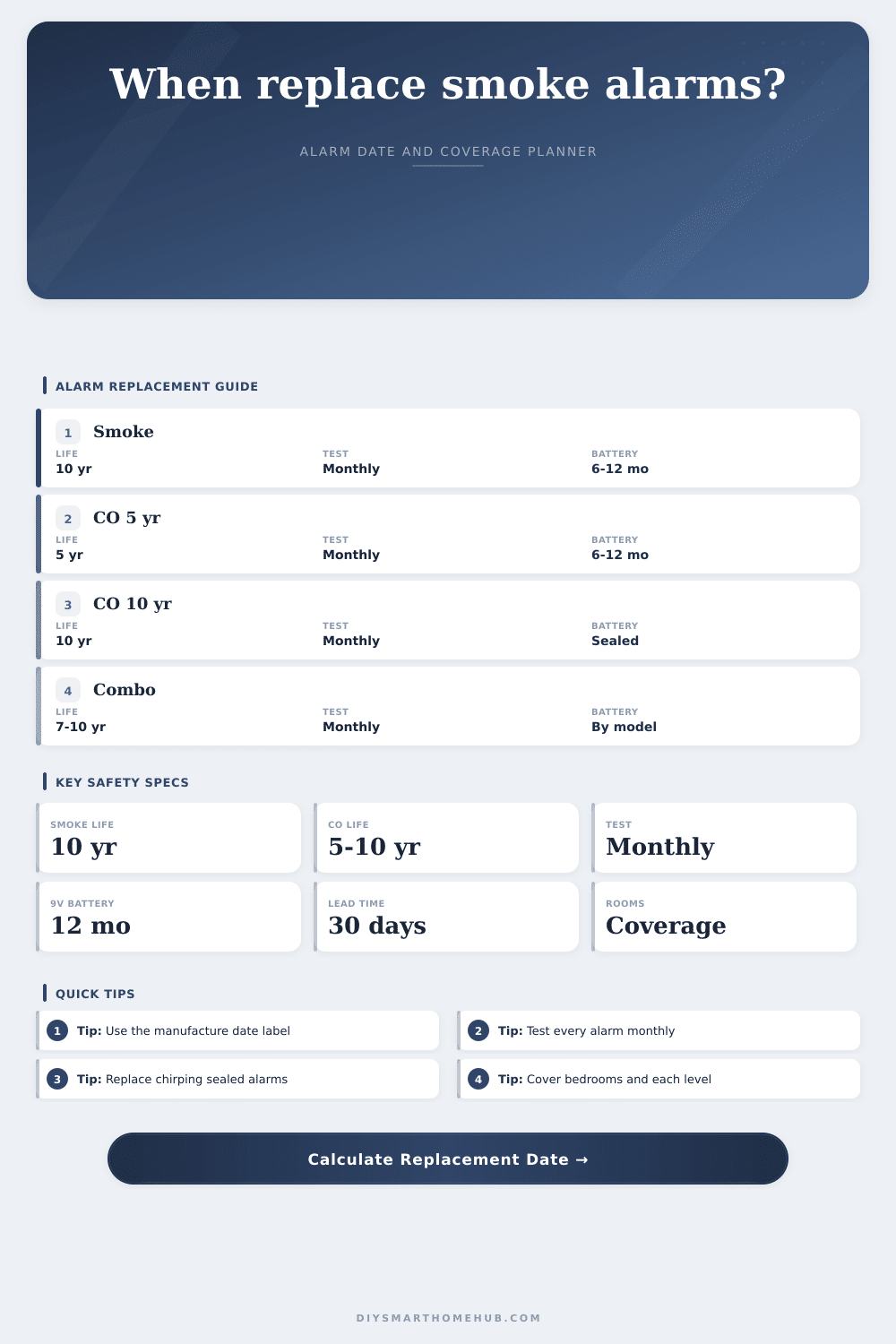
| Alarm Type | Replacement Life | Test Timing | Battery Planning |
|---|---|---|---|
| Battery smoke alarm | 10 years from manufacture date | Monthly test button check | Replaceable batteries commonly 6-12 months or when chirping |
| Hardwired smoke alarm | 10 years from manufacture date | Monthly test button check | Backup battery by manual, often annual for replaceable types |
| Carbon monoxide alarm | 5, 7, or 10 years depending on model | Monthly function test where recommended | Replaceable battery interval or sealed unit end-of-life signal |
| Combination smoke/CO alarm | Usually 7-10 years by model label | Monthly test button check | Follow model instructions for backup or sealed power |
| Location | Smoke Target | CO Target | Calculator Use |
|---|---|---|---|
| Bedrooms | One per bedroom | Near sleeping areas | Bedroom count adds directly to smoke target |
| Outside sleeping areas | One per separate sleeping area | One near each separate sleeping area | Sleeping area count is a shared target |
| Levels | One on every level | One on every level | Level count adds to smoke and CO target |
| Large homes | Additional alarms may be needed | Extra alarms may be useful near fuel appliances | Room count adds an extra zone per four surplus rooms |
Smoke Only
Uses a 10-year replacement life and smoke coverage target: bedrooms, outside sleeping areas, every level, plus large-home zones.
CO Only
Uses 5, 7, or 10 years by model and a CO target based on levels plus separate sleeping areas.
Combination
Uses the selected combo model life and the larger of smoke or CO coverage targets for a combined planning count.
We all know how to change a smoke alarm battery. But we do so after it starts beeping at us, and then we complain about it. But that irritating buzz is actualy our deadline. If you let it reach a volume that makes you uncomfortabley, it’s too late; you’ve put off replacing the thing.
There’s only one clock to pay attention to: the date on the back. Not the install date. Not the buy date. That little sticker where manufacturer sealed up the sensor? That’s the anchor.
Why You Must Check Your Smoke Alarm Dates
Every smoke or CO alarm use a sensor. Every sensor has a lifespan. It doesn’t break or change in a way we can see; it just slowly and silently becomes less effective until it stop working. Pressing the test button on your ten year old smoke detector may cause it to sound off. That means the circuit is intact, but it does not mean that if there was a fire, the sensor would of noticed it.
Enter the manufacture date into the calculator above and the math are done for you. You won’t have to guess whether you’re inside or outside of the working period.
Another wrinkle is that carbon monoxide detectors can lives very long or very short lives, depending on which one you use. Some are good for ten years, some are only five. Different manufacturers uses different sensor technologies and those will have different rates of wearing out. You need to look at the label. In fact, if you assume all CO detectors are ten year device, you could spend five years livig with dead ones on your walls and not even know it. This tool takes into account varying lives of the models, so you’ll always replace them on time for what’s actualy on your wall.
All plans fail when it comes to battery management. Most people think that when you get a new battery, it automatically has a new alarm. Wrong. It may be convenient with a sealed 10-year battery, but if it go dead, the entire unit must be replaced. Nine volt replaceable batteries should be changed annually, if not twice annually for peace of mind. The monthly test cannot be skipped: it’s the only way to know the unit is alive during an actual emergency. You can skip one month here or there, but to skip a year would be negligent. The planner help you remember these schedules so as to never rely on your memory alone.
Beyond just running the old alarms, I think many people overlook how much coverage matter. Maybe your smoke detectors are ten years old but still work fine. That’s great, but what if they’re all grouped together at the end of the hallway? That means there’s a gap. And bedrooms should be alarmed, too, plus any hallway outside sleeping rooms. Basements should also be protected, and every floor of house.
This calculator looks at how many bedrooms you have and your layout. It then determines roughly how many device you should have. It flags where you may be covered but not properly covered.
Another variable that will change things is connecting alarms. They’ll all go off if one does, waking everyone in the house. Alarms installed alone has voids of silence. It doesn’t alter the expiration date… The tool will tell you if yours are linked or not, but it adds a level of redundancy to those alarms while they still functioning. It does not extend their lives.
Local building codes in many areas specify where CO and smoke detectors must be located. As a rule of thumb, smoke detectors is placed outside all bedrooms and co detectors are located close to fuel burning appliances. This is easily explained in the reference table on that page. So no, you don’t have to memorize any codes. Just use it as an audit checklist. How does what’s currently installed line up with the recommended minimums?
This is one of those little jobs that pay huge dividends. Twenty minutes, under ten bucks, a fraction of a single evening out versus depending on an old sensor whose failure has been going quietly haywire for years now. Make a note of the date, schedule the replacement, crush the beep. That date is the anchor. That’s why you’ve got it there. Because it holds things down, and it keeps your house secure.