TV Wall Mount Weight Calculator
Check a TV wall mount against real mounting loads: display weight, mount rating, extension arm torque, stud spacing, support layout, dynamic movement, fastener demand, and safety factor.
📌Real TV Mount Presets
Loaded preset: 55 Inch Fixed. Short reach and two wood studs usually keep torque and fastener tension low.
⚙Mount Load Inputs
Full Load Breakdown
📺Mount and Display Spec Comparison Grid
📊Reference Tables
Fastener Capacity Reference
| Wall profile | Pullout | Shear | Best use |
|---|
Support Layout Comparison
| Layout | Studs | Fasteners | Torque note |
|---|
Dynamic Load Profiles
| Profile | Dynamic | Safety | Use case |
|---|
Preset Load Benchmarks
| Preset | TV | Reach | Support |
|---|
💡Calculation Notes
A televisions can range in weight from thirty pounds to over one hundred pounds, and the weight of that television will place different amount of stress upon the wall mount depending upon the way in which that mount is to be used. For instance, mounts that is used to hold televisions in a fixed location will typically have the television placed against the wall. However, mounts that include an arm that allows the television to extending away from the wall will apply more force upon the mounting hardware due to the concept of leverage.
Thus, the weight rating of the wall mount isnt the only consideration in selecting an appropriate mounting hardware for television. The calculator include several different factors that must be entered to calculate the safety factor of the mount. Such factors includes the weight of the television, the weight capacity of the mount, the reach distance of the mount, and the type of wall construction.
How to Pick a Safe TV Wall Mount
The safety factor calculator performs several calculation with these different factors. For instance, it can calculate the torque that the weight of the television will place upon the mount when the mount is extended. Additionally, it can calculate the forces upon the fasteners that will hold the mount to the wall.
Based off these calculations, the calculator will provide a governing safety factor that indicates which component of the mount will fail first. One of the factor that is considered in the calculation of the safety factor is the reach distance of the mount. The reach distance of the mount will impact the amount of torque that is placed upon the mount.
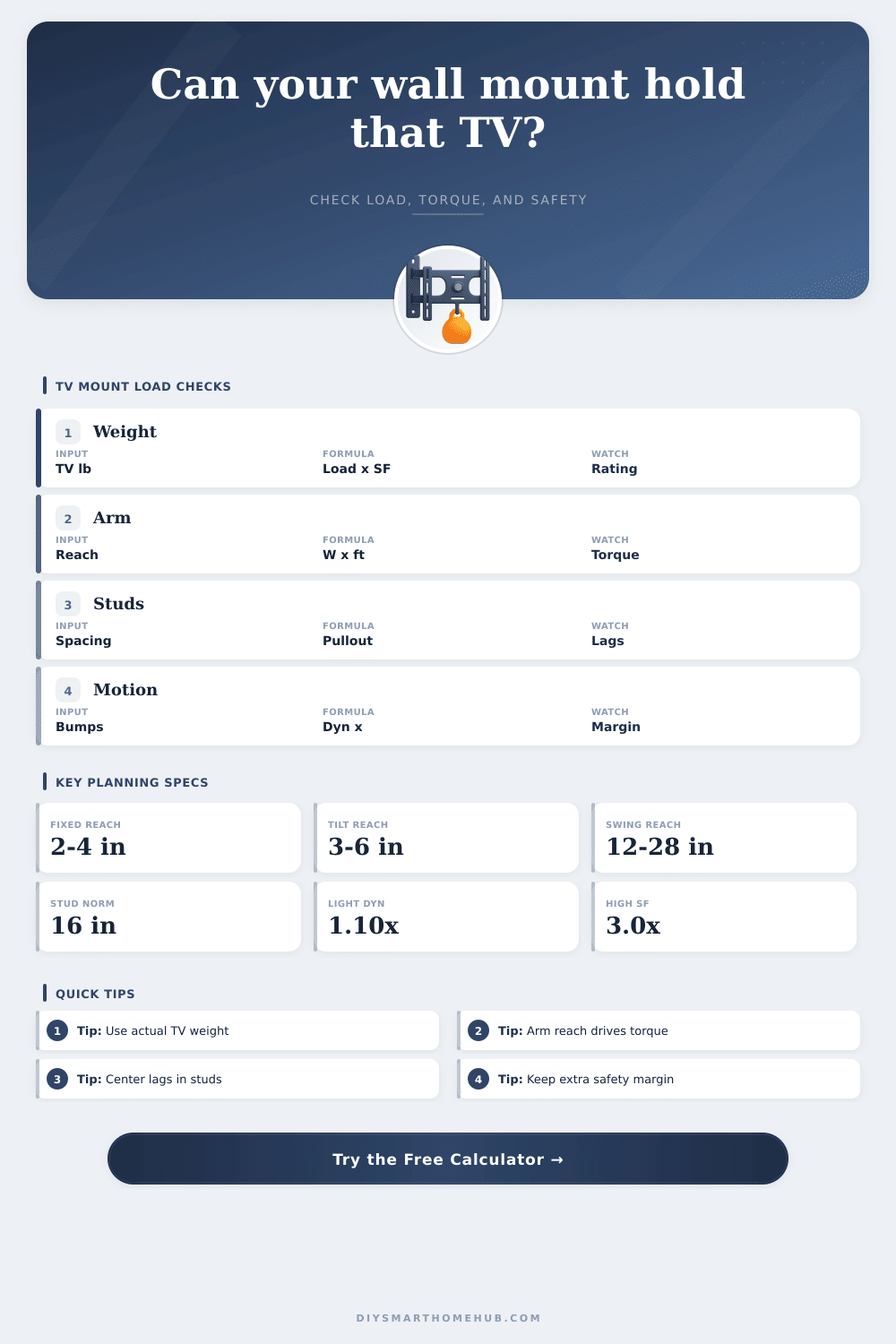
The amount of torque are equal to the weight of the television multiplied by the distance that the television will extend from the wall. For instance, a mount that includes a television positioned only three inches from the wall will experience less torque than a mount whose arm allow the television to extend much farther from the wall. Thus, the longer the arm of the mount, the more tension that will be placed upon the fasteners that attach the mount to the wall.
The weight of the television multiplied by the reach distance of the mount is the amount of torque that the mount will create, and this is one of the main reason that an arm that extends far from the wall may create a safety limit for that mount. Another of the factors that is considered is the construction of the wall into which the mount will be installed. The construction of the wall will impact the amount of weight that can be supported by the fasteners.
For instance, studs that are constructed of wood can utilize lag screws, which can exert a significant amount of force upon the wood studs. However, studs that is made of metal will require the use of toggles, which hold less weight than the lag screws that can be utilized in wood studs. Additionally, studs made of masonry will require the use of different types of anchors than the screws that is used in wood studs.
Finally, the number of studs upon which the mount is placed will impact the amount of force that is placed upon each individual fastener. For instance, if the mount is placed upon a single stud, the weight of the television will be placed upon only one fastener. However, if the mount is placed upon two studs, the weight will be distributed between two different mounting hardware components.
Another of the factors that is considered is the dynamic load of the mount. The dynamic load is a multiplier to the safety factor that is provided to account for the movement of the television. For instance, if the television is to remain stationary and the room in which it is to be placed is to remain quiet, then the dynamic load will be low.
However, if the television is to be placed in a room that experiences a great deal of movement, or if the television is to be placed outdoors, the dynamic load will be higher. Thus, the higher the dynamic load, the higher the safety factor that is required of the mount. For instance, a stationary television may only require a 2.0x safety factor, but a mount that is to experience a great deal of movement may require a 3.0x safety factor.
Thus, while these factors do not impact the weight of the television, they do impact the safety factor that is required of the mount installation. In addition to these factors, it is also necessary to consider the weight of the mount itself. The weight of the mount itself will add to the weight of the television.
For instance, a heavy mount with an articulating arm may weigh thirty pounds. This thirty-pound weight will also create a torque upon the mount. Thus, if the weight of the mount is not accounted for, the calculator will underestimate the true weight and torque of that mount.
In addition to these factors, it is also necessary to consider the published weight of the mount. The published weight of the mount is typically based upon the assumption that the mount is to be installed close to the wall. However, as the arm extends away from the wall, the capacity of that published weight decreases.
Thus, it is possible that the weight of the television will be too great for the mount of which the published weight is to be utilized. The reference tables that are provided allow for the determination of the strength of the types of studs that will be used. These tables provide information regarding dynamic profiles, which allow for the determination of the dynamic load of the mount based upon its use.
While these tables can provide the information necessary to determine the safety factor of the mount, they are not a replacement for the local building codes. In addition to the building codes, factors like the environmental factors in which the mount will be used can also impact the safety factor. For instance, if the mount will be utilized outdoors, factors like the thickness of the drywall, the presence of old holes in the wooden studs, or the type of wood that is being utilized can reduce the strength of the studs.
In these cases, it is better to utilize a higher safety factor to provide the security of the mount once it is installed upon the studs of the wall. You should of checked the weight of the furnitures before you start. It isnt always easy to recieve the right measurements.
Its also important to make sure you dont use a mounting hardware that is too small. There is alot to think about when you are installing a tv. Use the modern tables to make sure you are safe.