Thermostat Cycles Per Hour Calculator
Check observed HVAC cycles, average runtime, thermostat deadband, outdoor temperature, load ratio, mode, system type, and equipment stage against practical CPH ranges.
🏠Thermostat cycle presets
Choose a field pattern, then replace the readings with your own one-hour observation. Runtime means average minutes the equipment stayed on during each cycle.
⚙Cycle observation inputs
Thermostat cycling result
The observed cycle rate is being compared with the selected HVAC type, deadband, load, and stage.
▦Thermostat and HVAC spec grid
Typical forced-air furnace cycle band before field adjustments.
Runs below this can point to oversizing, airflow, or control issues.
A narrower setting raises the expected cycle count.
Single-stage equipment uses the base target band.
📊Reference tables
Typical thermostat cycles per hour by system
| System type | Typical CPH | Minimum runtime | Normal reading |
|---|---|---|---|
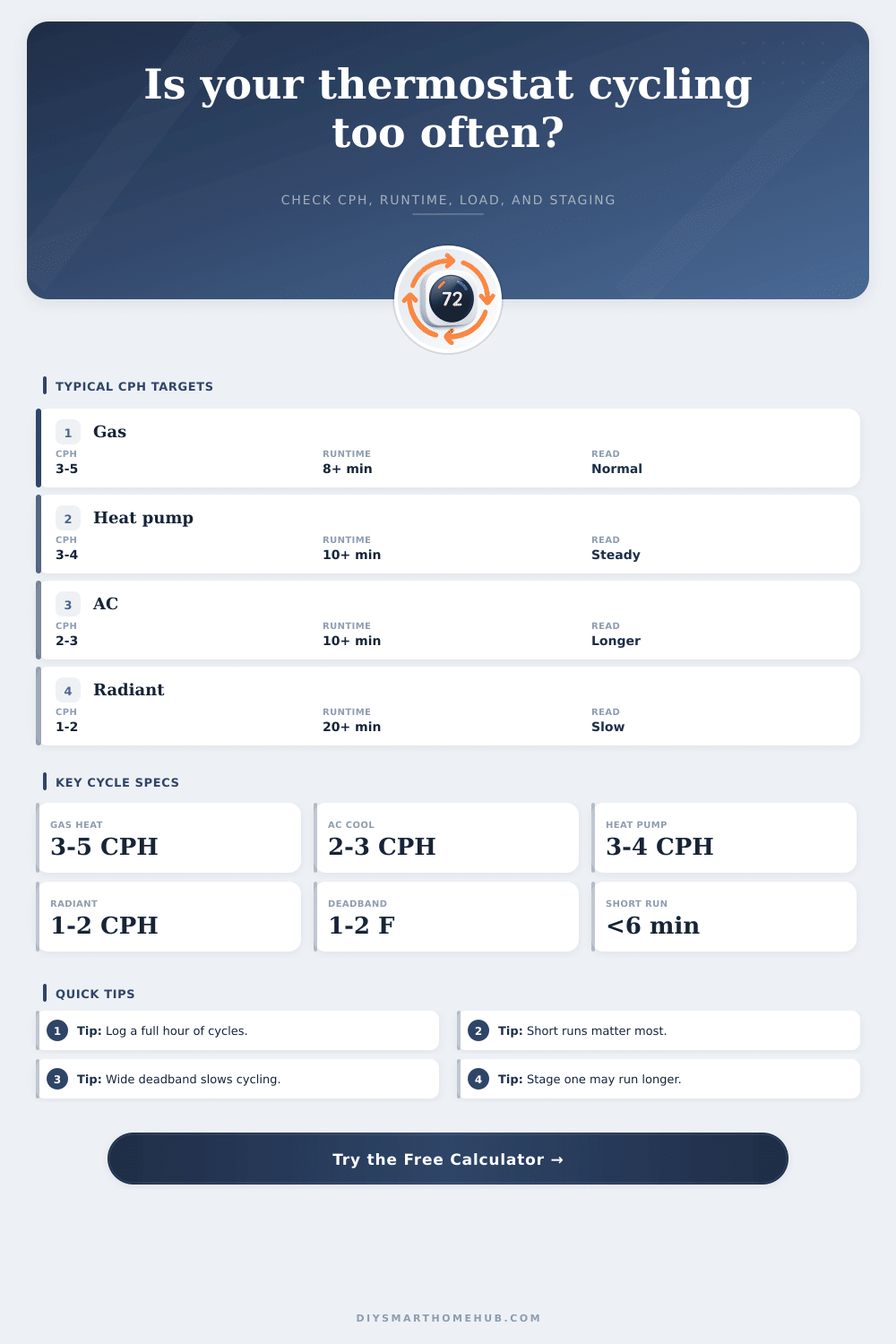
| Gas forced-air furnace | 3 to 5 | 8 minutes | Several moderate runs per hour with off time between starts. |
| Oil furnace | 2 to 4 | 10 minutes | Fewer starts are usually preferred because burners like longer operation. |
| Air-source heat pump | 3 to 4 | 10 minutes | Steady low-stage operation is normal in mild to cold weather. |
| Central air conditioner | 2 to 3 | 10 minutes | Longer runs improve coil stability and moisture removal. |
| Radiant floor or slab heat | 1 to 2 | 20 minutes | Slow thermal mass should not react like forced air. |
| Variable-speed mini-split | 1 to 3 | 15 minutes | Low output may run nearly continuously with few hard starts. |
Deadband and thermostat behavior
| Deadband | Cycle effect | Comfort effect | Best match |
|---|---|---|---|
| 0.3 to 0.5 F | High CPH | Very tight temperature hold | Use carefully with variable equipment or smart algorithms. |
| 0.7 to 1.2 F | Standard CPH | Balanced comfort | Common forced-air thermostat differential range. |
| 1.5 to 2.0 F | Lower CPH | More temperature swing | Useful for slow systems or when starts are too frequent. |
| Over 2.0 F | Very low CPH | Noticeable swing | Better for radiant mass than quick forced-air zones. |
Load ratio and outdoor temperature interpretation
| Load ratio | Expected duty | Outdoor clue | Cycle reading |
|---|---|---|---|
| 0.10 to 0.35 | 10% to 30% | Mild day | Short cycling is easier to expose because the load is small. |
| 0.35 to 0.70 | 30% to 55% | Normal day | Moderate CPH with useful runtime is the usual target. |
| 0.70 to 1.00 | 55% to 80% | Near design | Longer runtime is expected; frequent stops are less desirable. |
| 1.00 to 1.50 | 80% to 95% | Severe day | Continuous or near-continuous operation can be normal. |
Common one-hour observation examples
| Observation | Cycles | Runtime | Duty | Likely read |
|---|---|---|---|---|
| Balanced gas furnace | 4 | 9 min | 60% | Normal if comfort and airflow are stable. |
| Rapid forced air | 8 | 4 min | 53% | High starts and short runtime deserve attention. |
| AC long dehumidifying run | 2 | 22 min | 73% | Normal on a warm, humid afternoon. |
| Radiant slab heat | 1 | 40 min | 67% | Slow cycle pattern matches thermal mass. |
💡Cycle interpretation tips
Your Thermostat should be thought of as a conductor, not just a light switch. Just like you don’t want a light to come on if it’s not needed, neither do you want to run your heating and cooling 24 hours a day, 7 days a week. Your thermostat controls the air flow, electricity usage, humidity levels and mechanical wear of your HVAC system.
Until there is an issue with your system most people don’t really pay attention to how many times their system comes on. Maybe the house gets drafty? Or maybe your energy bill skyrockets for no apparent reason. Maybe you start noticing the furnace kick on every few minutes. That’s what we call cycles per hour. It can be the difference between being comfortabley cool or feeling like you live in a machine.
Why You Should Check Your Thermostat Cycles
This gives you the tool to understand what that means. And no, you don’t have to be a HVAC tech to use it. All you’ll need is roughly an hour’s time and a stopwatch. Sit in the room where the thermostat is located, start the stopwatch, and listen for the compressor hum or the burner igniting, these indicate the unit has actualy started, rather than just the fan circulating air. How long does it run? At what point does it shut off entirely? Record these figures then input them, plus your outdoor temperature and system type, into the calculator. It will tell you if your equipment is running efficient or working too hard.
To make sense of the data, it’s important to know how many times other systems should cycle. For instance, a gas furnace typically fires between three and five times per hour when weather is moderate. That’s enough time for the heat exchanger to reach full operating temperature before shutting off. Not only does this save energy, but it also maintains better air quality inside the house. So if your gas furnace is firing eight times per hour with brief spurts of warmth, there’s probably something wrong with its sizing (perhaps an oversized unit) or where you’ve located the thermostat.
A radiant floor heating system, on the other hand, operate very slowly. The concrete slab heat storage takes hours to shift temperatures, so expect one or two cycles per day at most. Don’t get the idea that you can force a radiant system to act like a forced-air furnace. You’ll be looking for issues that don’t exist.
Perhaps the most overlooked factor when considering home comfort is the thermostat deadband, or the range of temperatures between one equipment turn-on and the next turn-off. Half a degree deadband is tight; it’s going to keep the temperature constant, but it’ll make the equipment start up a lot. If you widen it even by a little bit, you drastically decrease how many times the system cycles (with a tiny amount of added air temp variation). Moddern thermostats allow you to adjust the differential, and tweaking this setting will oftentimes correct short cycling problems without calling out a repair man. It’s not much, but it alters the whole operating profile of your home climate control.
This also goes back to what’s normal and that’s very dependent on outdoor conditions. On a mild spring day, for instance, seeing a heat pump come on three times per hour is no cause for alarm; it’s doing exactly what it should do. But seeing it cycle four times per hour in deep winter suggests something’s probably not right. It might be trying to use an expensive auxiliary electric heat strip instead of just relying on the heat pump. The calculator takes into account your outdoor temperature input and provides context about whether the cycle rate you see matches the expected demand for your home. In other words, if you’re seeing rapid cycling on a mild day, then the issue is likely internal to either the equipment itself or its controls, not some extreme weather condition demanding it turn on.
The more often you start it up, especially for short durations, the quicker your tools will wear out. Motors and compressors see a ton of abuse from frequent startups, which means you’ll have more repairs and replacements sooner then later. Ideally, you want your air compressor running long enough that it has time to reach its best performance before shutting off. Check for airflow restrictions. Clean or replace filters. Check sensor locations, making sure they are not right in front of a drafty window or directly exposed to sunlight. Your tool might be telling you something is wrong with runtime if it’s too short.
At its core, then, this is about comfort, which means it’s more about the consistency of things than specific numbers. Every home is different. Every day is different. The calculated benchmarks aren’t a strict set of rules, but a point of reference to help keep your sanity when checking how your system is behaving. So if it falls somewhere in that ballpark and your house seems comfortable, congrats, you’re probably in good shape. If it’s way out on either end, there’s often some easy solution just waiting to be seen. And listening to that mechanical rhythm can tell you more about what’s going on with your home than any individual temperature read will.