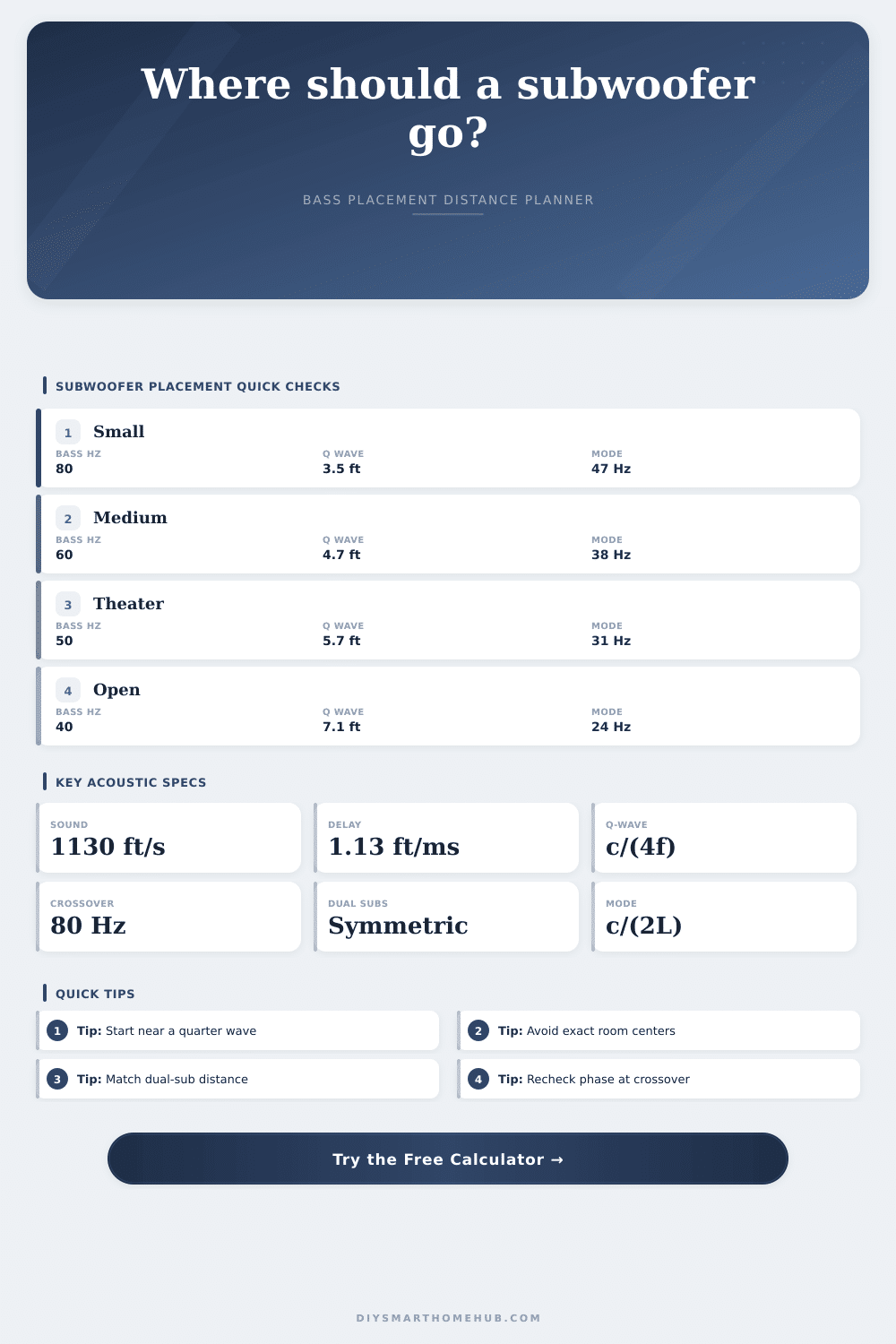
DIYSmartHomeHub bass geometry planner
Subwoofer Placement Distance Calculator
Estimate quarter-wave wall distance, axial room modes, phase delay, crossover wavelength, and dual-sub symmetry from room size, bass target, crossover, and listening position.
Quarter-wave distance
0 ft
c / (4f)
Closest room mode
0 Hz
axial mode comparison
Phase delay
0 ms
distance / 1.13 ft per ms
Crossover wavelength
0 ft
c / crossover Hz
Formula breakdown
Distance from a wall that corresponds to one quarter of the chosen bass wavelength.
Axial mode frequency for one room dimension, repeated for length, width, and height.
Approximate acoustic travel speed used for distance-to-delay alignment.
Crossover wavelength gives a scale for phase rotation near the speaker handoff.
Quarter-wave distance by bass frequency
| Frequency | Quarter wave | Half wave | Use case |
|---|---|---|---|
| 40 Hz | 7.1 ft / 2.15 m | 14.1 ft / 4.31 m | Deep bass placement scale |
| 50 Hz | 5.7 ft / 1.72 m | 11.3 ft / 3.44 m | Theater subwoofer tuning |
| 60 Hz | 4.7 ft / 1.44 m | 9.4 ft / 2.87 m | Common room-mode overlap |
| 80 Hz | 3.5 ft / 1.08 m | 7.1 ft / 2.15 m | Typical AVR crossover |
| 100 Hz | 2.8 ft / 0.86 m | 5.7 ft / 1.72 m | Small speaker handoff |
Axial room mode examples
| Dimension | Mode 1 | Mode 2 | Placement note |
|---|---|---|---|
| 10 ft | 56.5 Hz | 113 Hz | Avoid exact center seating |
| 12 ft | 47.1 Hz | 94 Hz | Watch square-room stacking |
| 14 ft | 40.4 Hz | 81 Hz | Often near 80 Hz handoff |
| 18 ft | 31.4 Hz | 63 Hz | Can shape main bass punch |
| 24 ft | 23.5 Hz | 47 Hz | Large-room deep mode |
Placement pattern comparison
| Pattern | Symmetry | Mode spread | Best check |
|---|---|---|---|
| Single front | Low | Simple | Quarter-wave front gap |
| Corner-loaded | Low | Strong boundary gain | Modal peak control |
| Dual front | Medium | Width averaging | Equal listener distance |
| Opposing mid-wall | High | Length averaging | Mirror coordinates |
| Quarter-wall pair | High | Broad averaging | Width and length offsets |
Crossover wavelength and delay scale
| Crossover | Wavelength | 1/4 cycle | 1 ft delay |
|---|---|---|---|
| 60 Hz | 18.8 ft / 5.74 m | 4.7 ft | 0.88 ms |
| 70 Hz | 16.1 ft / 4.92 m | 4.0 ft | 0.88 ms |
| 80 Hz | 14.1 ft / 4.31 m | 3.5 ft | 0.88 ms |
| 90 Hz | 12.6 ft / 3.83 m | 3.1 ft | 0.88 ms |
| 100 Hz | 11.3 ft / 3.44 m | 2.8 ft | 0.88 ms |
If there’s one piece of advice to remember here, it’s this: You can spend as much money as you want on the world’s best subwoofer, but if you put it in the wrong spot, it’ll still sound muddled. Low frequencies are weird; they bend around corners in counterintuitive ways. They gets absorbed by walls, floors, and even furnitures. What seems like thunder in one corner may dissapears completely just a few feet away. That’s what makes geometry far more important then flashy claims.
Fortunately, the calculator above do all the hard work, converting abstract acoustics into real-world distances you can actualy measure using a tape.
Why Subwoofer Placement Matters
So what’s going on? The idea centers around that quarter-wave distance. Because sound waves bounce off of walls, when a direct wave encounter a reflection that is out-of-phase, it cancels itself out. You get these dead spots as a result. If you place a subwoofer exactly one-quarter of the wavelength of your target frequency from the wall to your listening position, you will often find a sweet spot where the reflection add to the sound instead of subtracting from it.
The tool figures that out based off the speed of sound, which, it turns out, changes a little depending on room temperature. Seems like no big deal…but because a warmer room moves sound faster than a colder one, it shifts the critical nodes. That’s why there’s an input for temperature. It is a small detail but it brings the math to life in your real-world environment.
The larger issue are the room modes. Each room has inherent natural frequencies based off its dimensions (height, width, length). Any time a bass note coincide with one of those frequencies, the sound pressure increases. Any time it doesn’t line up with any of them, the sound pressure decreases. That’s what makes one movie sound boomy while another sound thin.
The calculator tell you what the lowest axial modes are in your space. If one of the major ones is right on top of your crossover frequency, then you’re in trouble. There is no tuning around that with just a subwoofer. You must change either the seating position or the speaker position. The reference table on the page explain this in clear terms and shows how shifting dimensions shifts these troublesome frequencies.
Dual subwoofers are a whole new ballgame. One speaker has been shown to excite room modes in a different way compared to two speakers, which basically smooths out the peaks and valleys of the listening area. With two subs, the calculator look for symmetrical positioning of both subs. So if your left sub sits four feet away from the front wall while the right sub sits six feet, then there’s an imbalance in phase that will muddy up the bass.
The tool accounts for this by measuring path difference to your ears. When the distance is close enough where the waves line up, that’s when it’s in sync. Otherwise, you’re hearing blur. The tolerance setting allow you to set the precision level required. If you’re listening casually, a few inches may not make a difference. If you’re doing critical monitoring, every inch matter.
The last piece of the puzzle is Phase alignment: your sub and main speakers should arrive at your ear simultaneously. The calculator will provide an estimate for the acoustic delay, which is simply distance divided by the speed of sound. That means that if your sub is behind your main speakers, it will require a delay in your receiver to “catch up”. And if it’s ahead, then it would of need a lead. You can crudely alter this with the phase knob on your sub, but a much better solution is digital delay in your AV receiver. The tool will help show you whether or not your physical setup will require a large delay adjustment.
High frequencies gets absorbed by furniture and carpet, while bass barely touches them at all. Geometry is nearly everything when placing subs.
Six inches. Try it. Repeat.
Dual subs need to be placed symmetrically to avoid phase imbalance and blur. The numbers on that calculator will provide a starting place, not a finish line. It will tell you the most likely places for nodes. Then you use your ears to determine whether or not it feels like the node.
Numbers first, trust the math. Then your hearing.
The way I look at bass is that we hear it but also feel it. Felling the difference is what’s important. Remember, you’re shaping the air in the room. Get the distance correct, and the air shapes back.