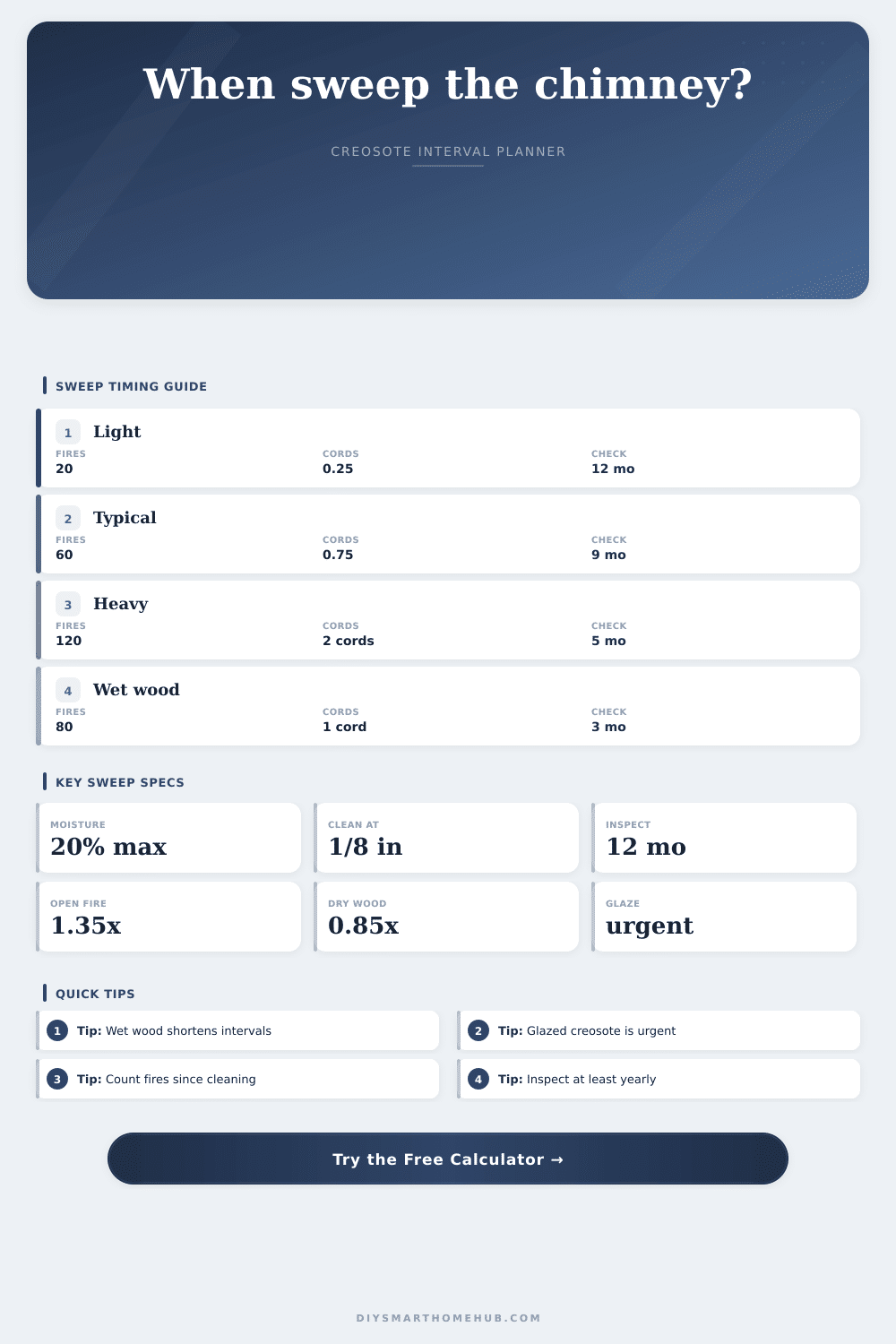
Chimney Sweep Interval Calculator
Estimate when to sweep a chimney from fires burned, cords used, wood moisture, appliance type, visible creosote, and the last cleaning date.
Your Chimney Sweep Plan
| Appliance | Base fire limit | Base cord limit | Risk factor | Planning note |
|---|---|---|---|---|
| Open masonry fireplace | 50 fires | 0.50 cord | 1.35x | More room air and cooler flue gases |
| Fireplace insert | 90 fires | 1.50 cords | 1.10x | Watch liner and connector deposits |
| EPA wood stove | 120 fires | 2.00 cords | 0.95x | Cleaner burns when operated hot |
| Older airtight wood stove | 85 fires | 1.25 cords | 1.30x | Low air settings can load deposits |
| Pellet stove vent | 160 fires | 2.50 cords | 0.75x | Ash service still matters |
| Gas fireplace | 180 fires | 3.00 cords | 0.45x | Inspect for venting and blockage |
| Condition | Low | Typical | High | Calculator effect |
|---|---|---|---|---|
| Wood moisture | 15% or less | 16-20% | 26%+ | 0.85x to 1.90x risk |
| Burn style | Hot bright | Mixed | Smoldering | 0.90x to 1.55x risk |
| Visible deposit | None | Flaky | Glazed | Immediate due override |
| Chimney path | Straight | Offset | Exterior cold | 1.00x to 1.25x risk |
| Scenario | Fires | Cords | Moisture | Typical interval |
|---|---|---|---|---|
| Holiday fireplace | 10-20 | 0.10-0.20 | 16-20% | Annual inspection, sweep if deposits show |
| Weekend fireplace | 25-45 | 0.25-0.50 | 16-20% | 9-12 months |
| Primary wood heat | 120-180 | 2.00-4.00 | 15-22% | 2-6 months |
| Wet wood season | 60-100 | 0.75-1.50 | 26%+ | 1-3 months |
But don’t wait till winter to think about having your chimney cleaned (the heat of the fire makes you want to be cozy… and then you forget about all the build-up). Creosote isn’t like soot, it’s a gunk that’s more like a thick, flammable resin that forms on your chimney flue walls when smoke cools down too much inside the chimney. The problem with creosote? It builds up without being seen… Until it’s too late. So using a calendar as your only guide will put you at risk.
Once you know how much you use, the calculator above do the rest. You enter your burn habits and it does the math for you. This saves you from guessing if you went over safety limit.
How to Know When to Clean Your Chimney
Chimney-sweeping is typically considered to be a time-based process: One year goes by and boom, time to get checked. While that’s true with an oil change, that’s not more true with a wood stove. Chemistry and volume dictate what kind of buildup your appliance create, not just the rotation of the Earth. To account for this, the tool asks how many cords of wood you’ve burned and how often you’ve lit fires since last time it was cleaned. It depends on how hard you’re working your appliance.
Maybe you’re burning a couple cord a month because you’re heating a cabin during winter. You could go from zero to heavy duty in five months. It’ll show you that time crunch on the page under a reference table, and if you ignore that tightening of schedule, well, now you’re at risk of a chimney fire right when things are coldest and darkest.
Wood moisture is a silent multiplier. The problem amplifies when you burn damp wood; you’re putting out the same amount of heat, but it’s going to produce more water vapor, which condenses on inside of your cool flue and binds with the tar to form glazed creosote, a tough-to-remove material that’s also combustible as all get-out. It is not just a pain. When moisture climbs over twenty percent, the risk factor increase dramatically on the calculator. And that isn’t some made-up number, it’s the threshold at which the combustion byproducts change from dry ash to sticky, unsafe stuff. Burning green wood? Storing firewood in an unventilated shed? Think of it this way: you’re basically doubling your hazard without knowing it.
The type of appliance is just as important as the fuel. Open masonry fireplaces draws in room air and hold onto cool flue gases, causing deposits to form quickly. Newer EPA-certified stoves burns cleaner and hotter, which allows for longer service periods. The tool automaticly accounts for those factors. It recognizes the need to pay special attention to a vent for a pellet stove versus an older, airtight stove that’s set to smolder through the night. That prevents your chimney from staying clean. Low-temperature burns like this don’t fully combust, leaving behind heavy tars that cling to tile and brick. If you tend to burn with low flames for coziness rather then hot, bright ones, then you’re increasing the rate at which buildup occurs.
The end cost estimate depend on access. That’s one variable. But that doesn’t alter the requirement for safety. The sweep may be more costly if your chimney has a complex flue or a very steep roof, but that won’t change how much creosote has built up over years. Don’t give in to sticker shock: don’t cancel a visit because of money.
Glazed creosote beats every calculation. When the pro eyes that shiny, sticky substance, it means now, not later. Not even a little bit later.
This is the bottom line. It’s about more than following a rule. It’s about knowing what your own risk profile is. You have a number from the calculator, but what really protects the house is that knowledge of how you burn, which fuels you use, and whether or not you’ve tracked your fires. Dry your wood, burn hot, and then when to call the pro, that’s something the numbers will tell you. The fire warms the home, the sweep protects it.