Smart Speaker Stereo Pair Spacing Calculator
Calculate stereo speaker spacing from the listener triangle, room width, side clearance, wall distance, toe-in, and time-alignment delay for paired smart speakers.
Run the calculator to see the fitted stereo pair layout.
Small sealed or DSP-heavy speakers can start closer to the wall, but corners still narrow the stereo image.
Most tabletop smart speakers behave better when the front-wall reflection is not extremely early.
Symmetric side clearance keeps the left and right reflections closer in timing and tone.
A centered seat should be near zero path mismatch; off-center seats may need app delay compensation.
| Calculation | Formula | What it means | Good planning range |
|---|---|---|---|
| Speaker spacing | 2 x depth x tan(angle / 2) | Center-to-center distance between the left and right speakers. | 50° to 70° stereo angle |
| Equilateral triangle | spacing = 2 x depth / sqrt(3) | At 60°, speaker spacing equals each speaker-to-listener path length. | Default music reference |
| Toe-in angle | atan((spacing / 2) / depth) | Angle each speaker turns inward if aimed directly at the listener. | 25° to 35° common |
| Room width limit | room width - 2 x side gap | Maximum practical spacing after side-wall clearance is reserved. | Keep both sides equal |
| Delay difference | path difference / speed of sound | Time offset created by an off-center listening seat or uneven placement. | Below 1 ms ideal |
| Room scenario | Listener depth | Target angle | Ideal spacing | Placement note |
|---|---|---|---|---|
| Desk or small office | 3 to 5 ft / 0.9 to 1.5 m | 50° to 60° | 2.8 to 5.8 ft / 0.9 to 1.8 m | Small changes in offset create visible delay differences. |
| Bedroom or compact den | 6 to 8 ft / 1.8 to 2.4 m | 55° to 60° | 6.2 to 9.2 ft / 1.9 to 2.8 m | Side-wall clearance usually sets the upper limit. |
| Living room sofa | 8 to 11 ft / 2.4 to 3.4 m | 55° to 65° | 8.3 to 14.0 ft / 2.5 to 4.3 m | Use symmetric side gaps before widening the stage. |
| Open plan lounge | 11 to 15 ft / 3.4 to 4.6 m | 50° to 60° | 10.3 to 17.3 ft / 3.1 to 5.3 m | Voice pickup and group sync may matter as much as geometry. |
| TV console pair | 7 to 10 ft / 2.1 to 3.0 m | 50° to 60° | 6.5 to 11.5 ft / 2.0 to 3.5 m | Front-wall clearance often limits bass smoothness. |
| Check | Formula basis | Interpretation | Calculator output |
|---|---|---|---|
| Temperature-adjusted sound speed | 331.3 + 0.606 x C m/s | Warmer air slightly reduces milliseconds per foot or meter. | Used for path and reflection delays. |
| Closer-speaker compensation | absolute path mismatch / sound speed | Add delay to the speaker with the shorter acoustic path. | Rounded to selected app step. |
| Front-wall reflection gap | 2 x front clearance / sound speed | Very short reflection delays can make placement sound less spacious. | Shown as milliseconds and equivalent distance. |
| Boundary cancellation estimate | sound speed / (4 x wall distance) | Rough first notch from the wall behind the speakers. | Useful for checking too-close placement. |
| Side-wall image path | mirrored speaker path - direct path | Compares first side reflection timing against the direct speaker path. | Shown for the nearer side-wall reflection. |
You have two of the same smart speaker. That’s not about getting a larger volume knob; it’s about enjoying stereo sound. And yet here we are, attempting to plunk these things into an actual room filled with furnitures, walls and yes, even that damn chair your dog insists isn’t going anywhere.
Geometry plays a big role in creating stereo imaging. Without the right triangle of the two speakers relative to your ears, the music will be flat and disjointed. Tight focus can feel cramped while wide separation may lack clarity. Getting the spacing correct matter more than you might think.
How to Place Your Smart Speakers
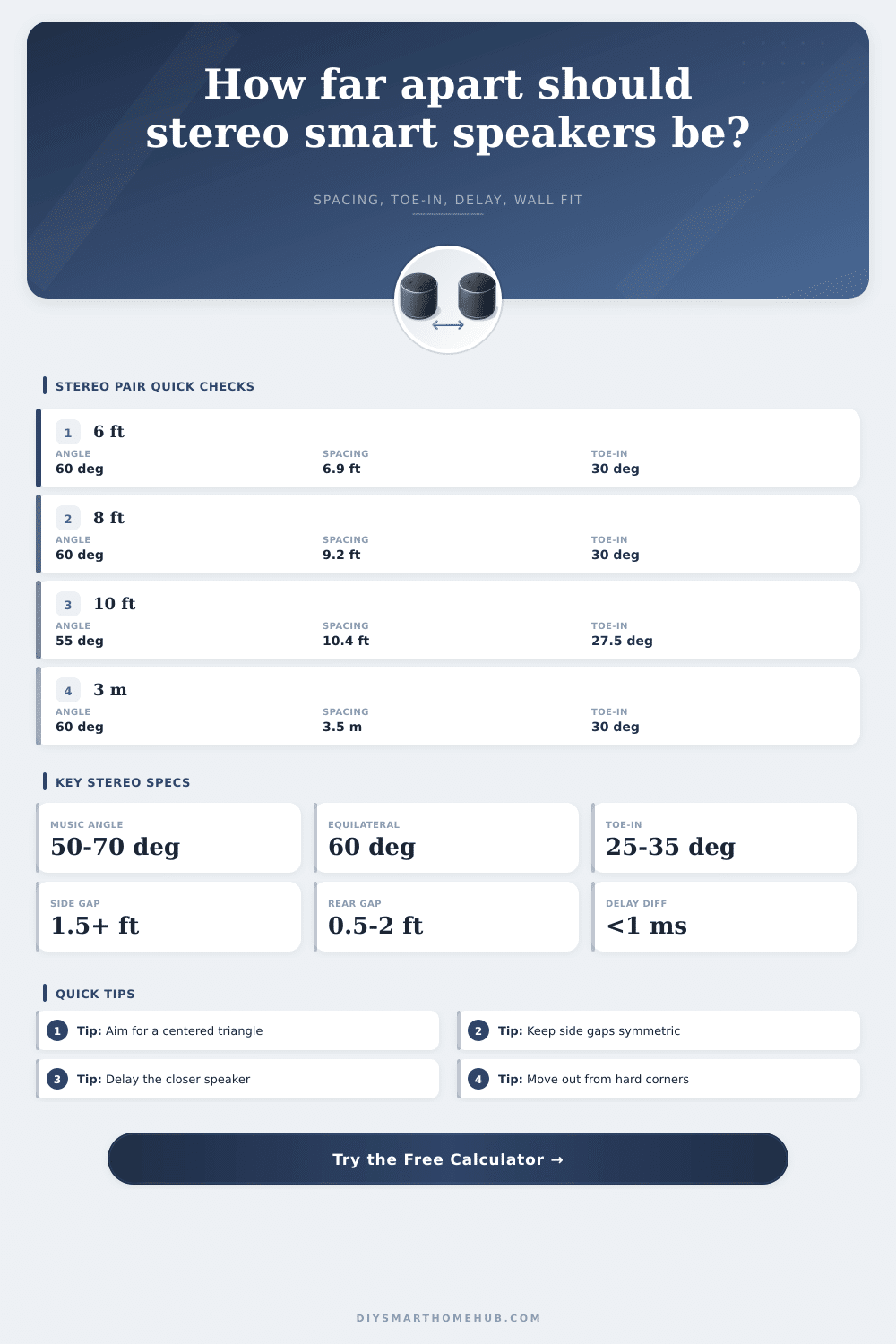
So if you’re not sure whether your set up will match that perfect equilateral, then don’t guess, just use the calculator above that does the math for you when you enter your room constraints and distance to listener. Generally speaking, sixty degrees is what most audio guide suggest for your speaker angles at the point of listening. That establishes an equilateral triangle with approximately equal sides. Why? It approximates the way we naturaly perceive sources in space. Want to get closer to the speakers? Make them narrow. Go further away? Spread them wider. Enter your desired depth and angle into the tool and it’ll adjust to match.
Another factor that catches folks out is toe-in. Pointing the speakers directly forward isn’t enough; they need to be angled slightly inward, toward your ears. That’s what makes the center image feel tighter. Vocals seem to emanate from one point between two driver instead of being spread around the room. Angle the speakers too far inward, and the image can sound closed in and narrow. Not enough, and it gets blurry and diffuse. For most living rooms, the calculation suggest an angle depending on your seating distance and speaker spacing; a place to start tuning by ear. Typically, it’ll fall somewhere between 25 and 35 degrees.
Everything gets complicated by walls, which reflect sound immediately and almost instantaneously. That means that if you set a speaker against a side wall, it’s going to return some of the sound to the room before the direct signal has even reached you, messing with timing and changing the frequency response. Your goal is to have enough space between your speakers so that these early reflections stay at bay. The chart below sets this out nicely in its reference table, where minimum gaps are indicated based off the type of speaker. Larger drivers requires more space to breathe and let their low frequencies spread out without being blocked by walls. Mini speakers can get away with being closer together.
But what if you don’t sit smack dab in the middle? That’s a timing issue. Because of that physical distance, one speaker will be further away from you. Sound travels approximately a thousand feet per second. A couple of feet becomes several milliseconds, which means a real amount of time before the sound reaches your ear. That time smears out the sharp sounds and weakens the stereo image.
Fortunately most moddern smart speakers let you digitally adjust delay in their respective apps. The tool calculates exactly how much delay to add to the closer speaker to align arrival times. It even accounts for air temperature, as warmer air causes sound waves to travel slightly faster. And don’t fret if you can’t nail down every measurement within millimeters. Floors aren’t perfectly flat, rooms aren’t perfect rectangles, and that’s OK. The measurements serves as a guide. Adjust based on what feels right. And if pushing the speaker up against the back of a table isn’t practical but results in some slight off-axis angle, so be it.
Now listen to something you know well. Are the vocals dead-center? Did you get it too wide or too narrow? If so, adjust the toe-in accordingly. Do things sound muddy? Back the speaker off the wall until they doesn’t. In the end, it’s not about nailing the numbers per se, it’s about understanding how distance impacts the wavefronts that reach your ears. Geometry first; then trust your ears.