Smart Kettle Boil Time Calculator
Estimate kettle heat-up time from water mass, specific heat, temperature rise, altitude-adjusted boiling point, kettle wattage, heating efficiency, vessel thermal mass, keep-warm power, and standby draw.
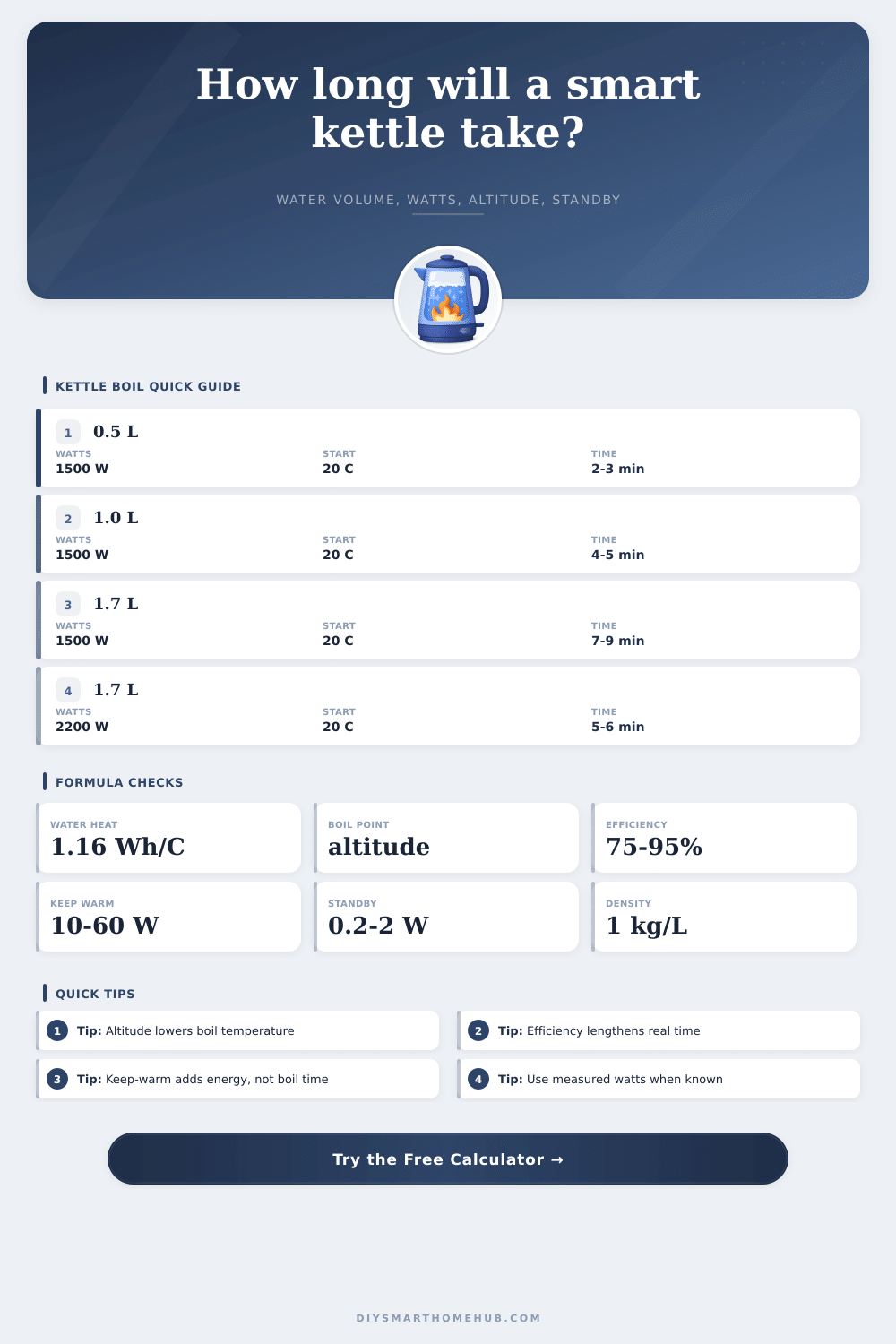
Core formula: water Wh = water kg x 4.186 kJ/kg C x delta C / 3.6. Heat-up time uses input Wh divided by kettle watts, so efficiency below 100% increases required electrical energy and minutes.
Boil-time examples at sea level
| Water | Start | 1500 W at 88% | 2200 W at 88% |
|---|---|---|---|
| 0.5 L / 16.9 fl oz | 20 C / 68 F | about 2.9 min | about 2.0 min |
| 1.0 L / 33.8 fl oz | 20 C / 68 F | about 5.8 min | about 4.0 min |
| 1.5 L / 50.7 fl oz | 20 C / 68 F | about 8.7 min | about 5.9 min |
| 1.7 L / 57.5 fl oz | 20 C / 68 F | about 9.8 min | about 6.7 min |
Altitude and target setpoints
| Altitude | Boil point | Use case | Calculator behavior |
|---|---|---|---|
| 0 ft / 0 m | 100.0 C / 212 F | Full boil | Targets 100 C in boil mode |
| 2500 ft / 762 m | about 95.0 C / 203 F | Mountain home | Stops at lower boiling point |
| 5000 ft / 1524 m | about 90.0 C / 194 F | High altitude | Reduces required delta T |
| Custom setpoint | 60-95 C common | Tea or formula | Clamps above local boil point |
Body allowance data
| Selection | Approx mass | Specific heat | Wh per C |
|---|---|---|---|
| Light plastic body | 0.20 kg | 1.30 kJ/kg C | 0.07 Wh/C |
| Stainless steel body | 0.35 kg | 0.50 kJ/kg C | 0.05 Wh/C |
| Glass body | 0.55 kg | 0.84 kJ/kg C | 0.13 Wh/C |
| Ceramic body | 0.75 kg | 0.84 kJ/kg C | 0.18 Wh/C |
Smart-kettle power modes
| Mode | Typical power | Affects time? | Affects energy? |
|---|---|---|---|
| Heat-up | 800-2200 W | Yes | Yes |
| Keep warm | 10-60 W average | No, after target | Yes |
| Standby idle | 0.2-2 W | No | Yes over hours |
| Sensor lag buffer | 0-20% extra | Yes | Yes |
Whether we are making coffee in the morning, there is always question of temperature: We want it hot, but not so hot that it scorches our beans. We want process to be fast, but we have our limits. Precision is something a smart kettle provides, but most people approach it like any old tap, rather than a tool designed specifically to handle heat. That changes once you understand what makes it tick. Suddenly, its no longer about guesswork; it’s all about controlling time and energy with purpose.
The primary variables is temperature change and water mass. It’s easier to heat half a liter of water to a boil then it is to push a full liter up just twenty degrees. You don’t have to know any unit conversion factors or specific heat coefficients; the calculator do that math for you. With larger volumes of water, each degree are even more important. For example, why waste your time and electricity waiting for a full liter to boil when youre only brewing a six-ounce shot of espresso?
How Smart Kettles Work
Altitude complicates things and we tend to forget about this factor until our drink taste flat. In places with low air pressure, such as at higher elevations, water boils at a lower temperature, which means your kettle will shut off earlier. This isn’t a bug… It’s physics. The device senses the elevation you entered and sets its target boiling point to match.
At higher altitudes… Such as in Denver or a mountain cabin, you won’t hit two-hundred twelve degrees Fahrenheit. And if you pretend otherwise, you’ll make confused assumptions about how fast timer should be running and wind up making under extracted drinks. Get the altitude right and youre aiming at temperature achievable, not just one that might exist theoretically.
What you don’t see is that there’s a hidden cost to any boil: inefficiency. Even the best kettles dont transfer all their electrical energy to water. Some is lost heating up the kettle’s body, some is vented with the steam, and some escapes from the sides. A plastic body might shed less thermal inertia than a heavy ceramic vessel, affecting how much power are needed to reach the initial rise. Fifteen percent of the electricity go toward heating up the surrounding air, leaving only eighty-five percent to actualy warm up the water.
And this makes a difference if youre attempting to maximize your efficiency, or simply curious about how much each boil will add to your daily electric bill. Another thing to consider for the energy equation is keep-warm functions. After water heats to setpoint, the appliance will switch over to low-power to maintain that temp. It may draw just a few watts, like perhaps thirty, but those accumulate over time, especially if you use machine for hours. Even worse is standby power, which silently draws power while youre away at work or sleeping. Connected modules and small LEDs is always drawing power.
If your appliance has a standby draw, check out how much it is so you can calculate whether you want to leave it plugged in overnight for convenience vs. This is a matter of cost. Cost.
At the bottom of the page are some reference tables: handy reference tests for everyday situations. They indicates roughly how long different wattages should take; check that your machine falls comfortabley inside what’s expected. Five minutes to boil a liter? Okay, maybe your 1500W kettle do. Seven minutes? Something isnt right there, either local voltage is lower than normal (under load), or mineral deposits have mucked up the heating element. This is a good way to test your gear and know if something is out of whack, with no special tools required.
But how do I know? How can you know? That’s why your smart kettle isn’t just about the kettle itself. It’s only as good as the inputs you provide it. If you don’t account for efficiency losses, if you don’t consider the altitude, if you don’t know the amount of water, then all of that makes machine a bit dumb. It is a tool to fight rather than work with. A smart kettle helps you get through the day quicker and more smoothly once you learn to read the numbers.