Soundbar to Seating Distance Calculator
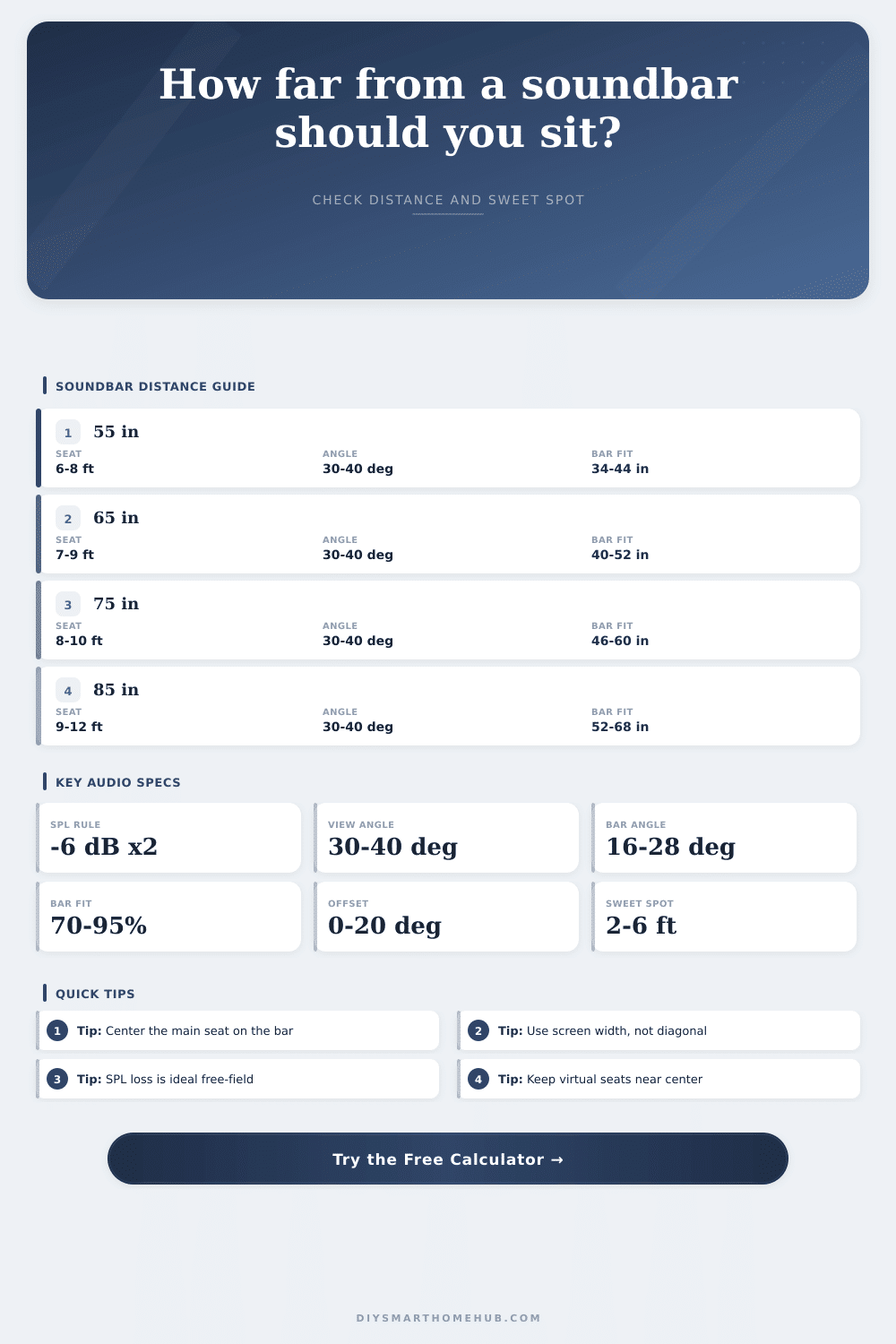
Estimate the best seating distance for a soundbar and TV by combining screen viewing angle, soundbar width, acoustic listening angle, SPL distance loss, room volume, seating offset, and virtual surround sweet spot width.
Formula breakdown
| Check | Formula | Inputs | Meaning |
|---|---|---|---|
| Screen seating distance | screen width / (2 x tan(view angle / 2)) | Screen width, target horizontal viewing angle | Computes the seat distance for 30, 36, or 40 degree viewing angles. |
| Soundbar width vs screen | bar width / screen width x 100 | Physical bar width, calculated screen width | Compares soundbar size to TV width; 70 to 95 percent is a common visual fit band. |
| Listening angle | 2 x atan(bar width / (2 x distance)) | Bar width and seat distance | Shows how wide the soundbar appears acoustically from the listener. |
| SPL distance loss | SPL2 = SPL1 - 20 x log10(d2 / d1) | Reference SPL, reference distance, seat distance | Free-field inverse-square estimate; rooms and processing can change real results. |
| Room size | width x depth x height | Room dimensions | Classifies room volume and checks whether the seat is too close to the rear wall. |
| Virtual sweet spot | 2 x distance x tan(off-axis limit) | Distance and profile off-axis angle | Estimates the centered seating width where virtual effects remain believable. |
| Profile | Bar angle target | Off-axis limit | Usual room fit | Planning note |
|---|---|---|---|---|
| Basic 2.0 or 2.1 bar | 18 to 28 deg | 12 deg | Small to medium rooms | Works best with centered seats and moderate distance. |
| Wide stereo processing | 16 to 26 deg | 15 deg | Medium living rooms | Can tolerate a slightly wider sofa while preserving front image focus. |
| Atmos or DTS:X virtualized bar | 14 to 24 deg | 18 deg | Small to medium rooms with clear center seat | Virtual effects usually narrow as seats move off center. |
| Bar with wireless surrounds | 12 to 24 deg | 25 deg | Medium to large rooms | Surround speakers widen the useful seating area behind the main bar. |
| Compact bedroom bar | 22 to 34 deg | 10 deg | Short-distance rooms | Closer seating helps small bars create useful stereo separation. |
| Premium multi-driver bar | 14 to 24 deg | 20 deg | Medium and large rooms | Wider driver spacing and processing can support a wider main sofa. |
| Scenario | TV and bar | Seat distance | Listening angle | Sweet spot | Expected constraint |
|---|
You purchase an enormous, eighty-five inch TV. Why? To feel as though you’re in the film. Then you install a nice, thirty-six inch soundbar below it. And you relax into your couch.
What’s wrong with this picture? Immediately. Oh, the image is gorgeous; totally immersive. But where’s the sound? Thin. Distant. Strangely centered. Out-of-step with what you see. Was the equipment purchase a mistake? Not necessarily. Usually, it’s a matter of geometry. Viewers tend to size their rooms by diagonal inches for the screen, while forgetting about sound pressure levels and sound output of the speaker array at different distances, which affect both sense of visual immersion as well as sound.
Find the Perfect Spot for Your Home Theater
So when you enter your bar width and TV size into the calculator (above), it runs the numbers for you so you don’t have to guess if your room would work acoustically. It takes into account soundbar spread plus viewing angles, then it gives you a seat position that meets the needs of both your ears and eyes. And that’s what most folks do wrong. They go after that sweet spot for the picture and think the sound just falls into place too. It almost never does (not without some purpose about it).
Forget the diagonal size of your screen; focus on the width. Where’s the best place to look? The footprint of any given sixty-five-inch television is fixed horizontally, and therefore so is your best viewing cone. For true cinema style immersion, industry standards recommend a viewing angle between thirty and forty degrees from center. If you are too close, you have to move your eyes around to see the whole frame. If you are too far away, the picture lacks detail and the emotional impact fade. The tool will convert all of this geometric data into a recommended range for distance, giving you a clear idea where the end of your adult-sized sofa belongs.
Okay, so what about the soundbar? A skinny two-point system isn’t going to behave like a larger and wider stereo processing bar. Without needing to rely as much on digital upmixing, the latter’s wider physical grille allow for an even wider soundstage spread. This prompts the calculator to measure the ratio between the width of your screen and the width of the soundbar. Move the bar as far back as you can, if it’s too small in relation to the TV, the resulting audio image will still feel pinched. Make sure the sound source covers at least a good part of the screen to create a unified experience.
Another silent killer for home theater systems is sound pressure loss. Ideally in an open space, every doubling of distance between you and the source results in a 6dB decrease in volume. That is, the farther away you sit from the speakers (five versus ten feet), the greater the amplification needed. To calculate it, the tool assume a reference output of one meter from the bar and allows you to choose how loud you want to listen. It will then estimate the dB drop due to increasing distance from the source. Based off that estimation, if you have a lot of distance from the speaker to where you’re sitting, you may have to turn up your settings or scoot closer, because turning the amp up usually creates more distortion.
The sweet spot is key to any virtual surround effect. Virtual surround relies upon algorithms which project phase shifts and time delays, but these line up properly only when you’re in the center of an arc. Based on your position relative to the bar, and its simulated sound profile, the width of that arc (and thus the size of the sweet spot) is defined by the calculator. Sit off-center, or have a long sofa. The phantom channels unravel, the immersive halo evaporates, and it sounds like a flat mono wash. Before shelling out for new gear, make sure your existing setup allows for such effects.
Another factor often overlooked is the volume of the room. Will it sound different in a small bedroom with an eight-foot ceiling compared to a larger open-plan living room with vaulted ceilings? To account for this, the tool uses the height, width, and depth to provide you with a realistic expectation as to how hard your equipment must work. It’s not simply about how loud the speakers can get; it’s about how the space interacts with that energy.
But it’s all balancing acts. On one side you’ve got the screen, which ideally wants you to sit close enough to fill your peripheral vision. And on the other side you’ve got the soundbar, which ideally wants to sit as far from your ears as possible (so the stereo image can expand); but still within earshot for maximum clarity. That overlap is where you find the sweet spot, where technology is absorbed by experience, and a bunch of gadgets become part of a cohesive home theater. When you’re in that spot, you stop noticing the separation between sight and sound; you’re just there with the movie.
It could of been more simple if the speaker was better.