Solar Heat Gain Through Window Calculator
Estimate how much solar heat enters through glass, then compare that window load with the room's existing indoor heat load.
📌 Window Load Presets
📐 Window And Room Inputs
Solar gain is calculated from exposed glass area, irradiance, SHGC, orientation, tilt, and shade. The indoor heat load input lets you see how much the window changes the room load.
📊 Solar Heat Gain Results
🔎 Glazing Spec Grid
🧮 Calculation Formulas
📋 Reference Tables
| Glazing type | Typical SHGC | Typical shade coefficient | Best calculator use |
|---|---|---|---|
| Clear single pane | 0.70 to 0.80 | 0.95 to 1.00 | Older windows with high solar heat |
| Clear double pane | 0.55 to 0.70 | 0.90 to 1.00 | Uncoated insulated glass |
| Low-E solar control | 0.25 to 0.40 | 0.85 to 1.00 | Cooling-dominant rooms and west glass |
| Low-E passive gain | 0.45 to 0.60 | 0.85 to 1.00 | Winter solar gain with better insulation |
| Triple pane low-E | 0.18 to 0.35 | 0.85 to 1.00 | Low transmitted heat and lower conduction |
| Exterior solar screen | Glass value | 0.35 to 0.65 | Reducing solar load before it reaches glass |
| Orientation | Factor | Peak behavior | Calculator note |
|---|---|---|---|
| North or diffuse | 0.35 | Mostly sky brightness | Use for shaded or indirect glass |
| East | 0.78 | Morning peak | Bedrooms and kitchens can warm early |
| South | 0.88 | Midday peak | Overhang shade can change the result |
| West | 1.00 | Late-day peak | Often the hardest cooling condition |
| Horizontal skylight | 1.12 | High sky exposure | Tilt and shade coefficient matter most |
| Shade condition | Coefficient range | Typical source | Input choice |
|---|---|---|---|
| Unshaded direct sun | 0.95 to 1.00 | Sun on full pane | Use 1.00 |
| Interior blinds | 0.70 to 0.85 | Slats, roller shade, curtain | Use 0.75 |
| Exterior screen | 0.40 to 0.65 | Solar mesh outside glass | Use 0.55 |
| Awning or balcony | 0.25 to 0.55 | Deep exterior overhang | Use 0.45 |
| Tree shade | 0.35 to 0.70 | Filtered seasonal shade | Use 0.60 |
| Common window scenario | Area | SHGC | What to watch |
|---|---|---|---|
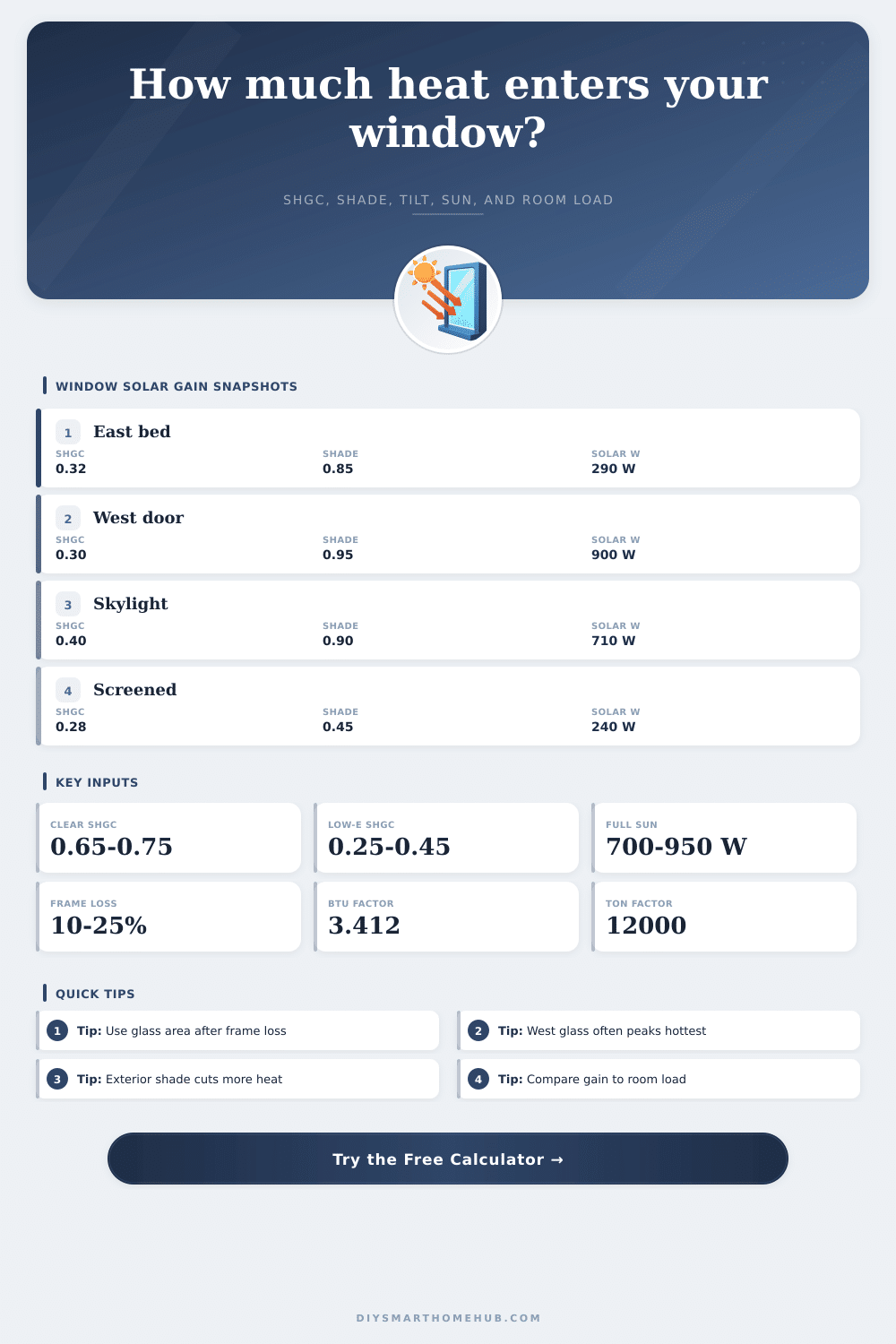
| Bedroom pair | 28 ft² | 0.32 | Morning heat can start early |
| Patio slider | 72 ft² | 0.30 | Large west glass can dominate load |
| Skylight group | 24 ft² | 0.40 | Tilt raises effective exposure |
| Sunroom wall | 180 ft² | 0.42 | Solar load may exceed indoor load |
| Screened condo | 64 ft² | 0.28 | Exterior shade changes the result quickly |
💡 Practical Calculation Tips
There’s something about the late afternoon in which I get uncomfortable. After a long day inside, the outside wall has been baking all day. Suddenly, the house is stuffy, hot and feels like an oven. Despite a thermostat set at seventy two degrees, the air itself feel heavy and warm. It isn’t a coincidence; it’s solar heat gain on west facing glass with no protection.
Why do most folks think the issue are their air conditioner? They’re convinced it must be busted or just too small. In reality, it’s not as complicated to figure out what’s wrong…but it’s harder to solve. You’re battling physics across a sheet of glass that was made to let light in, not keep heat out.
How to Keep Heat Out of Your House
The Solar Heat Gain Coefficient (SHGC) is an important number to know: it indicates the amount of solar radiation passing through the window which then gets converted into heat within your building. If it’s a high number, the window function more like a greenhouse lens; if it’s a low number, the glass has been coated to reflect much of that energy away from your space.
Knowing what all these numbers mean will help you make better decisions before purchasing new windows, it runs the math for you based on the dimensions of your particular space and shading (input those variables into the calculator above). But understanding the inputs helps you make better choices before you even buy new windows, which changes how you look at that beautiful large picture window in the living room.
The orientation of your building is much more important than many people think. The angle of the sun also shifts during the day, so if you have an east window, it receive morning sun, which is manageable because house has cooled down overnight. You can lessen this with some trees or overhang to reduce the effect.
West facing glass however, is the problem child, since the sun hits it when the outside air temperature is already at its daily peak and then you add to that the high irradiance of direct sunlight hitting the window glass. This overload most conventional AC units, which are unable to keep pace with the cooling load. For west glass, you want a very low sun-heat gain rating (anything higher than a zero point four on a west exposure will get you in trouble come summertime).
The solution is shades. Shade does make a huge difference. But it’s just exterior ones, as interior ones don’t do as good job (you’ll see why in a second). The sun is already through your window’s glass by the time light reaches your white roller shade. An exterior solution like an overhang, awning or screen will block it from hitting the window at all, keeping the space cool inside. And, the table on the page spells it out: it shows how significantly the load decreases when shaded properly, because that’s what the data proves.
It’s no small feat either. A single exterior screen can reduce your heat from the sun by over 50%! That makes a world of difference both in comfort and to your electricity bill. You’d be tempted to think you’d get better results upgrading your windows instead of spending money on a screen, but in fact, screens often win out in terms of peak heat reduction: they target the root cause of the issue.
I also see estimates that are mucked-up by frame fraction. People take their measurement of the whole window unit and assume all of it is useful. But remember, the frame portion blocks some of the potential gain, so it’s just not letting light through. The true exposed area is what you want… So take away 10-25% for the frame material. With big windows, huge sliding doors, or sunrooms, those lost square feet turn into hundreds of watts of extra heat when you factor that into your calculation.
Accuracy matters because if you don’t account for these things, your cooling load will be higher or lower then it actualy is. Keep in mind that there are other sources of heat in the room. For example, people using their laptops or a stove cooking dinner will also add watts to the space. So the combined load is higher. In this example, maybe the sun contributes five hundred watts while your activities indoors add only two-hundred, so windows are no longer your largest source of heat. They’re the dominant one. Because the sky is contributing more than anything else, your AC must work harder: It needs to offset the main source of gain.
This context can help you determine whether upgrading your glazing makes sense (or rather, if improved shading would of have greater effect). The question becomes: Where do you get the greatest bang for buck?
In short, windows are a compromise between performance and view. You don’t want heat (free or otherwise) but you do want light. So you tweak the variables: orientation; coating; shade. That way you get light without the heat so the space is still usable. Having control means you are not uncomfortable, letting you let the sun in when you want it and bounce it off when you don’t. That balance turns what used to be a baking room into a comfortable space, and you won’t have to turn up the thermostat until your power company calls you about using too much energy.