Soaker Hose Runtime Calculator
Estimate bed area, target gallons, hose output in GPH per foot, pressure derate, total adjusted flow, and watering runtime for raised beds, rows, borders, shrubs, and smart valve zones.
Calculation breakdown
| Soaker hose type | Rated output | Rated pressure | Runtime behavior |
|---|---|---|---|
| Low-flow porous hose | 0.4 GPH/ft | 10 psi | Slow, even watering for shallow boxes |
| Standard porous soaker hose | 0.6 GPH/ft | 10 psi | Good default for raised beds and rows |
| Medium output soaker hose | 0.8 GPH/ft | 10 psi | Shorter runtime when the bed absorbs well |
| High output soaker hose | 1.0 GPH/ft | 10 psi | Best kept in shorter zones |
| Flat fabric soaker hose | 1.2 GPH/ft | 8 psi | Fast output, sensitive to pressure changes |
| Heavy porous rubber hose | 1.5 GPH/ft | 10 psi | High flow for shrubs or deep border beds |
| Inline dripline used as soaker | 0.5 GPH/ft | 20 psi | More stable when pressure-compensating |
| Watering depth | Gallons per 32 sq ft | Gallons per 100 sq ft | Typical soaker use |
|---|---|---|---|
| 0.35 in | 7.0 gal | 21.8 gal | Seedlings or surface refresh |
| 0.50 in | 10.0 gal | 31.2 gal | Light maintenance watering |
| 0.75 in | 15.0 gal | 46.7 gal | Moderate vegetable bed soak |
| 1.00 in | 19.9 gal | 62.3 gal | Standard deep weekly watering |
| 1.25 in | 24.9 gal | 77.9 gal | Dry raised bed or fruiting crops |
| 1.50 in | 29.9 gal | 93.5 gal | Deep recharge for hot weeks |
| Bed setup | Hose length | Water target | Approx runtime |
|---|---|---|---|
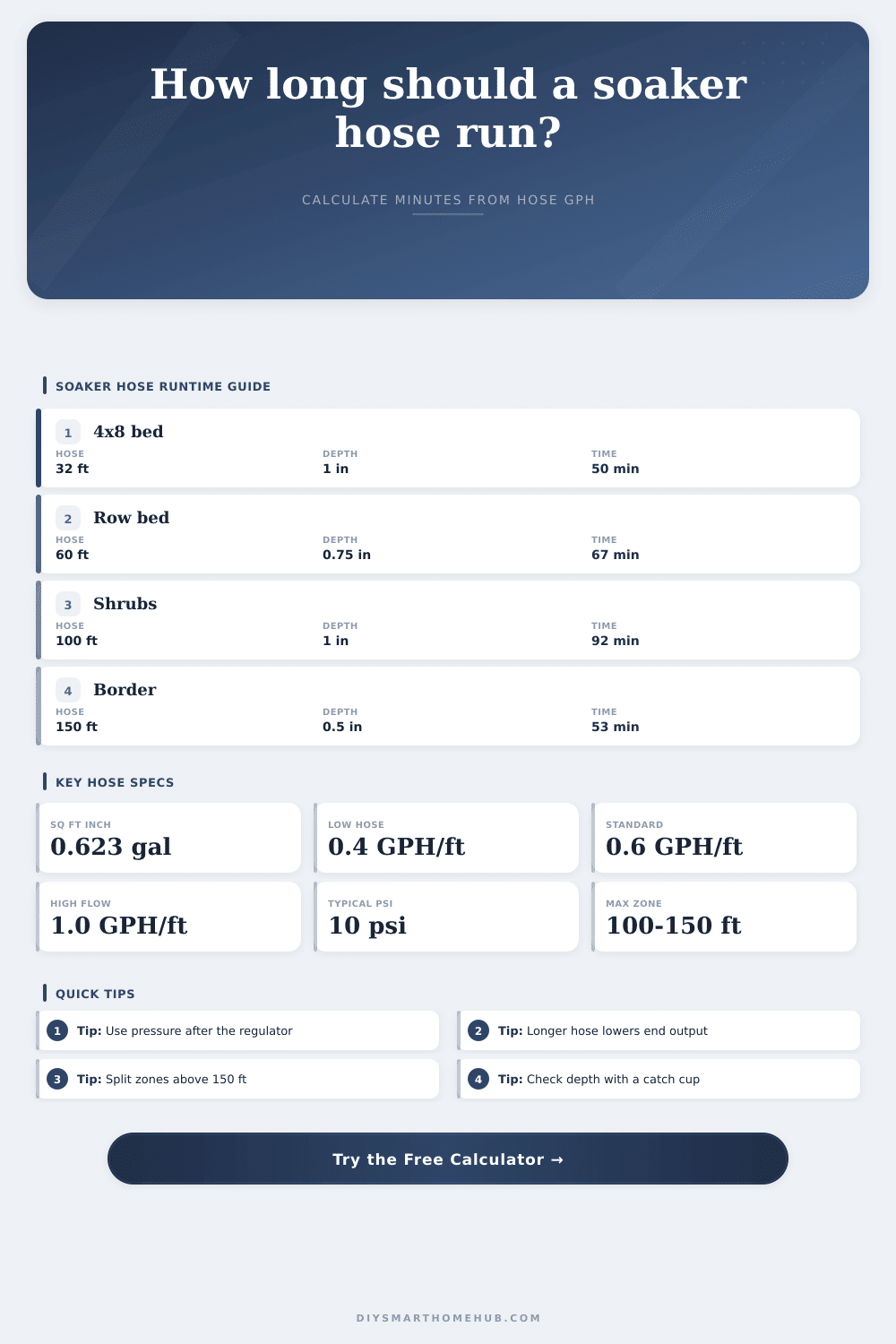
| 4 x 8 raised bed | 32 ft | 19.9 gal at 1 in | About 62 min before pressure changes |
| Two 4 x 8 beds | 70 ft | 39.9 gal at 1 in | About 57 min before pressure changes |
| Tomato row, 3 x 30 ft | 60 ft | 42.1 gal at 0.75 in | About 70 min before pressure changes |
| Foundation strip, 4 x 45 ft | 100 ft | 112 gal at 1 in | About 112 min before pressure changes |
| Long flower border, 3 x 90 ft | 150 ft | 84.1 gal at 0.5 in | About 56 min before pressure changes |
| Available pressure | At 10 psi rating | At 20 psi rating | What it means |
|---|---|---|---|
| 5 psi | 0.71x output | 0.50x output | Runtime rises sharply |
| 8 psi | 0.89x output | 0.63x output | Usable for many porous hoses |
| 10 psi | 1.00x output | 0.71x output | Common porous hose rating |
| 15 psi | 1.22x output | 0.87x output | Watch for misting or uneven ends |
| 20 psi | 1.41x output | 1.00x output | Common dripline rating |
| Project | Area | Suggested hose | Planning note |
|---|---|---|---|
| Balcony planter set | 12 sq ft | 12-20 ft | Low-flow hose avoids saturation |
| Single 4 x 8 bed | 32 sq ft | 28-40 ft | Loop or serpentine at 10-12 in spacing |
| Two 4 x 8 beds | 64 sq ft | 60-80 ft | Balance both beds with similar loop lengths |
| Long vegetable row | 90 sq ft | 60-90 ft | Two lines help wide root zones |
| Foundation shrubs | 180 sq ft | 100-150 ft | Consider splitting high-flow hoses |
Single loop
Simple for small raised beds when total length is short and pressure stays near the hose rating.
Serpentine bed
Uses spacing across the width of a bed, making the recommended hose length easier to compare.
Parallel rows
Works well for tomatoes, peppers, shrubs, and crops with long planted rows and wider spacing.
Tree ring
Circle inputs estimate the wetted basin, while the hose length controls total GPH available.
Smart valve zone
Use supply GPM, fitting losses, and pressure derate to avoid overloading one timed irrigation zone.
Thirty minutes at the faucet = good watering, right? Wrong. If you don’t treat irrigation like a math problem by considering factors such as water pressure, hose length, and even soil type, you’re likely to leave beds soaked in some spots and bone-dry in others. The tool at left will translate your hose specs (and other variables) into actual minutes of run time for any given bed dimension. No more guesswork; just full soil.
A sound estimate hinges on knowing how much water your plants require and how much your watering system will provide. To determine the volume needed to hit your goal in inches of water soaked into the soil, you first figure out a conversion factor. This factor is about.623 gallons per square foot of bed area when wetted at one inch of water. The tool assume a certain volume per inch of water depending on bed size. The rest of the equation rely on that value.
How to Water Your Garden Correctly
For example, if the bed were four feet wide by eight long; meaning it’s 32 square feet, you’d multiply that area by the soak depth you want to achieve. Voila! You know the volume you’re shooting for. To make things easy, calculator does all the multiplying for you. This lets you focus on whether a one-inch soak is better for seedlings or tomatoes set to fruit.
But then there’s the hose, the variable. Soaker hoses aren’t created equal. And none of them have much information about their discharge rate on their label. With the tool you can choose anything from high-output rubber lines to low-flow porous tubes. All types comes with a defined gallons per hour per foot rating at standard pressure.
But here’s where most plans go wrong: Rated output assumes best-case scenarios, which don’t exist in backyards very often. Elevation changes (if your bed is higher than your faucet) or friction inside the hose itself will cause your actual delivery to drop off as it travels farther from the spigot. Efficient irrigation depends heavily on regulating water pressure. Delicate porous tubing shouldn’t be used with too much pressure; it causes misting instead of soaking! That’s why most home setups operates under excessive pressure levels.
Enter the pressure here in the calculator after all regulators, etc., have been accounted for. Depending on the flow/pressure relationship, a reduction factor will be used by the calculator. For instance, if you’ve got a twenty-pound-per-square-inch-rated hose but a ten-pound-per-square-inch-rated regulator installed, you’re only going to get a fraction of the flow indicated on the hose. To account for that, the calculator reduces the total gallons per hour accordingly. You’ll see the estimated run time stay in line with your expectations instead of being too high. (Without this derating, your timer might show 40 min, so you think you’re applying an inch of water…but you’re really getting six-tenths of an inch.)
And then there’s the complication of head loss caused by long runs. When you stretch a two-hundred-foot-long hose around a big vegetable garden, the last foot will recieve fewer gallons per hour than the first. To account for this, the calculator use both the diameter and length of your feed hose. It factors in filters and fittings that impede flow, too.
Maybe you have tons of water available from your tap, but are forcing it up and over a hill, and then squeezing it through a little-diameter timer filter and downhill to a bed on your patio? The total adjusted flow the tool calculates takes those elevation changes into account. Its calculated run time is one that reflects what’s reaching the soil, not what’s coming out of the spigot.
Embedded within the interface are handy reference tables, too. These detail the performance (based off pressure) of various hose types. They let you determine instantly, for example, whether your existing arrangement will work or whether you have to split up some zones. You can see at a glance, for instance, whether a long flower border needs to be divided into two separate valve zones to maintain even distribution. That’s so you don’t make the typical error of having just one huge zone, which sprays well at the beginning and dries out the rest of the way along.
The key to watering well is adjusting the amount you supply based on how much is needed at the right moment. This tool turns a time-consuming hit-or-miss guessing game into something you can do repeatedly (plug in your actual pressure, hose type and number of beds), so your roots gets what they need without wasting a drop. Stop watching the clock and just do the math.
This makes for happier plants and a watering schedule that is easier to fit into your routine. It’s the difference between calculating and observing, which is always better in gardening. You should of used this sooner.