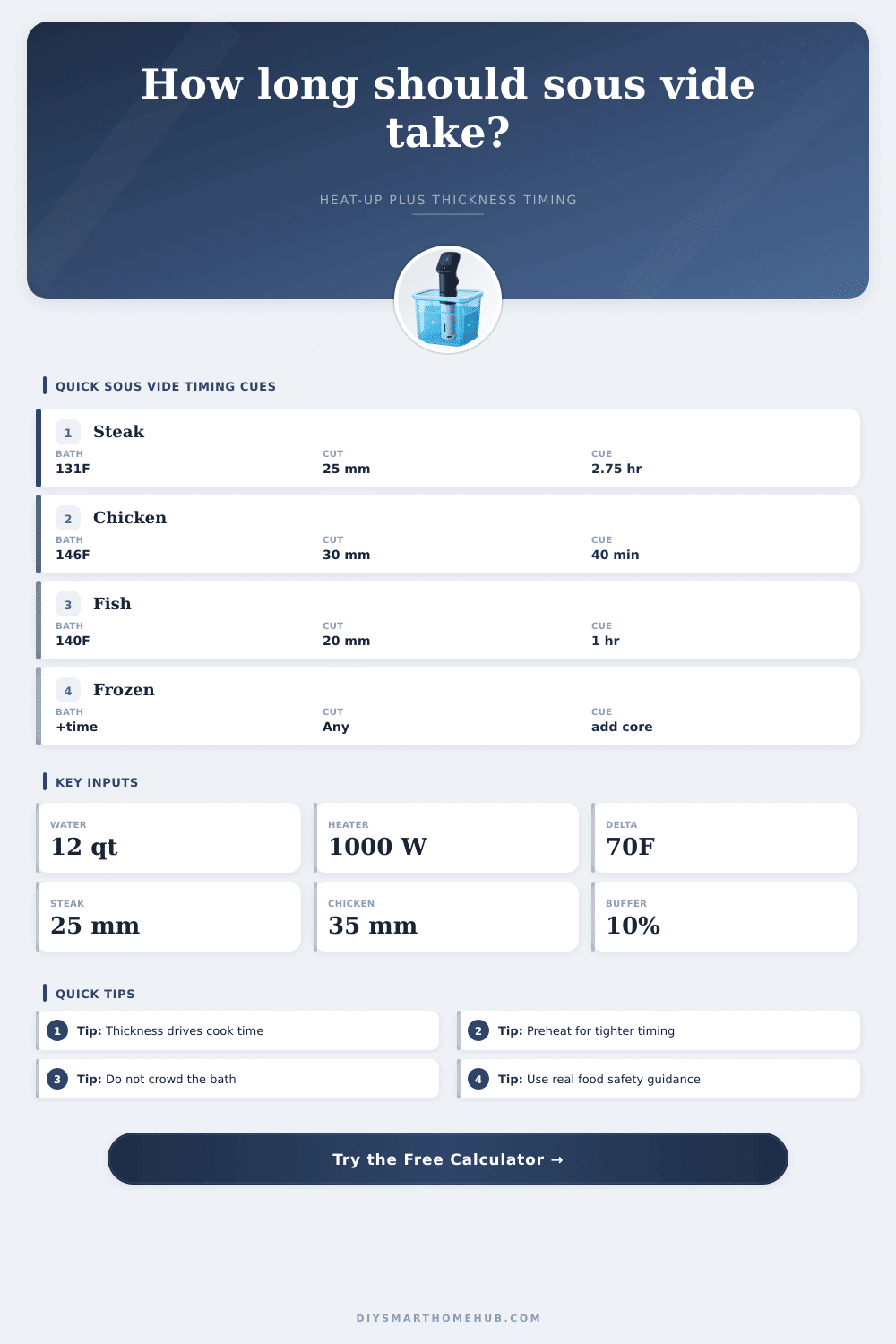
Smart Sous Vide Time Calculator
Estimate water heat-up time, temperature delta, thickness-based cook time, and pasteurization context from the bath, heater, food type, and food thickness.
Enter inputs and calculate to see timing.
| Thickness | Slab heat from fridge | Cylinder heat from fridge | Frozen slab heat | Use case |
|---|---|---|---|---|
| 10 mm / 0.4 in | 19 min | 11 min | 30 min | Thin fish or cutlet |
| 25 mm / 1.0 in | 1.25 hr | 40 min | 1.75 hr | Thin steak or chop |
| 40 mm / 1.6 in | 2.5 hr | 1.25 hr | 3.5 hr | Thick steak |
| 60 mm / 2.4 in | 4.75 hr | 2.5 hr | 7.25 hr | Small roast portion |
| Food table | Supported bath range | Reduction context | Thickness source | Important limit |
|---|---|---|---|---|
| Beef, pork, lamb | 131F to 151F | Listeria, Salmonella, E. coli | Baldwin Table 5.1 | Thawed from 41F |
| Poultry | 134.5F to 149F | 7D Salmonella context | Baldwin Table 4.1 / FSIS | Thawed from 41F |
| Lean fish | 131F to 140F | Listeria context | Baldwin Table 3.1 | Immediate service matters |
| Fatty fish | 131F to 140F | Listeria context | Baldwin Table 3.1 | Longer than lean fish |
Reference context: thickness tables follow Douglas Baldwin's published sous vide heating and pasteurization tables; government time-temperature context follows FDA Food Code and USDA FSIS Appendix A style tables. This calculator is a planning aid for ordinary home cooking, not a HACCP validation tool.
| Scenario | Bath setup | Food thickness | Typical result | Planning note |
|---|---|---|---|---|
| Weeknight steak | 12 qt, 1000 W | 1.25 in / 32 mm | About 3 hr from cold water | Preheat saves waiting |
| Chicken breast | 10 qt, 1000 W | 1.4 in / 36 mm | About 2 hr after preheat | Use poultry table range |
| Salmon fillet | 8 qt, 800 W | 0.8 in / 20 mm | Short heat-only cook | Pasteurize only at higher temps |
| Short ribs | 14 qt, 1100 W | 2.0 in / 51 mm | Long hold dominates | Timing is texture-driven |
Most people think sous vide is an easy fix for poor planning. You’re convinced all you have to do is figure out the correct steak temp, and chuck it in the bath and wait till dinnertime. In practice, though, there’s a lot more mechanics involve. There’s the heat transfer between the water and the bag, and then between the bag and the food. And no, this doesn’t happen instantaneously. If you don’t account for time required to get heat to the middle of whatever you’re cooking, you’ll either wind up overcooking the outside or leaving a cool spot inside.
That’s where the calculator above comes in: after plugging in the details of what you’re making and your bath set up, it figures out the rest for you so you don’t have to guess at thermal mass and coefficients. Generally speaking, the largest variable in any situation involve the relationship between heat output and water volume. That thousand watt immersion circulator sounds like it will do the trick…until you attempt to warm fifteen quarts of winter-time tap water. Mass requires time to absorb energy. What happens if your goal is a one-hundred-thirty-six degree bath? What if you begin with sixty-eight degree water? There is a large difference there. Physics can’t be rushed. This time estimate allows you to plan for the preheat phase which is often more critical than the cooking phase itself.
Why Sous Vide Is Not Just Easy Cooking
After that, it’s all about thickness. Weight does not matter anymore. Thickness is what matters most. Heat penetrates based on distance from top to bottom, so a very thick, light piece will take longer to get hot than a really thin, heavy one. Home chefs (most of us) weigh things when cooking according to recipes, but never consider thickness unless we find ourselves with a raw center three hours into our steak. This chart on the page explains it well: double the thickness, quadruple the required time to reach equilibrium. A small difference has a big impact on time, safety, and ultimately, texture.
Heat transfer rate is also affected by food shape. A slab (e.g., ribeye) and a sphere (e.g., roast) will lose heat at different rates than a more cylindrical tenderloin. These shape differences are accounted for by the calculator so you don’t have to model complicated temperature changes in your head. Simply choose the closest match. This attention to detail makes all the difference between a good result and a great one. After all, over-estimating won’t hurt anyone. However, underestimating means thinking that round, dense proteins will reach temperature all the way through faster then they actually will.
Another layer that folks tend to fumble with is safety. We have all heard of pasteurizing something, but what does that really mean? It doesn’t just mean reaching a certain temperature; it means keeping that temperature for a set amount of time to make sure pathogens die. The calculator taps into well documented tables to recommend minimum times depending on both the temperature range and the specific type of food. It is a safety net for ground meats and poultry where you can’t just tell if it’s cooked thoroughly by looking at the color. It removes the guesswork while reducing bacteria without needing to memorize complicated time-temperature charts.
The one silent variable that kills so many good assumptions is circulation. Water won’t circulate around the folded-up bag squished up against the bottom of the pot. Without circulation, there is no heat transfer. This app has a crowding factor because life isn’t neat and tidy. Real kitchens get crowded; you’re not likely to be cooking a bunch of perfectly spaced out bags in a vacuum. A little wiggle room for when things get packed in there tight makes your estimate realistic, not overly optimistic. Remember: air in bags insulates, and your kitchen ain’t no laboratory.
The best shortcut, by far, is to preheat the bath. An hour before cook time, fire up the bath. The biggest variable is usually water volume versus heater power. Now you have a very precise idea about when the water reaches the right temperature. From that point forward you’re on the clock with the food. When you don’t pre-heat, you’re guessing how much of your cook time was actually spent getting the water up to temperature vs. You are cooking the meat. Guessing like this causes people to overcook because they are worried, adding additional minutes “just in case”.
It’s about consistency, not speed. You don’t have to go fast. This thing lets you step away from the kitchen while it does its work in the background. And it turns this complex heat issue into a simple timeline. Set the bath, measure the thickness, press the button, and the machine takes care of the rest. Understanding what it’s really measuring is the big part of the trick, heat flows slowly in thick protein, and if you respect how slow that flow is then you’ll get better results than fighting it with hotter baths. Believe in the timing, not your intuition; your food will reward that self-control.