Smart Plug Wattage Calculator
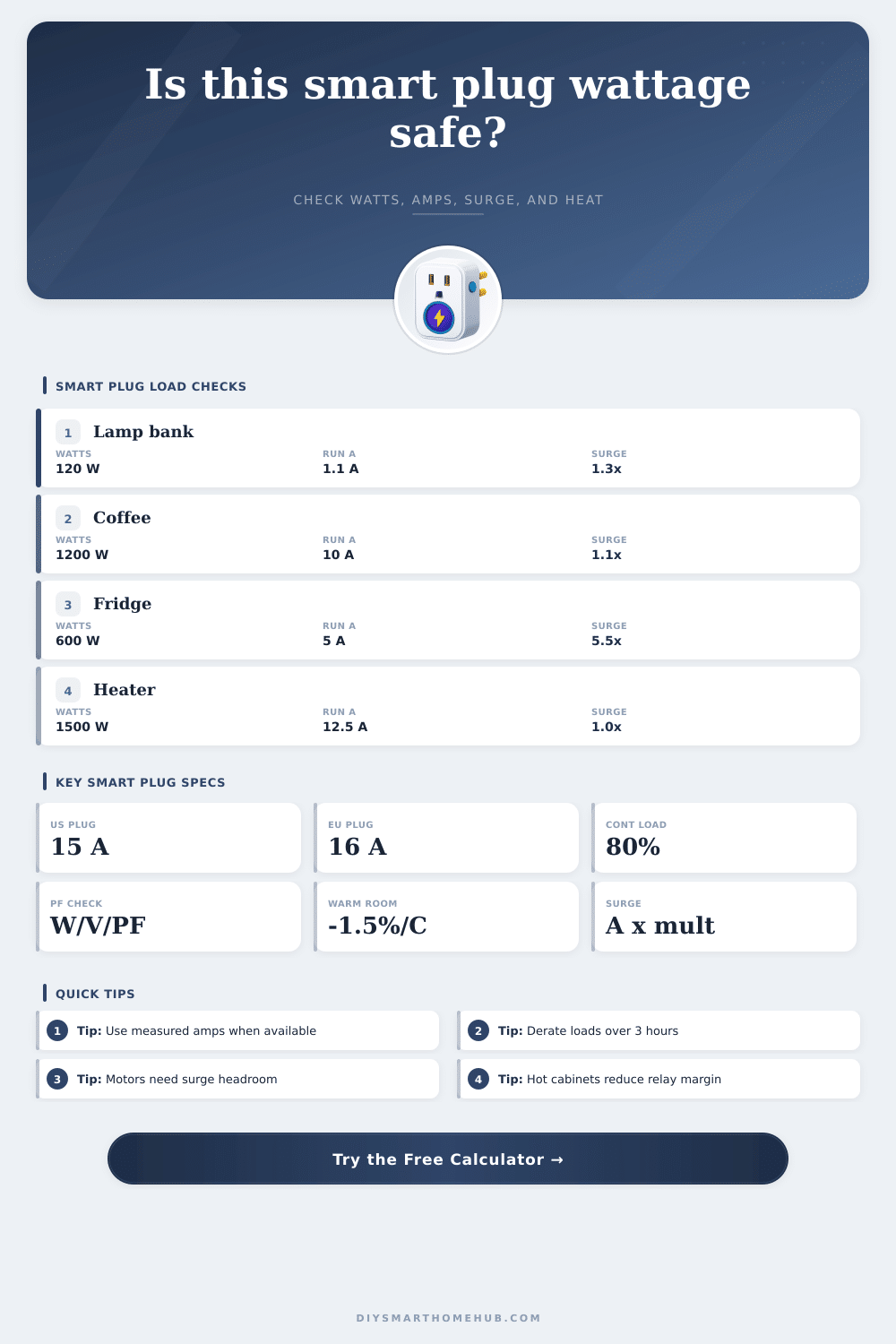
Compare a device against a smart plug rating using watts, voltage, measured running amps, startup surge, power factor, continuous duration, relay derating, and ambient temperature.
🎯Device presets
Smart plug and device inputs
Live smart plug spec grid
Smart plug load suitability results
📊Calculated smart plug spec grid
🔌Common smart plug rating table
| Plug class | Typical amp rating | Watts at 120 V | Watts at 230 V | Suitability note |
|---|---|---|---|---|
| Compact mini plug | 10 A | 1200 W nameplate | 2300 W nameplate | Best for lamps, electronics, and small fans. |
| US full-size plug | 15 A | 1800 W nameplate | Not typical | Derated continuous limit is often 12 A or 1440 W. |
| EU / UK plug module | 13 A to 16 A | Not typical | 2990 W to 3680 W | Check local plug, fuse, and device markings. |
| Heavy relay module | 20 A | 2400 W nameplate | 4600 W nameplate | Enclosure heat and terminals often decide the real limit. |
| Metering smart outlet | 10 A to 15 A | 1200 W to 1800 W | 2300 W to 3450 W | Measured watts help verify the calculator inputs. |
⚡Device wattage and surge table
| Device load | Typical watts | 120 V running amps | PF range | Startup surge cue |
|---|---|---|---|---|
| LED lamp group | 30 W to 150 W | 0.3 A to 1.5 A | 0.60 to 0.95 | Usually 1.1x to 2.0x, driver dependent. |
| Router, modem, hub | 15 W to 60 W | 0.2 A to 0.6 A | 0.80 to 0.95 | Small supply inrush, continuous heat matters. |
| Coffee maker | 900 W to 1500 W | 7.5 A to 12.5 A | 0.98 to 1.00 | Mostly resistive with low startup surge. |
| Space heater | 750 W to 1500 W | 6.3 A to 12.5 A | 0.98 to 1.00 | Continuous heat load, not a relay-friendly use. |
| Refrigerator | 120 W to 700 W | 1 A to 6 A | 0.65 to 0.90 | Compressor start may be 3x to 7x running amps. |
| EV level 1 charge | 960 W to 1440 W | 8 A to 12 A | 0.95 to 0.99 | Long duration makes continuous derating decisive. |
🌡Relay derating and ambient temperature table
| Condition | Calculator factor | Why it matters | Typical action |
|---|---|---|---|
| Short use under 3 hours | 100% duration factor | Contact heating has less time to accumulate. | Still check watts, amps, and surge. |
| Continuous 3+ hours | 80% duration factor | Common electrical planning practice derates steady loads. | Keep load under the derated amp limit. |
| Ambient 30°C or cooler | 100% temperature factor | Relay temperature is near normal room assumptions. | Use nameplate with selected relay derating. |
| Ambient above 30°C | Minus 1.5% per °C | Cabinets and garages reduce thermal headroom. | Lower the allowed current or move the load. |
| Relay derating below 80% | User-entered factor | Cheap relays, enclosures, and terminals may need headroom. | Use a plug with a higher current class. |
🚦Verdict threshold table
| Check | Good | Watch | Too close | Fail |
|---|---|---|---|---|
| Running amps vs effective limit | Under 75% | 75% to 90% | 90% to 100% | Over 100% |
| Device watts vs plug watt rating | Under 75% | 75% to 90% | 90% to 100% | Over 100% |
| Startup amps vs surge rating | Under 75% | 75% to 90% | 90% to 100% | Over 100% |
| Relay heat profile | Cool and light | Warm room | Hot enclosure | Derated limit exceeded |
Yes! You bought that slick smart plug so you can shut the light off in your bedroom while in bed. What could go wrong? Nothing, right? For three weeks everything works great. Then you plug your space heater into it. Oops. At best, it is now a very expensive paperweight, or at worst, a melted pile of junk sitting on your nightstand.
This isn’t usually about the device; it’s about the invisible connection between the relay and the load inside that shiny case. The vast majority of folks will glance at wattage rating sticker on their appliance and think they know what the full story is. They don’t. Most people look at the wattage label on an appliance and assume that is the whole story. But electricity also has momentum, heat and weight. All these things matters when you ask that little mechanical switch inside the shiny box to handle current for your whole entertainment center or coffee station.
Why Smart Plugs Can Break
After plugging in the details about your device into the calculator above, it figure out the rest of the math for you. You don’t have to guess if that surge will weld the contacts or even trip the breaker. Using it is another matter entirely though when you understand what those fields mean. Let’s begin with amperage and voltage.
By default, that standard outlet we’re used to in North America is rated for fifteen amps. It seems like an adequate amount until you realize that any continuous loads needs to be lowered. Typically, electrical codes advise maintaining constant loads at no higher than eighty percent of this maximum value to avoid potentially melting the wires behind the wall. There are also thermal constraints on relay within the smart plug.
When you run a load for over three hours, the metal contacts warms up and become less able to carry electricity safely. This is why the time input is important too. Running an aquarium heater for 12 hours versus a baking cycle for 45 minutes is two very different thing. Just because the current is the same doesn’t mean the thermal stress caused by that current are the same, especially when running through a small piece of metal for such a long period of time.
And then we get into startups: Compressors and motors is finicky. While running, a fridge may only be pulling two amps, but when the compressor fires up it’s going to grab like six or eight for maybe one-hundredth of a second. Most smart plugs can handles that type of burst. But if you’ve got a bunch of motorized things stacked up, or you’re using an older one with some worn-out contacts, suddenly that startup is a problem.
The tool tests it against the burst capacity of the plug itself. If your startup power draw is higher than its short-term capacity, you could see some arcing inside the plug each time you turn the thing on. And that arcing gnaws away at the contact surfaces over time. It’s a slow failure mode that will tend to stop the plug from functioning entirely before doing any immediate damage.
And there’s another wrinkle called power factor, which most people don’t pay attention to. All those moddern electronics, laptops and other things with a power supply, they don’t draw power smoothly. It chops it into pulses. So their label might say it pulls one-hundred watts but really draws more amps off the wall to achieve that power. The power factor input corrects for that difference. If your power factor is low, then you may see something modest looking on the wattage sticker, but it will be drawing higher current in real life. You could take a bunch of LED lights and assume they are light based off the wattage sticker. In fact, they may be pushing higher amperage through that relay than you expected.
Even ambient temperature has its part to play. Electrical contacts can’t break when there’s nowhere for heat to escape (like in an enclosed media center), or cabinet with tight spaces around plugs. If your environment is hotter than standard room conditions, the calculator also takes a reduction into account. Electrical contacts have lower breaking capacity in hot air.
This isn’t exactly rocket science, but it’s something worth thinking about when you’re running close to the wire. Don’t think in labels; think in stress. Your smart plug doesn’t exist solely to turn things on and off; treat it as a component that degrades under surges and heat. Separate sensitive stuff from heavy loads. Understand and respect the continuous limits. You should of get years of convenience out of it without ever having to pay for it at the hardware store.