Smart Home Financing Monthly Payment Calculator
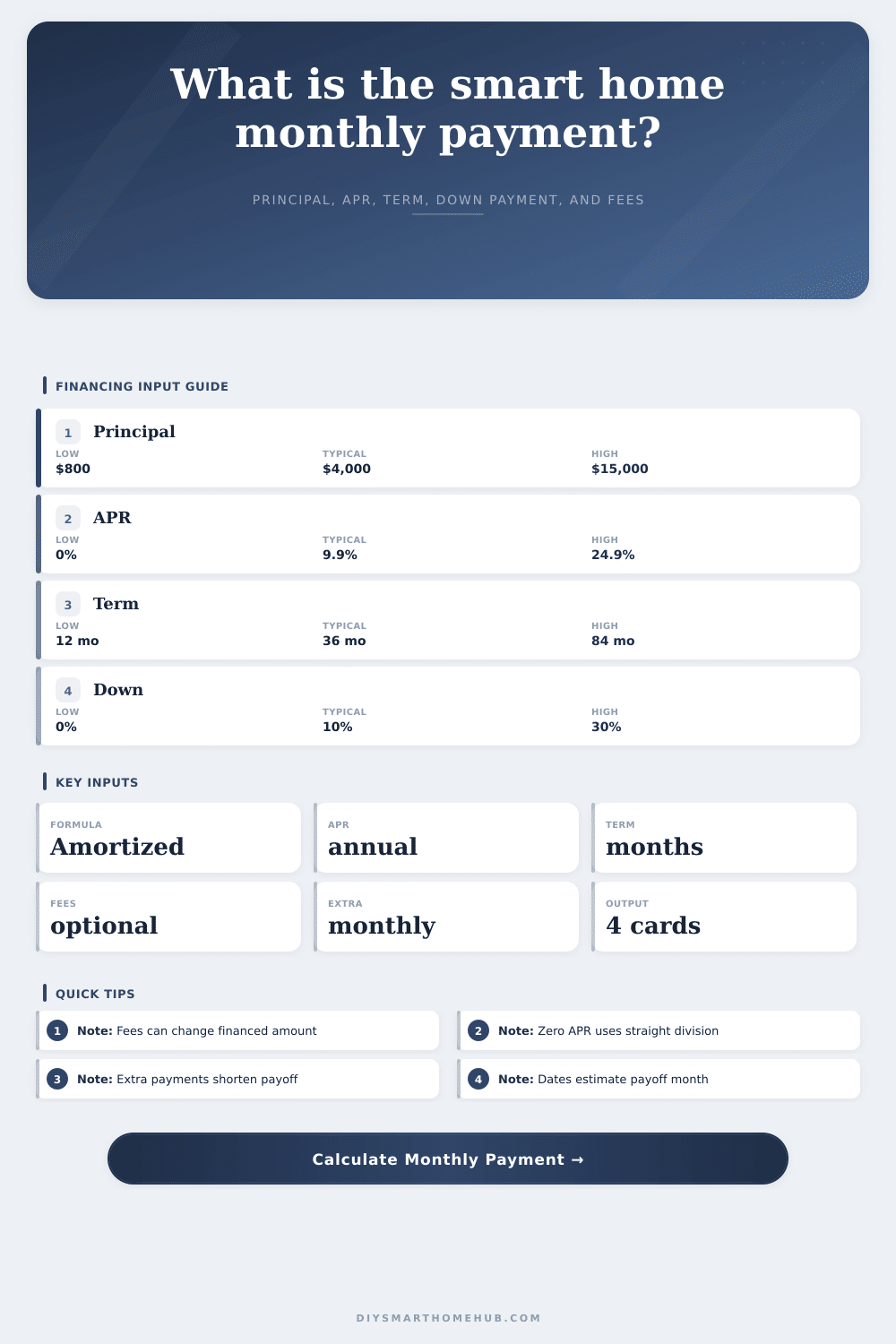
Estimate an amortized monthly payment from user-entered smart home project principal, APR, term, down payment, financed fees, upfront fees, first payment date, and extra monthly payment.
| Month | Payment | Interest | Balance |
|---|---|---|---|
| 1 | $0 | $0 | $0 |
| Term | Payment | Interest | Total paid |
|---|---|---|---|
| 12 mo | $0 | $0 | $0 |
| APR | Monthly | Interest | Payoff |
|---|---|---|---|
| 0% | $0 | $0 | 0 mo |
| Scenario | Principal | Term | Fields used |
|---|---|---|---|
| Starter bundle | $800-$1,500 | 12-24 mo | Principal, APR |
| Room phase | $1,500-$3,500 | 24-36 mo | Down, fees |
| Security set | $3,000-$7,500 | 36-60 mo | APR, term |
| Whole home | $8,000-$18,000 | 48-84 mo | All inputs |
It starts with a single doorbell cam. Ends with a whole-house rewire.” I’ve heard this story more times than I can count.
What started as a simple weekend install of a front-porch doorbell camera became a complete smart home overhaul. It was an overhaul featuring automated blinds, lighting scenes, and thermostat. Before you know it, your smart home project has grown beyond what you planned, and now you’re staring down the barrel of an invoice that affects your wallet. At this point, financing isn’t just a general idea; it’s something affecting your real-world cash flow. So it makes sense to understand how (and why) you spread the cost. If you do not, your smart home will drain your savings account.
How to Pay for Your Smart Home
That’s where the calculator comes in. You fill in your variables, your principal amount, what down payment you can afford, which term (i.e., 3 years); and the calculator does math for you. Next, it adds in the interest rate. Finally, it ask you to account for fees. Most people ignore fees because they think fees will be a rounding error. They don’t realize that if they finance the fee, then it becomes part of their principal, which means you’re paying interest on the fee! Not just on device itself.
So you can tick a box in the tool: pay the fee now or roll it into loan? Instantly, you see the tradeoff: more up-front expense, less long-term cost.
The phrase “term length” is something most consumers think of as an unchanging value. Thirty-six months is just the term length; that’s the way things are done. If you want to reduce amount of interest you’ll pay, get a shorter-term loan. Your monthly payment will increase. If you’d rather not see such a high number on your bill every month, go for a longer-term loan. Your monthly payment will be lower and the bill will blend into your budget. But over time, it will cost you more in interest then you thought. This is made clear in the reference table provided alongside the calculator.
Switching from a twelve-month loan to an eighty-four-month loan shifts your bottom line. You’re going to feel the pain one way or another. You can have a larger number each month or a higher total sticker price. There isn’t a right answer here. It is just your answer.
What about that extra payment field? That one feels like nothing: toss another twenty-five bucks per month into the mix. But it all goes directly toward the principal balance. The less there is left to balance, the less interest it builds, which has the net effect of compounding and speeding up how quickly you’ll repay the debt. More money stays in your pocket. And the repayment plan adjust to match. It tells you exactly when you’ll say goodbye to debt. Yet most folks never use this feature. Why? Because they believe their budget is locked in place.
Your budget is far less rigid than you imagine. Remember: Don’t get sucked in by all of the gizmos. If you stress over paying for this thing, then what’s the point? All of these systems has some impressive technology. But all of that technology sits on top of where the real risk lives. That’s the financing. The cost of carrying a balance, even a low balance, can be quite expensive, given high APRs. That’s particularly true if you carry a balance for years.
When possible, zero APR promotions is sweet. But they’re typically paired with a short term (meaning a larger monthly payment). Use the calculator above. Let it do the math for you. Eliminate the marketing hype. Get the raw number. Tinker with various scenarios. See how sensitive your payment will be to small changes in interest rate or duration.
The bottom line: Your home should be automated, but not your debt. Convenience is name of the game, not a financial anchor. Model a couple of scenario, take the time to do this before signing on the dotted line. You should of thought about it first. View the “total interest” column just as carefully as you view the monthly payment. Total interest is the cost of waiting. How much are you willing to pay? When you know how much, you’ll walk into the store with confidence.
One doorbell camera at a time. A proper plan creates a fully connected home. It is a secure home. It is a comfortabley home. It is also a home that fits your financial goals.