Smart Alarm Exit Delay Calculator
Estimate a practical alarm exit delay from the measured exit path, keypad or app arming confirmation, people leaving, door close margin, contact bounce, motion settle time, and panel rounding.
🎯Exit Delay Presets
⚙Alarm Exit Inputs
Your exit delay recommendation will appear here.
Full Breakdown
📟Alarm / Keypad Spec Comparison Grid
📊Reference Tables
| Delay band | Typical programmed value | Good fit | Watch item |
|---|---|---|---|
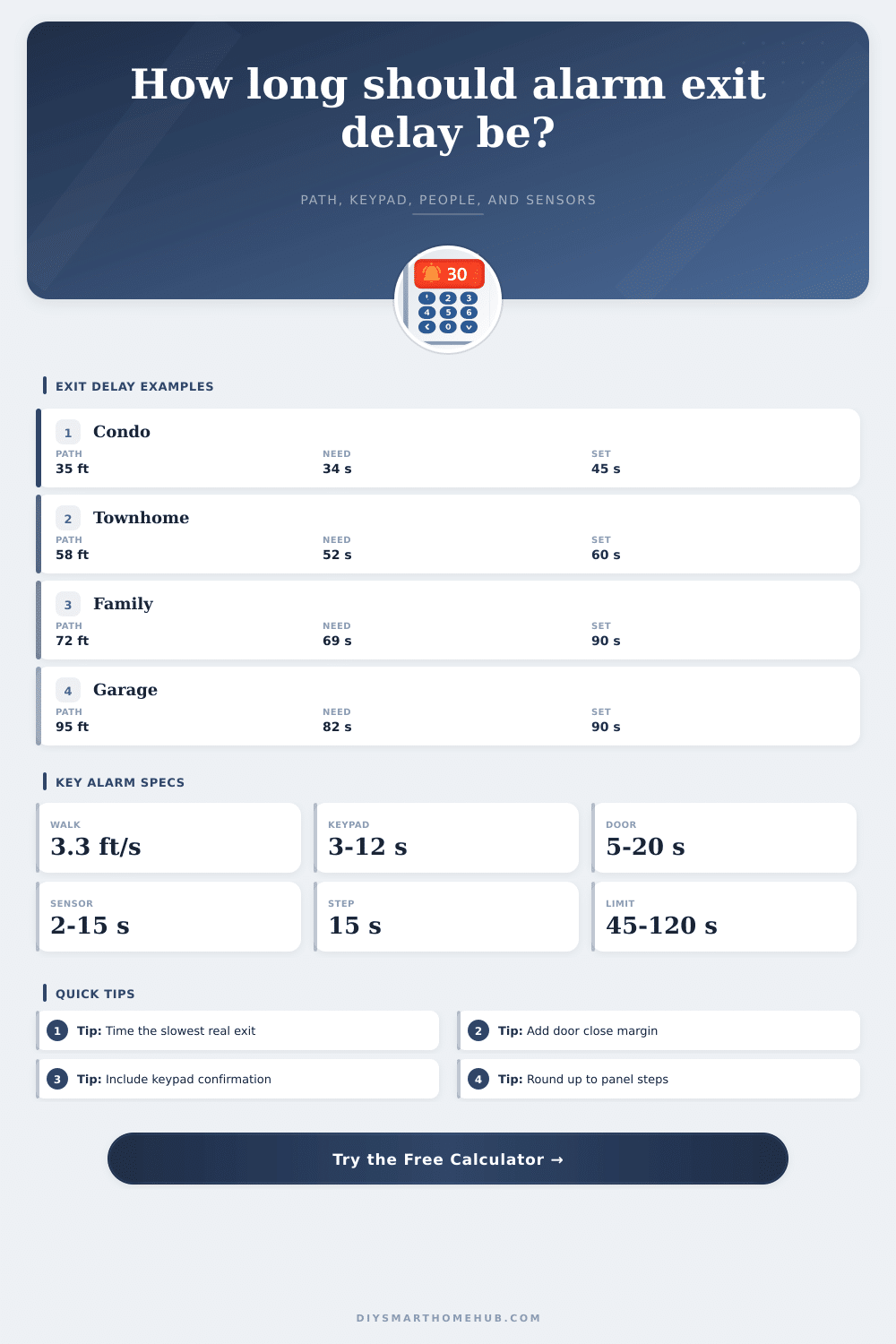
| Very short | 30 to 45 seconds | Small condo, keypad near exit, one or two occupants | False alarms if confirmation beeps lag or door latch sticks |
| Standard home | 45 to 75 seconds | Most front-door exits with normal walking speed | School bags, children, and storm doors can consume margin |
| Long path | 75 to 105 seconds | Garage, stairs, long hallway, or detached keypad route | Long delays leave more time before perimeter is fully protected |
| Extended | 105 to 120 seconds | Senior household, staff closing route, or long driveway transition | May exceed basic panel defaults or monitoring expectations |
| Sensor or arming event | Practical settle allowance | Why it matters | Calculator input |
|---|---|---|---|
| Reed contact on entry door | 1 to 4 seconds | Contact bounce or a slow latch can report open again after closing | Sensor settle plus door close margin |
| Wireless contact | 3 to 8 seconds | Battery devices may batch status or repeat messages | Sensor settle and relay lag |
| PIR motion near exit | 5 to 15 seconds | Motion can remain active while people are still in the exit zone | Sensor settle time |
| mmWave presence sensor | 8 to 20 seconds | Presence clearing is often slower than a contact closure | Sensor settle time |
| Doorway flow profile | Extra time per added occupant | Example use | Formula effect |
|---|---|---|---|
| Clear single door | 1.8 seconds | Adults leaving through an unobstructed door | (occupants - 1) x 1.8 |
| Bags, coats, or school items | 3.0 seconds | Morning exits with backpacks or packages | (occupants - 1) x 3.0 |
| Children or assisted exit | 4.5 seconds | Children, mobility aid, or assisted departure | (occupants - 1) x 4.5 |
| Pets at exit door | 3.8 seconds | Managing a pet gate or preventing a pet from slipping out | (occupants - 1) x 3.8 |
| Staff closing sequence | 2.6 seconds | Office closer checking a final door or cabinet | (occupants - 1) x 2.6 |
| Preset scenario | Distance | Occupants | Profile | Typical result |
|---|
💡Exit Delay Planning Notes
An exit delay determine the amount of time that passes between arming the alarm system and the alarm’s siren beginning to sound. If the exit delay is too short, a person may be within the home when the alarm are sounding. Additionally, if the exit delay is too long, the alarm system will leave the home unprotected for an extended period of time after the people has left the home.
The exit delay should be set to match the exit route out of the home and the people that lives within the home. The exit route out of the home is one of the first factor that should be considered when setting the exit delay. The distance between the arming point of the system and the exit door will determine the time that it takes for the person to walking out of the home.
How to Set the Right Exit Delay for Your Home Alarm
Additionally, you should consider the walking speed of the people that live in the home. For instance, a person with groceries may be slower then a person who is exiting the home alone. Additionally, if the people that live in the home include senior citizens or young children, it may take those individuals longer to exit the home than an adult, so their walking speed on the exit route should be more slower than the speed of an adult when calculating the exit delay.
The method for arming the alarm system is another of the factors that may impact the exit delay. For instance, if the alarm system is armed with a keypad, the system will begin to time the exit delay as soon as the keypad arms the alarm. However, if the alarm system is armed with a mobile phone application, there may be a delay in which the signal reach the alarm system.
Such a delay in signaling the alarm system to be armed will take up some of the time that would have been allotted for exiting the home. Therefore, this factor in the calculator allows for the person to choose if they will arm the system with a keypad or with a mobile phone application. The number of people that will leave the home is another of the factor that will impact the exit delay.
It is likely that not all of the people that live in the home will exit at the same time. For instance, one person may be able to walk out the door quickly, but three people may need to wait for one another to pass through the door. Such a delay in exiting the home is accounted for in the alarm system through the use of flow profile that take into account the extra time for the number of people that live in the home.
Additionally, the more people that live in the home, the longer it will take for all of them to exit the home, so there will be a need to increase the exit delay if there are more people in the household. Additional factor other than those discussed above may impact the exit delay. For instance, some of the exits of the home may require additional effort to open and close the door, such as a door to a garage, or a storm door that does not open and close quickly.
In these instances, there may be an exit delay for those doors. Additionally, if the system use sensors to detect whether there are people entering and exiting the home, those sensors may take additional time to detect that the door is closed and the people have exited the home. In these cases, an additional time may be added to the exit delay to allow for these sensors to settle in their detection of the people in the home.
The exit delay calculator will provide a recommended exit delay as a rounded number. Most alarm system panels will not allow for a delay that is not rounded to the nearest number. For instance, if the recommended exit delay is 52 seconds, the alarm panel may only offer a delay of 45 or 60 seconds.
Thus, it is important to review the possible exit delay for the alarm panel for the home. If the exit delay that is recommended is relatively long, it may be better to work to either shorten the exit route out of the home or to fix the behavior of the sensors that monitor the home. The reference tables on the page can provide guidance regarding the different exit delays.
Short exit delays are appropriate for small units and for homes where the keypad for the system is located near the exit. Standard exit delays are provided for most homes that exit the home through their front door. Longer exit delays are provided for homes where the keypad is located in a garage or on the top of the staircase in the hallway of the home.
Long exit delays are recommended for homes that have senior citizen or young children that live in the home, as well as for offices. These tables provide context for the number that is provided by the calculator, but are not rules that must necessarily be followed. Another of the step in setting the correct exit delay is to time one of the exits out of the home.
For instance, start the timer when you press the arm button on the alarm system. Continue to time how long it takes for you to exit the home and the doors to latch. Stop the timer after the last door of the home has latched and the sensors show that the people has exited the home.
This timing provides the basic time needed for the exit delay. Additionally, if the sensors for the alarm system take long to latch the last door of the home, it may be better to fix that sensor rather than adjusting the exit delay of the alarm system. Finally, another of the factors to consider is that the longer the exit delay, the longer that the perimeter of the home will be open to unauthorized persons attempting to enter the home.
Thus, while setting an exit delay for the home, the goal will be to find the shortest amount of time for which the alarm system will allow the people in the home to exit, yet will still not trigger the alarm system. Assuming that the correct exit delay is set, the alarm system will function as needed while minimizing any stress on the people who live in the home. Youll find that setting it correctley is key.
Dont forget that the homes size and layout matters too. It could of been a simple process if more people follows the guide. Actually, its better to double check everything.
The alarm system works best when you follow the instructions. This process should of been easier if the people uses the calculator more often. You should of checked the sensors first.
The exit delay can be very helpful. It is a moddern way to keep things secure. If you want to feel more comfortabley, use a keypad.
There is alot to learn about these systems. It is a luxurius feeling to be safe. Its important to be careful.
Youve got to be sure. I hope this helps you. The system is realy good.
People often forget the most basic things. It isnt that hard. The exit delay is a great tool.
The system is very relieable.