Salt Water Pool Salt Calculator
Estimate how many pounds and kilograms of pool salt to add after comparing current ppm, target ppm, salt purity, splashout dilution, refill-water salinity, and rounded bag size.
📋Pool Salt Presets
Preset ready: New Fill 12k Pool. Change any value to match your chlorinator label, salt test, and actual bag size.
⚙Salt Calculator Inputs
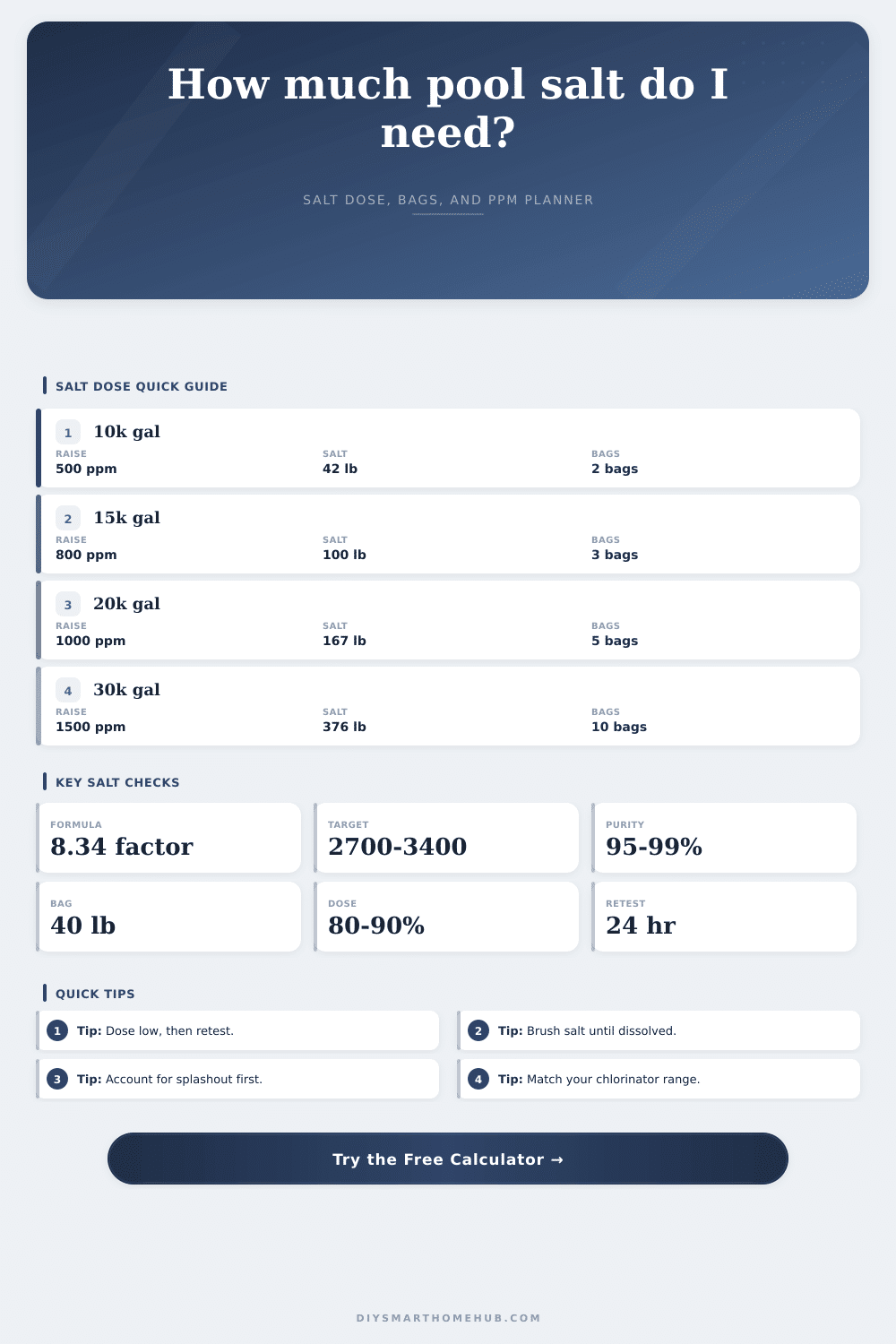
Formula used: salt lb = gallons × ppm increase × 8.34 / 1,000,000. The calculator then adjusts for purity percent, kilograms, rounded bag count, and dilution from splashout or refill water.
Salt Dose Results
Use the exact dose for careful measuring, then compare it with the rounded bag outcome before adding every bag.
Calculation Breakdown
Calculated salt additions should be circulated and retested before final fine tuning.
📘Salt Calculation Reference Grid
📊Pool Salt Tables
Salt pounds for common ppm increases
| Pool volume | 250 ppm | 500 ppm | 1000 ppm |
|---|---|---|---|
| 10,000 gal | 20.9 lb | 41.7 lb | 83.4 lb |
| 15,000 gal | 31.3 lb | 62.6 lb | 125.1 lb |
| 20,000 gal | 41.7 lb | 83.4 lb | 166.8 lb |
| 30,000 gal | 62.6 lb | 125.1 lb | 250.2 lb |
Approximate 40 lb bag ppm effect
| Pool volume | At 100% | At 99% | At 95% |
|---|---|---|---|
| 10,000 gal | 480 ppm | 475 ppm | 456 ppm |
| 15,000 gal | 320 ppm | 317 ppm | 304 ppm |
| 20,000 gal | 240 ppm | 237 ppm | 228 ppm |
| 30,000 gal | 160 ppm | 158 ppm | 152 ppm |
Dilution effect examples
| Before | Replaced | Refill ppm | After |
|---|---|---|---|
| 3200 ppm | 5% | 0 ppm | 3040 ppm |
| 3200 ppm | 10% | 0 ppm | 2880 ppm |
| 3000 ppm | 15% | 200 ppm | 2580 ppm |
| 2800 ppm | 20% | 500 ppm | 2340 ppm |
Common salt pool scenarios
| Scenario | Gallons | PPM gap | Exact salt |
|---|---|---|---|
| Small top up | 8,000 | 300 | 20 lb |
| Family pool | 16,000 | 700 | 93 lb |
| Large refill | 25,000 | 1200 | 250 lb |
| New 20k fill | 20,000 | 3200 | 534 lb |
Table values show pure salt before purity correction. The interactive calculator applies your exact purity percent and bag size.
🔍Pool Salt Comparison Grid
Exact Dose
Best when you weigh or split bags. It minimizes overshoot after a small correction or when the pool volume estimate is uncertain.
First Dose
Uses your selected percentage of the exact dose so you can circulate, test again, and finish with a smaller adjustment.
Rounded Bags
Convenient for full-bag additions, but it can push ppm beyond the target when the exact need is just over a bag boundary.
Dilution Adjusted
Best after splashout, backwash, drain-down, or heavy rain because the current reading is blended with the refill-water ppm.
✅Calculator Tips
Pool volume estimates, test strips, and chlorinator readings can disagree. Adding 75% to 90% of the calculated amount first gives room to retest before the final adjustment.
When water is replaced, the remaining salt is diluted by the refill water. Enter the replacement percent and refill ppm before trusting the salt addition number.
Salt systems is also an option in your pool. However, you want to make sure you have right amount of salt. That’s where the calculator comes into play. If you don’t know how much salt is needed or if you’ve added too little or too much, it gives you a solid answer, not a guess.
But understanding what that number mean requires looking a little deeper. The capacity on your pool list isn’t the same as actual volume. Backwashing, rain, and splashing all affect the actual water volume. Add the wrong amount of salt based off an incorrect estimate, and you’ll either have too much salt (which damages the cell) or too little salt (meaning you’ll need to buy more bag).
How to Use a Salt Pool Calculator
The tool asks for your current salt reading and your target level. Depending on your system most systems does well with about 2700 (3400 parts per million salt). This range is wide enough to make minor adjustments. However, it is important enough that missing the mark by a lot matter.
Consider the purity of the salt. All salt are not created equal. Different bags of salt has varying levels of pure sodium chloride. Some are ninety-nine percent pure and others might be lower. Fortunately, the calculator takes that into consideration automaticly.
In other words, if you use a salt that’s only ninety-five percent pure, then you’ll need to add more weight to get same level of salt. While it sounds like a minor difference, the little bit realy does adds up when it comes to big batches of salt. Ignoring purity is like paying for air.
Salt concentration changes when it gets diluted: as rain falls or water splashes out and drains away, there is less salt in the water. If you refill with near-zero-salt city water, that water dilute what was there. It resets baseline for your existing chemicals. The tool lets you input the percentage of water replaced and salinity of that refill source.
Resetting the baseline is necessary before you can recalculate. If half the tank has been replaced, you can’t rely on a test from last week. The math have changed, and so should your dose.
Don’t add it all in one go either. According to the calculator, add about eighty or ninety percent of what you think is needed initially. That’s because this leave some room to adjust as needed. You should of added it slowlier. So you make up the solution, run it through for twenty-four hours, then test water again. Adjust accordingly if necessary. Either top up a little bit more (if you’re below) or reduce a little bit (if you’re above). This way you don’t overshoot the mark.
You save money and never make an error on your chlorinator.
The size of your pool also matter when it comes to adding salt. Salt is added different than pools with 10k gallons versus larger ones. This includes pools with 30k gallons and so on. Adding one bag of salt can be too high for a smaller pool but not effective at all for larger ones. The scales lets you know if you should buy big bags to add bulk and make it go further or little bags to add more precisely.
A salt pool is a patient thing. Salt in, wait awhile, check the water. Adjust accordingly. It’s not an instant deal. Think of adjusting salt like turning the dial on the radio. Slowly adjust to get it dialed in and keep it tuned. Keep the pool equipment humming along and the water crystal clear.