Pool Evaporation Loss Calculator
Estimate daily evaporation inches, gallons lost, weekly refill volume, cover reduction, and hose refill time from pool surface area and local conditions.
Calculation breakdown
| Pool shape | Surface area formula | Example size | Example surface area |
|---|---|---|---|
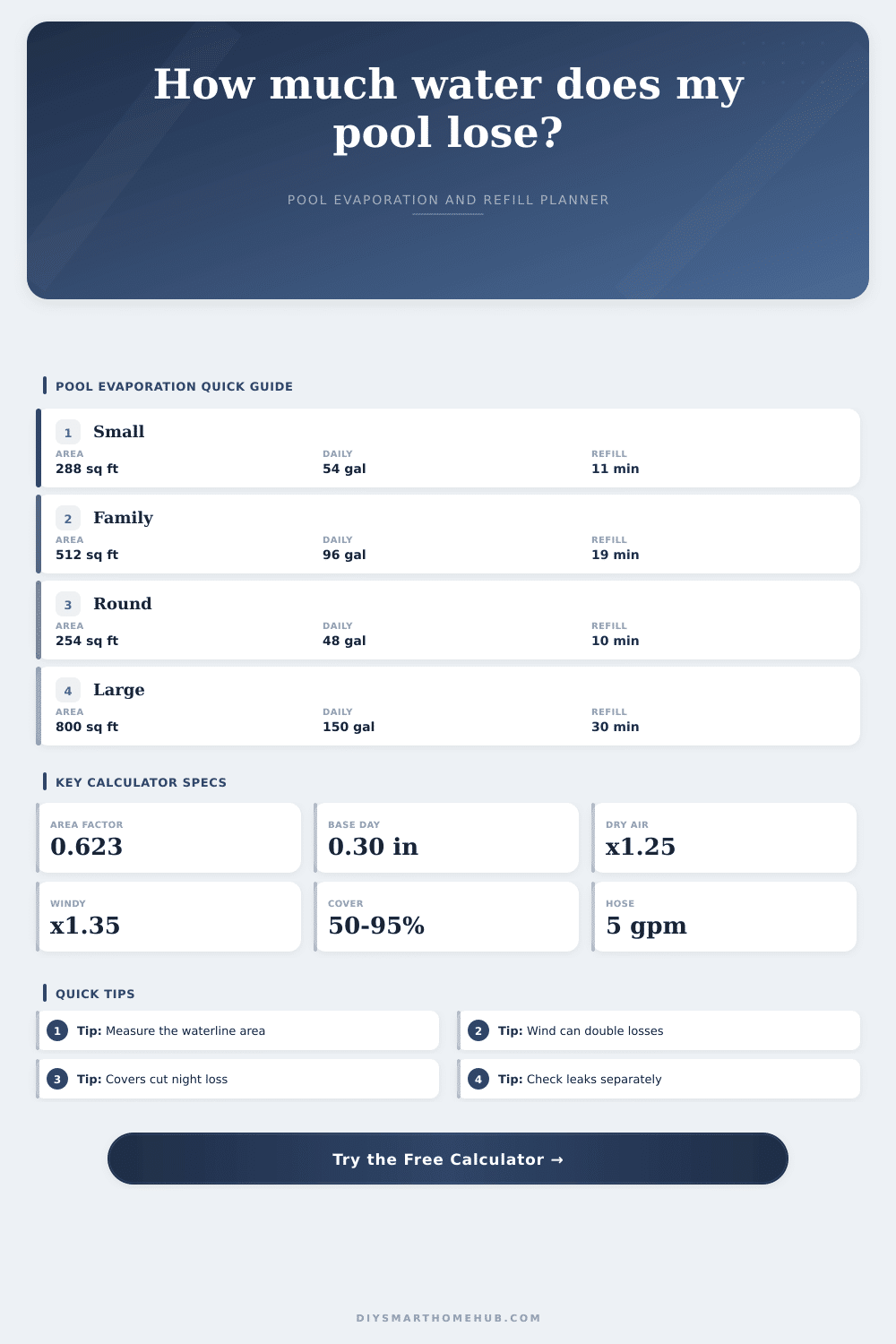
| Rectangle | Length x width | 16 ft x 32 ft | 512 sq ft / 47.6 sq m |
| Round | pi x (diameter / 2)² | 18 ft diameter | 254 sq ft / 23.6 sq m |
| Oval | pi x (length / 2) x (width / 2) | 15 ft x 30 ft | 353 sq ft / 32.8 sq m |
| Freeform | Length x width x area factor | 18 ft x 36 ft x 0.65 | 421 sq ft / 39.1 sq m |
| Condition | Baseline inches per day | Typical multipliers | What changes the result |
|---|---|---|---|
| Humid and calm | 0.10 to 0.20 in/day | Temp 0.85x, wind 0.85x | High humidity and still air slow evaporation. |
| Average outdoor day | 0.20 to 0.35 in/day | Temp 1.00x, wind 1.00x | Useful starting point for many uncovered pools. |
| Hot and dry | 0.35 to 0.55 in/day | Temp 1.12x, humidity 1.25x | Dry air accepts more water vapor from the surface. |
| Heated or windy | 0.40 to 0.80 in/day | Temp 1.25x, wind 1.35x | Warm water and wind can create very high losses. |
| Cover situation | Reduction to enter | Net loss example | Best use in calculator |
|---|---|---|---|
| No cover | 0% | 100% of computed loss | Use for uncovered daytime or exposed overnight water. |
| Partial cover or blanket gaps | 40% to 70% | 30% to 60% of computed loss | Use when steps, spillovers, or open sections remain exposed. |
| Solar blanket | 70% to 90% | 10% to 30% of computed loss | Use for floating covers that touch most of the water surface. |
| Automatic or safety cover | 85% to 95% | 5% to 15% of computed loss | Use when the cover is closed for most evaporation-prone hours. |
| Water to replace | 3 gpm hose | 5 gpm hose | 8 gpm hose |
|---|---|---|---|
| 50 gallons | 16.7 minutes | 10.0 minutes | 6.3 minutes |
| 100 gallons | 33.3 minutes | 20.0 minutes | 12.5 minutes |
| 250 gallons | 1.4 hours | 50.0 minutes | 31.3 minutes |
| 500 gallons | 2.8 hours | 1.7 hours | 1.0 hour |
Uncovered day
Best for estimating visible waterline drop when the pool is open through sun, breeze, and dry afternoon air.
Covered night
Use a high cover reduction when the cover seals most of the water during cool, dry overnight hours.
Wind exposed
Choose a higher wind multiplier for open yards, raised pools, spillovers, vanishing edges, and screen-free decks.
Humid climate
High humidity lowers the vapor drive, so evaporation can be modest even when the pool surface is warm.
You add water, adjust your chemistry, wipe down side. A few days later, a hot, dry breeze blows across lawn. And your water level has receded until it’s at the skimmer. Fill it back up again. Where did all the water go?
Hundreds of gallon evaporate from most pools each week (but that’s not a “leak”). That’s physics. Knowing how much water you’re losing will help you plan your re-fill schedule, and it’ll help you save on chemicals and heat while protecting your equipment.
How to Calculate Pool Evaporation
From there, simply enter your local weather conditions and the calculator will take care of the rest (see above). You no longer need to worry about converting or plugging in any conversion numbers; that’s all taken care of for you.
The single-most important variable here is actual surface area of water being evaporated. Evaporation occurs only at top level, so it’s easy to understand how someone can confuse pool volume with surface area. For example, even though a shallow but large pool has less water, it may actualy lose more due to its increased surface exposure.
To make estimating the square footage easier, we’ve included some reference tables within calculator for popular shapes such as ovals, rounds and rectangles. If you don’t know the precise measurements, this should of help you get close enough to start.
Now let’s assume you’ve got the space. Next, it’s up to Mother Nature. To begin with: Wind removes that thin blanket of moist air that would otherwise settle on top of the water’s surface. When new, dry air meets the water surface without that moist buffer evaporation speeds up.
The calculator lets you input for wind exposure (from a windblown hillside to a covered courtyard). If your pool is exposed to a breeze, you can expect higher-than-average evaporative losses.
Conversely, humidity have the reverse effect. During a swampy summer when the air is already dripping wet with water vapor, your pool will lose less. And during a dry desert climate where the air is desperate for a drink, it will aggressively suck moisture off the pool’s surface. The tool uses your relative humidity percentage to show how much the air wants to absorb moisture.
And then there’s temperature. Warm water evaporates faster than cool water. Heat in the pool itself feed into evaporation. You can choose between warm air over the water, which is warmer than the water itself, or cooler air mixing in at night like a hot tub.
These are all factors that feed into calculator to find the starting point for how fast water will evaporate. Each degree of difference impacts the vapor pressure. These small details add up to why your pool might seem to shrink faster when it is heated in the evening versus a milder afternoon.
The best protection against evaporative losses is covers. An automatic cover or even a solar blanket will create a physical barrier between the air and water and reduce evaporation by as much as ninety percent.
The calculator allows you to enter a cover reduction percentage and observe effects of a covered vs an uncovered pool. For example, you may find that while a cover during the daytime will save money just a couple hours with your pool uncovered at night can offset those savings. The reference tables on this page clearly show how different cover types affects net loss.
And lastly, how long until that missing water is replaced? That’s based off your hose flow rate, which changes a lot depending on your municipal pressure and the size of your hose. A regular garden hose flows at five gallons per minute, and a bigger one might flow at ten. That gives you an idea of when to top off.
It also reminds you not to leave the hose running all night. Doing so wastes energy used to heat fresh water and increases your water bill due to evaporation.
You cannot prevent evaporation; you can manage it. You need to know what makes water evaporate so you can refill, heat or cover accordingly. You do not want to eliminate evaporation entirely. You simply want to learn it enough to maintain balance in your pool while minimizing cost. If your water level falls, you’ll know if it’s because of the weather or if it’s time to take action.