Room BTU Cooling Load Calculator
Estimate room cooling capacity from floor area, ceiling height, insulation, sun exposure, occupants, electronics heat, and window load.
Cooling load estimate
Enter room details and calculate to see the BTU/h load.
| Input | Calculator formula | Typical range | Why it matters |
|---|---|---|---|
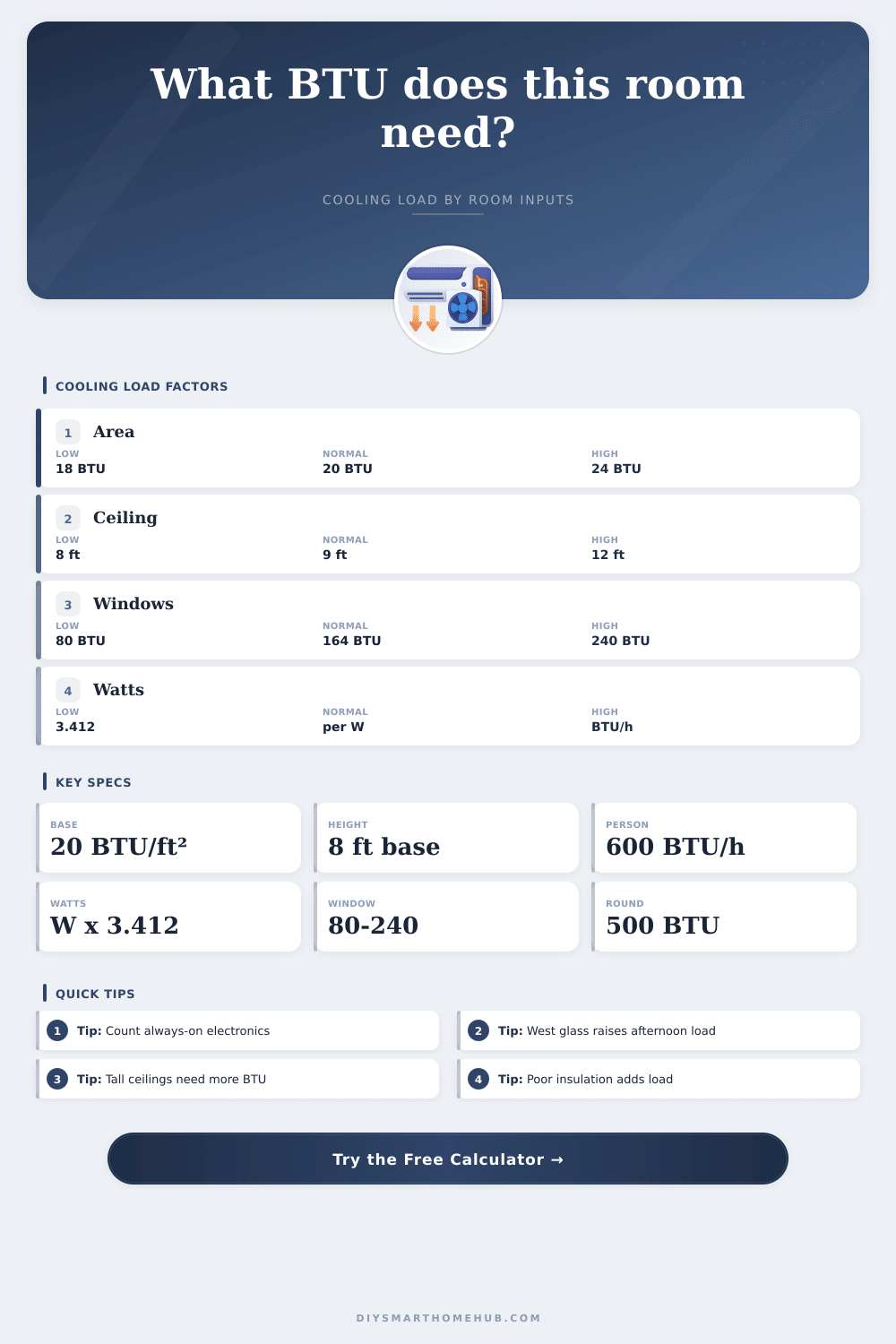
| Floor area | Area x 20 BTU/h per ft² | Small room to open plan | Sets the baseline cooling load before adjustments. |
| Ceiling height | Base load x height / 8 | 7.5 to 14 ft | Taller rooms contain more air volume and wall exposure. |
| Insulation | Base load x 0.82 to 1.32 | Excellent to leaky | Envelope quality changes heat entering the room. |
| Sun exposure | Envelope load x 0.90 to 1.25 | Shaded to west-facing | Direct solar gain raises peak afternoon load. |
| Occupants | People x 600 BTU/h | 0 to 10+ | People add sensible and latent heat to the room. |
| Electronics | Watts x 3.412 BTU/h | 0 to 2,000 W | Nearly all device power becomes room heat. |
| Windows | Glass area x exposure factor | 80 to 240 BTU/h per ft² | Glass adds conductive and solar cooling load. |
| Window condition | BTU/h per ft² | Metric equivalent | Best use in calculator |
|---|---|---|---|
| Low-E shaded glass | 60 | 646 BTU/h per m² | Modern shaded windows with solar control. |
| North or fully shaded | 80 | 861 BTU/h per m² | Minimal direct sun, still includes conduction. |
| East morning sun | 120 | 1,292 BTU/h per m² | Morning sun with lower afternoon peak. |
| South mixed sun | 164 | 1,765 BTU/h per m² | General-purpose exposed-window estimate. |
| West afternoon sun | 240 | 2,583 BTU/h per m² | Hot afternoon glass and high peak demand. |
| Room type | Area | Typical load pattern | Watch point |
|---|---|---|---|
| Bedroom | 120 to 220 ft² | Moderate people load, low electronics | Window orientation can dominate small rooms. |
| Home office | 100 to 180 ft² | Computer and monitor heat add up | Count equipment that stays on during cooling hours. |
| Media room | 180 to 320 ft² | High electronics and occupant heat | Receivers, game systems, and displays become heat. |
| Garage studio | 250 to 500 ft² | Poor insulation, high shell gain | Ceiling and door insulation drive the result. |
| Open plan zone | 450 to 900 ft² | Large area with mixed sun exposure | Separate zones may need separate measurements. |
It’s surprisingly difficult to feel comfortable in a room that’s technically the right size but the wrong temperature. You purchase an air conditioner based off a chart in your local hardware store and hope for the best. By July, you find out that it’s running full blast all day long but never manages to make the space cool enough. Worse yet: it cycles on and off every ten minutes, blowing cold air for seconds before shutting down. Leaving you humid and annoyed because nobody bothered to calculate the cooling load; only guess it.
And we know what happens when you guess. To get it right means taking into account the room as a system… Not simply a box with four walls and a roof. You’re off to a start with floor space, but that’s just the starting line.
Why You Need to Calculate Cooling Load Properly
Most rough estimates takes into account an average amount of insulation and an average (i.e., 8 foot) ceiling. There are west-facing windows. There are ten-foot ceilings. That baseline gets blown away fast, since you’ve got not only more air to condition but also more solar heat flowing in through the window glass. To avoid underestimating how much air you need to treat, the calculator above adjusts the base load accordingly for envelope quality and height.
You’ll notice that with tall rooms, the unit has to work a lot harder to pull the temperature down at head level. Because hot air rises, the unit must work extra hard to pull the temperature down at head level, and people routinely mess this up by measuring square footage without factoring in cubic volume.
Finally, there’s the matter of self-generated heat, a thing that often hides from view until it piles on top of itself. Nearly every piece of electronics consume electricity, and nearly all of what an electrical gadget uses is turned into heat. Add in a desktop computer, a TV, some gaming consoles, and suddenly you’re adding thousands of BTUs per hour to the cooling task, despite the fact that each of those items doesn’t look so bad on its own. The tool takes this into account, allowing you to enter in wattages. Using the normal conversion factor, it turns the watts right into a thermal load.
You’ll discover that often a home office or a media room require much more capacity than a similarly sized bedroom. Why? Because one room contains mostly still air while the other room is filled with heat-producing equipment. But then again, humans also contribute, since each person generates their own amount of sensible and hidden heat as part of their body’s metabolic process. When we invite friends over to watch a movie on movie night, our human load makes a difference, enough that we can measure it, if five people crowd into the same living room. That’s a small thing, but when you’re operating at the edge of what a tiny unit can handle, it matters.
Finally, glass is the weak spot on any thermal envelope, which is why it has its own category for windows. A south-facing window lets in consistent daylong heat; a west window slams it with afternoon solar blast. Those are weighted by exposure factors in the calculator. (A shaded north window contributes little; an unshaded expanse of west glass is heavy.) Numbers go way down if there’s external shading or moddern Low-E coatings. So: Your house’s orientation makes a bigger difference to how well your air conditioner cools then what compressor brand you got.
This all ties back into the insulation quality. If your room has bad insulation and leaks, it’s fighting an uphill battle to keep cool air in, whereas if it’s tight and well insulated, it will hold on to cool air far better. This variation is accounted for in the tool; you can specify if the walls are drafty and old or solid and sealed. You can also add a 10-20% buffer to the size. This ensures you aren’t buying just barely enough for a perfect day, but instead have extra capacity if the heat wave is harder than expected.
You should of checked this first. The bottom line: When it comes to sizing cooling equipment, there’s always a balancing act between running long enough cycles to remove moisture from the air but not work the heck out of the compressor. The BTUs are key to comfort. And as it turns out, comfort is more about doing the homework on what actualy heats up your room than about brand names.