Heat Pump COP by Outdoor Temp Calculator
Estimate delivered COP, derated heating capacity, balance point, electric input, and auxiliary heat share from rated output, input watts, outdoor temperature, and design heat load.
Outdoor temperature performance
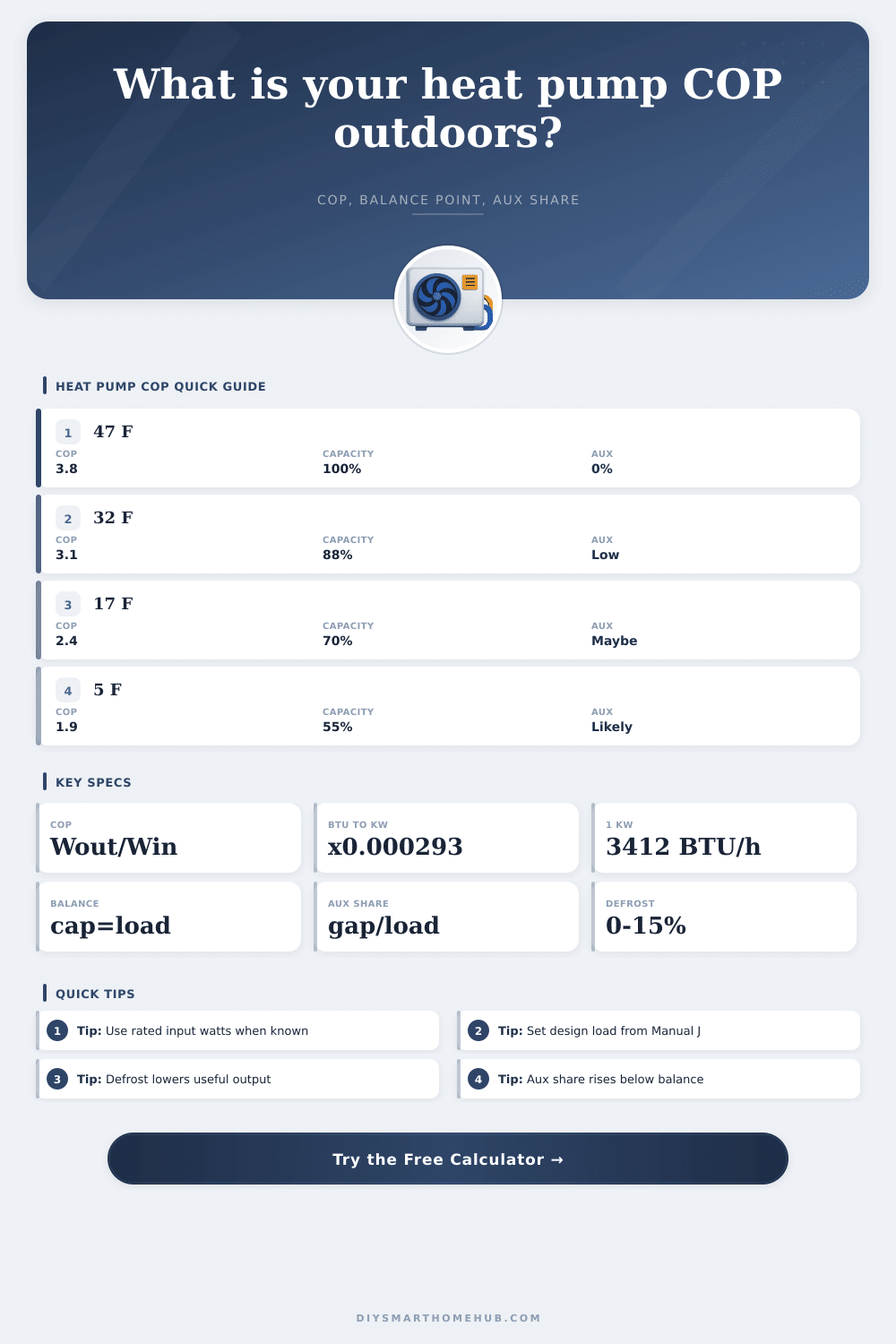
| Outdoor condition | Typical COP pattern | Capacity behavior | Planning note |
|---|---|---|---|
| 47°F / 8°C rating point | Often 3.0 to 5.0 | Usually near rated heating output | Good anchor for nameplate or submittal data. |
| 32°F / 0°C damp cold | COP drops and defrost may appear | Moderate derate | Include cycling or defrost penalty for real operation. |
| 17°F / -8°C low rating | Often around 1.8 to 3.0 | Cold-climate units retain more output | Use manufacturer 17°F data when available. |
| 5°F / -15°C design cold | COP may approach resistance backup | Capacity can be the limiting factor | Balance point decides whether aux heat is needed. |
| Step | Formula used | Output | Why it matters |
|---|---|---|---|
| Rated COP | Heat output W / electric input W | Base COP | Verifies the nameplate efficiency basis. |
| Temperature COP | Rated COP x temperature derate x defrost factor | Outdoor COP | Estimates performance away from the rating point. |
| Home load | Design load x current temperature difference / design temperature difference | BTU/h demand | Links outdoor temperature to house heat loss. |
| Balance point | Find outdoor temp where heat pump capacity = home load | Temp threshold | Marks where auxiliary heat begins to contribute. |
| Auxiliary share | Max(load - heat pump output, 0) / load | Percent of load | Separates compressor heat from backup heat. |
| Scenario | Rated heat output | Design heat loss | Common result to watch |
|---|---|---|---|
| Bedroom mini split zone | 9k to 12k BTU/h | 4k to 10k BTU/h | COP stays high if load is below capacity. |
| Open living zone | 15k to 24k BTU/h | 12k to 22k BTU/h | Defrost penalty can show during damp freezing weather. |
| Ducted central heat pump | 24k to 48k BTU/h | 20k to 60k BTU/h | Balance point can sit above design temperature. |
| Radiant air-to-water source | 18k to 60k BTU/h | 15k to 55k BTU/h | Water temperature and outdoor temp both affect COP. |
When the house remains cool and your heat pump turns on, don’t assume anything’s amiss with the unit. Physics simply means compressor has to work extra-hard when drawing out heat from the outside air. That struggle has a direct impact on something called the COP. It stands for Coefficient Of Performance. Think of it as a measure of how many units of heat you get for each unit of electricity you use. In mild weather, you could see three or four-to-one in good times. But once the outside gets too chilly, that number dwindles, eventually getting so small that all you’re doing is running an electric resistance heater. Use the calculator above to see the decline set in, before it shows up on your utility bill.
What about the balance point? Here’s the single most critical figure to monitor. The balance point is the outdoor temp at which heat loss of your house matches the maximum capacity of your heat pump. When the outside temp are above the balance point, the system will handle all the heat needed by itself. If it’s below the balance point, the system kicks in auxiliary electric strips to close the gap. These strips is only efficient in the sense that they are honest about their waste, since they convert electricity to heat at a one-to-one ratio. A one-to-one ratio is half as efficient than the COP of two provided by a heat pump. By knowing where your balance point lies, you can tell whether you’ve sized your unit properly for your climate, and whether you’re likely to be socked with a whopper of a bill during the winter months.
Understanding Heat Pump Performance
The other input is called Derating. Derating relates performance loss to ambient temperature. The system harvests less heat as outside coil cools down. Use the tool to enter a percentage derate for each 10 degree drop from the rating point. Why does this matter? Not all heat pumps is created equal. Some have a higher derating factor then others. For example, some air-source units lose capacity quickly as temperatures drops, whereas a cold climate model maintains capacity well into lower temps. Failure to account for that will skew your results. You’ll overestimate output and end up with heating power insufficient for your needs. You think it’s full blast at zero; it’s actualy half what’s needed. The page has a table of typical COPs by temperature band, so you can eyeball whether your assumptions makes sense.
Complexity: Theory doesn’t address defrost cycles. In damp cold conditions, the outdoor coil accumulates frost which restricts airflow. To fix this, the system turns itself off and back on in reverse briefly (blowing cool air into your home) until the frost melts. This wastes energy by stealing it from the heating load. The calculator provides a penalty field for this effect. Just a five percent reduction can be the difference between meeting your load comfortabley or having to pay for expensive backup heat when it’s sleeting outside. Small factor, big difference.
People also mix up capacity with comfort. If a bigger unit warms space quicker, they assume it’s more comfortable, so they order a bigger one. But bigger units short cycle, meaning the compressor constantly turns on and off instead of staying on to run efficient. While the rated efficiency may look great on paper, short cycling lowers effective COP.
It prompts you to plug in the heat loss of the room you want to heat, ideally from a proper load calculation as opposed to a guesstimate based off approximate square footage. Accurate input avoids false confidence caused by guessing. Knowing precisely how much heat is escaping the walls and windows lets you know just how much heat the system will have to make. When there is auxiliary heat running, the output section show the combined COP. That’s what you’re really getting, the overall cost of heating your space to whatever temperature you have it set for. It’s usually less than just the compressor by itself, but it still shows actual price tag for maintaining warmth. Anything less than a combined COP of two means you’re no longer getting efficiency; you’re paying extra for comfort.
The idea is to treat the heat pump like the main engine and the aux strips like an emergency backup. Use the latter for super-cold days, don’t burn through it every day when it’s only mildly chilly outside. Sometimes raising or lowering the indoor setpoint just enough can put you back over the tipping point and avoid that penalty altogether. With that view of things, the heat pump goes from a mystery to a manageable system. You stop questioning why the bill spikes and begin to know when outside conditions push the system out of its best range.
Once we break it down by variables, the math is straightforward. Capacity will tell you whether the system can keep up. COP will tell you how much it costs to do so. And balance point will tell you when the backup arrives. You should of kept those numbers in mind; winter comfort is less about mystery and more about management.