Professional Monitoring vs Self Monitoring Cost Calculator
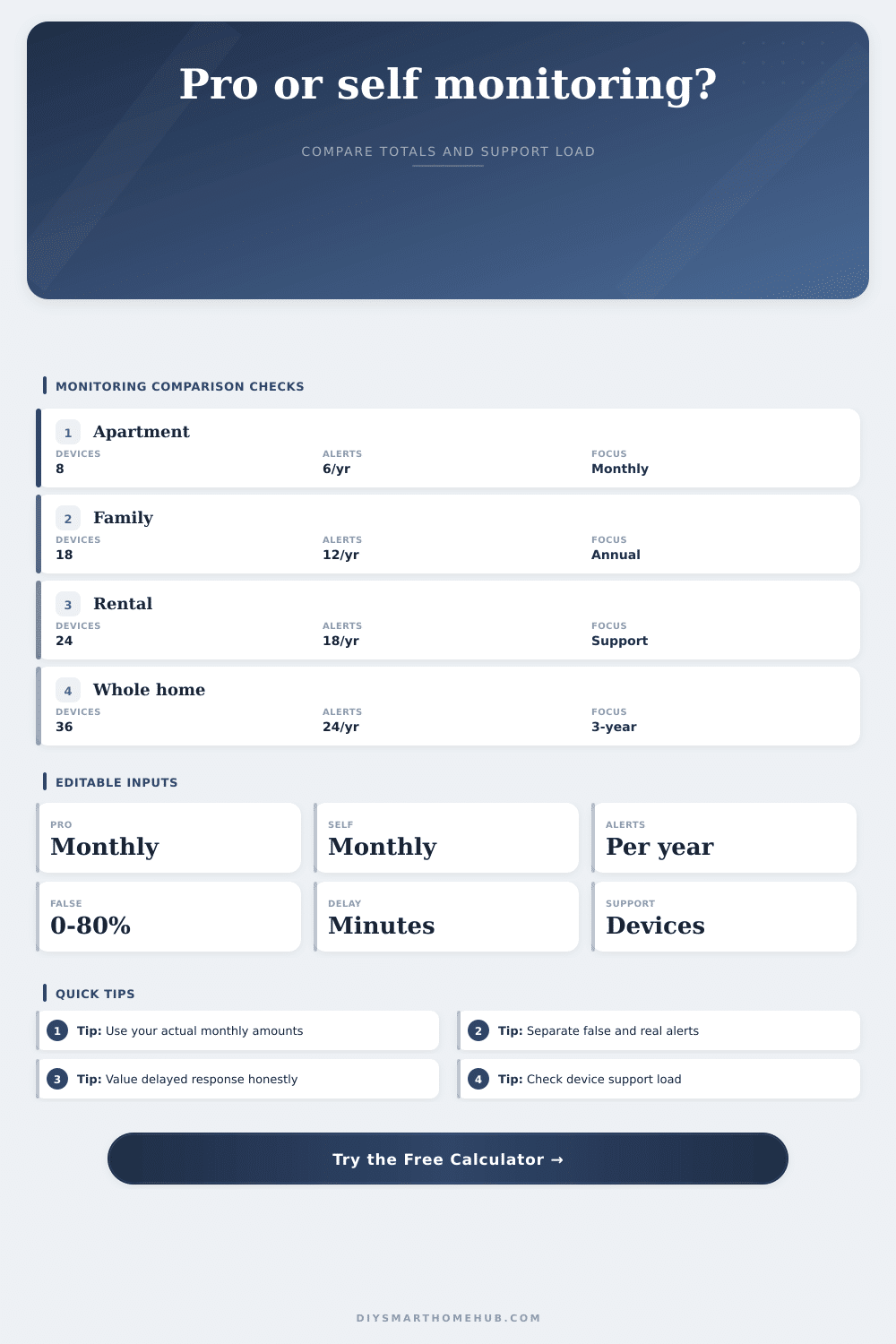
Compare professional monitoring and self monitoring with your own monthly amounts, alert volume, false alarm assumptions, response-time value, 3-year totals, break-even response value, and device support load.
Calculation breakdown
Professional monitoring
Uses the professional monthly amount you enter, plus the full modeled false alarm impact for events that escalate.
Self monitoring
Uses the app or cloud monthly amount you enter, partial false alarm impact, and response delay value for real alerts.
Response value
Converts extra self-response minutes into an annual value using real alerts and your entered value per minute.
Device support
Compares device count against solo self-monitoring and coordinated monitoring support bands so scale is visible.
| Formula item | Calculator formula | Input used | Result affected |
|---|---|---|---|
| Professional monthly total | Professional monthly amount entered | Professional monitoring monthly amount | Professional annual and 3-year totals |
| Self monthly total | Self app or cloud monthly amount entered | Self-monitoring app or cloud monthly amount | Self annual and 3-year totals |
| False alarm events | Alert events x false alarm share | Alert events and false alarm percentage | False alarm allowance on both paths |
| Response delay value | Real alerts x extra minutes x value per minute | Extra minutes and response-time value | Self-monitoring effective annual total |
| Break-even value | Base professional premium / response minutes exposed | Monthly amounts, false alarms, real alerts, delay minutes | Response value needed for crossover |
| Device support band | Device count | Self-monitoring load | Planning interpretation |
|---|---|---|---|
| Light | 1-12 devices | Up to 100% | Usually manageable if alerts are tuned and responsibilities are clear. |
| Moderate | 13-24 devices | 101-200% | Self monitoring may need shared access, naming discipline, and alert rules. |
| Heavy | 25-40 devices | 201-333% | Device count increases testing, maintenance, and missed-alert exposure. |
| Portfolio | 41+ devices | 334%+ | Coordinated response roles often matter as much as the monthly amount. |
| Alert pattern | False alarm share | Real alert share | Calculator focus |
|---|---|---|---|
| Well tuned | 0-15% | 85-100% | Response-time value matters more than nuisance events. |
| Normal mixed home | 16-40% | 60-84% | Both false alarm impact and response value should be modeled. |
| Noisy setup | 41-65% | 35-59% | False alarm impact can dominate the yearly comparison. |
| Untuned alerts | 66%+ | Under 34% | Retune alerts before treating any path as the final choice. |
| Scenario | Typical devices | Alert volume | Comparison signal to watch |
|---|---|---|---|
| Apartment starter | 6-10 | Low | Monthly difference may outweigh support complexity. |
| Family security stack | 18-28 | Medium | Response value and shared notification coverage become important. |
| Rental or remote property | 20-35 | Medium-high | False alarm impact, travel, and missed alerts can drive the decision. |
| Whole-home buildout | 36+ | High | Device support load can matter more than a small monthly difference. |
So when the motion sensor by your back door trips because a leaf blew on it or the baby monitor goes off, you’re panicking (in that situation), does it matter whether you have a self monitored system or a professionally monitored one? Sometimes it seems like a coin flip. But sometimes one will cost you more each month. And the other will cost you in stress and time, an expense that’s easy to overlook because it isn’t dollars. So when you’re comparing systems, don’t ask yourself which has the coolest app. Ask yourself which route will save your mental health (and wallet) over next three years, not just this month.
When most people examine monthly cost they end there. That’s where they go wrong. $27 more per month doesn’t seem like much of a difference. But over time, that translates into hundreds of dollars per year. Money is only half the equation. The second half is what happens when someone actualy needs to use system.
The Hidden Cost of Self Monitoring
You get that call at 3 AM. How is that going to happen if it’s just you? If it’s self monitored, then you’re it. You are now the dispatch center. You are the one who verifies the alarm and makes the call.
There’s a calculator I made that does all of this math for you. But it needs accurate information from you. First, what are you paying monthly? Add up everything. Don’t forget about additional cloud storage and cellular backup if you have self monitoring plan. Next, consider how many alerts you get per month. A standard family home might have a dozen notable ones each year. An apartment with fewer entrances may only have half as many. A big rental property with two-dozen sensor could easily top 18 or even more.
The more alerts, the more friction for you. Even at lower prices, self monitoring is an expensive way to get false alarms. Waste a few hours a month on false alerts and you realize that self monitoring are costing you in time and stress. Thirty-five percent of your alerts are false? That’s a waste of your time. It happen every single month. A professional monitor takes care of that expense. They know what to ignore. It costs you nothing but their expertise to filter out the noise.
Self-monitoring means you lose sleep and waste energy. It can also lead to municipal fines from false reports being sent out. You can put a dollar figure on that negative impact. That’s a good thing. Because now you’ve acknowledged that false alarms don’t just annoy. They cost something as well.
There’s another invisible variable: response time. A pro will respond in minutes. Responding yourself depends on whether you are awake, near the unit, and not otherwise distracted (for example, scrolling through email when an alert hits). That can be valuable time (minutes)… That may shut the door on catching an intruder or stopping a leak. Is that something you want to take a chance on? Only you know what level of uncertainty you are comfortabley with.
The number of devices actually does matter. It’s one thing to manage a couple of sensors. It becomes different problem when there is dozens. That’s where it gets overwhelming and you begin to fail at remembering what alerts are associated with which device. Do you remember which batteries are dead? Are their batteries expired? Forget about it! These are the tasks that grows in complexity and cost. The reference table is pretty clear on the page. The amount of thinking involved increases rapidly as you add more and more devices. If you’re doing it yourself, that’s quite a bit of mental work.
That’s the math for the real picture: Add up the costs of device maintenance, the frustration of false alarms, and the headaches of delay in responding to issues over a period of thirty-six months, and monthly savings evaporate. That is the amount where watching things yourself becomes less cost-effective than professional help. It’s called the break-even figure. If it’s more than the value of your time and stress, then peace of mind would of pay for the professional route.
Remember that security isn’t just a matter of excluding undesirable persons. It’s a question of maintaining predictability in your life. Consider these costs when determining what to spend money on. The “least” expensive on paper is frequently the “most” expensive in reality. Either way, you’re paying for the convenience. Just decide if you’ll pay someone else or if you will pay with your attention. Make sure it’s the one that allows you to sleep at night.