pH Adjustment Volume Calculator
Estimate acid or base adjustment volume from reservoir gallons, current pH, target pH, alkalinity buffering, solution strength, concentration percent, and a step-size cap.
| Formula check | Equation | Input units | Result unit |
|---|---|---|---|
| Rectangular volume | gallons = L x W x H / 231 | inches | US gallons |
| Metric volume | liters = L x W x H / 1000 | centimeters | liters |
| Cylinder volume | volume = pi x radius squared x height | in or cm | gal or L |
| pH delta | delta = target pH - current pH | pH readings | pH units |
| Alkalinity conversion | alkalinity meq/L = ppm as CaCO₃ / 50 | ppm CaCO₃ | meq/L |
| Buffer fraction | fraction = delta / 1.5, clamped 0.06 to 1.00 | absolute pH delta | unitless |
| Buffer demand | meq = liters x alkalinity meq/L x fraction | L and meq/L | meq |
| Free H term | meq = |10^-target - 10^-current| x liters x 1000 | pH and liters | meq |
| Concentration scale | effective meq/ml = profile meq/ml x percent / 100 | meq/ml and % | meq/ml |
| Dose volume | ml = total meq / effective meq/ml | meq and meq/ml | ml |
| ml per gallon | ml/gal = total ml / net gallons | ml and gallons | ml/gal |
| Step dosing | steps = ceiling(total ml / (cap ml/gal x gallons)) | ml and ml/gal | steps |
| ppm estimate | ppm = ml x density x 1000 x percent / 100 / liters | ml, g/ml, L | mg/L |
| Reservoir example | Nominal volume | Net allowance | Net math volume |
|---|---|---|---|
| Countertop pod tank | 1.2 gal | 0% | 1.2 gal / 4.5 L |
| Small tray reservoir | 4 gal | 5% | 3.8 gal / 14.4 L |
| Storage tote | 14 gal | 8% | 12.9 gal / 48.8 L |
| Mixing bin | 20 gal | 10% | 18.0 gal / 68.1 L |
| Irrigation barrel | 32 gal | 0% | 32.0 gal / 121.1 L |
| Stock tank | 55 gal | 6% | 51.7 gal / 195.7 L |
| Reference term | Low example | Medium example | High example |
|---|---|---|---|
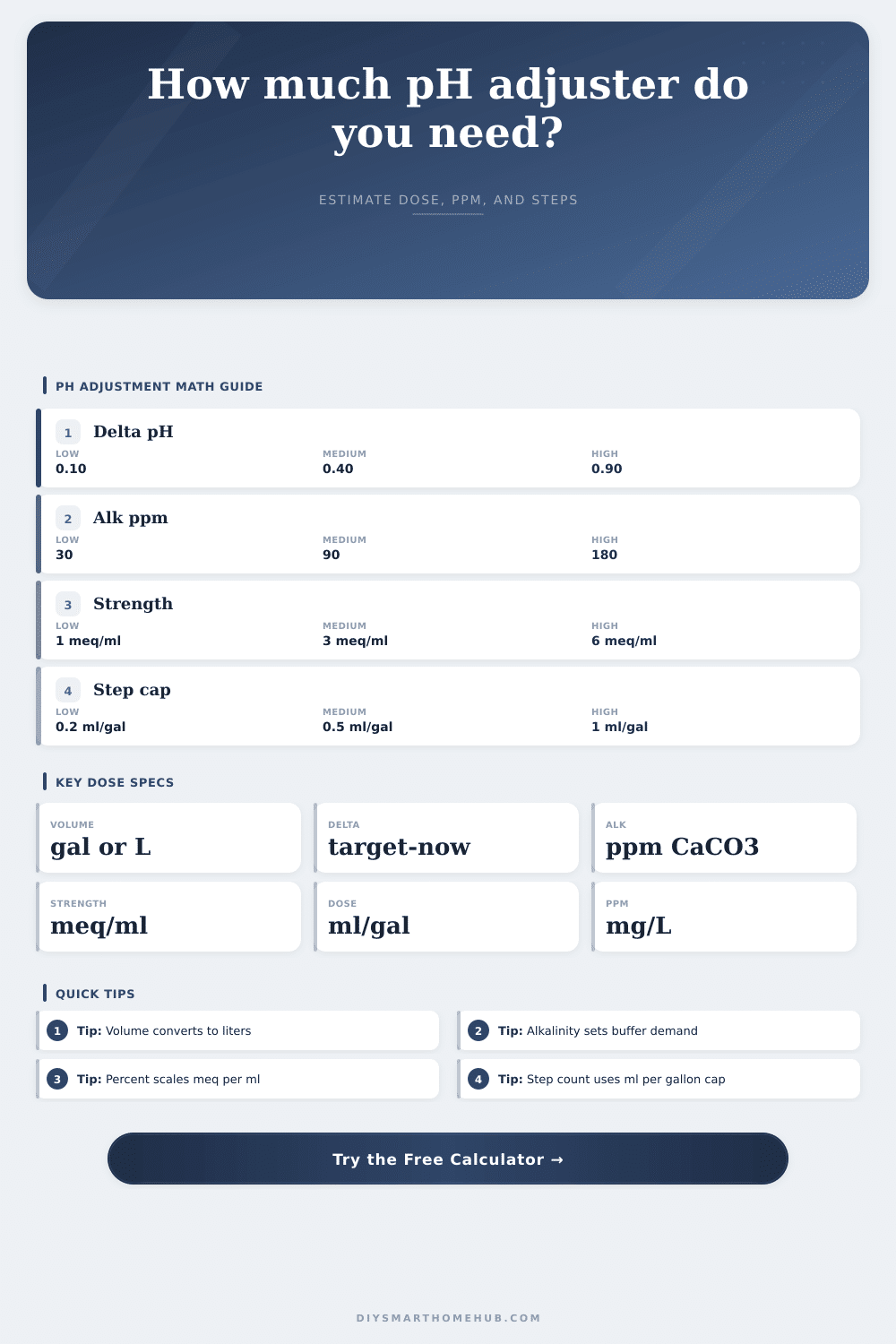
| Total alkalinity | 30 ppm = 0.60 meq/L | 90 ppm = 1.80 meq/L | 180 ppm = 3.60 meq/L |
| pH delta fraction | 0.10 / 1.5 = 0.067 | 0.45 / 1.5 = 0.300 | 1.50 / 1.5 = 1.000 |
| Effective strength | 1 meq/ml x 20% = 0.20 | 3 meq/ml x 30% = 0.90 | 6 meq/ml x 50% = 3.00 |
| Step cap example | 0.20 ml/gal | 0.50 ml/gal | 1.00 ml/gal |
| Profile example | Target move | Effective strength | Estimated total |
|---|---|---|---|
| Acid profile A at 30% | 7.2 to 6.8 | 0.30 meq/ml | 108 ml |
| Acid profile B at 30% | 7.2 to 6.8 | 0.90 meq/ml | 36 ml |
| Acid profile C at 30% | 7.2 to 6.8 | 1.80 meq/ml | 18 ml |
| Base profile A at 30% | 5.8 to 6.2 | 0.30 meq/ml | 108 ml |
| Base profile B at 30% | 5.8 to 6.2 | 0.60 meq/ml | 54 ml |
| Base profile C at 30% | 5.8 to 6.2 | 1.20 meq/ml | 27 ml |
If you’ve ever maintained a large aquarium or grown plant in a hydroponic system, you know what happens when you first add some nutrients to the reservoir. In just a few minutes, the pH meter flies all over the place. Every time you add a drop of an acid or a base, the water seems to resist, almost as if the water is trying to fight back against the chemistry change.
It’s not random chaos (it’s called buffering). And if you want to know how many drops of an adjuster will be needed, you must look beyond just the pH number and focus instead on what keeps the pH number constant. Total alkalinity is the true motivator. When you go up with the pH (adding more hydroxide ions), it absorb those ions and vice versa for lowering the pH (by removing hydrogen ions). So with high alkalinity water, you’re simply dumping adjustment into a hole until your sponge is full.
How to Adjust pH Without Guessing
The calculator at the top does this for you; just input your own buffer values, then it figures out exactly how many milliliters it’ll take to shift the needle for you; no more guessing. Most people only think about the pH delta, and completely forget that when going from 7.0 down to 6.5 with low alkalinity water, it only takes a small percentage of the dose than it would otherwise take with high alkalinity water. That’s where most folks screw up, since they assume all water are equally resistant.
Know your net reservoir volume, the total amount of water, not just the reservoir itself. Items inside the tank, such as plant baskets, grow stones, or pumps, will take up space and reduce the amount of water it hold. That means what you thought was a 20 gallon tank may be really an 18 gallon one with enough room for all your hardware and filters. This allowance for displacement is factored into the tool so you’re not diluting your dose based off how much empty space is in your tank. It is a small detail, but it make a big difference when you’re trying to hit a bullseye.
Everything also depends on the solution’s strength. A thirty percent phosphoric acid solution hits much harder than a diluted version. And remember, all chemicals has a base strength that dictates what concentration percentage should of be used. Underestimate it and you’ll overpour. Your pH crashes and stresses your livestock or roots. The reference table on the page makes it clear how different profiles scale depending on their concentration. From there you can see that a potent solution require far less volume than a weak solution to get the same result.
Maybe the most useful part of it for actualy use is step dosing. The danger with dumping your entire dose at once is that the water will overshoot the desired chemistry and the system may not be adequately mixed to compensate. The step size caps the dose volume during each addition. So you take a little bit, mix it up, let it sit, check it again. It turns a scary chemical change into a controlled situation. This way, you won’t panic as the pH runs away from you.
Water chemistry in the real world doesn’t stay constant. Over time plants will take up minerals and may also change the pH slightly upwards or downwards. Your start isn’t necessarily your forever. The calculation you get from this tool is only a starting place. You’ll have to check it and calibrate as necessary. Knowing what ppm to add allows you to gauge how much active ingredient is getting into the system compared to overall volume. This ppm estimate puts the dose into context so you know if you are adding small traces or meaningful amounts of mineral content.
Instead of thinking of adjusting pH as a correction, think of it as a balancing act. You’re not pushing water to do anything, but working with its natural buffering capacity until there’s a stable balance. Confidence comes from the math, control comes from observation. Use the estimated dose, add in increments, and listen to the system for the signal that it’s time.
Adjusting pH isn’t the goal; it is an attempt to create a stable environment where fish or plants can thrive without constant help. Understanding what stabilizes your pH is the first step toward establishing such stability.