DLI Target by Crop Calculator
Compare crop daily light integral targets with measured PPFD, photoperiod, canopy area, fixture PPF from watts and PPE, and the coverage area your light can support.
Crop light target
Fixture output model
| Crop or stage | Common target DLI | Typical photoperiod | PPFD for midpoint | Planning note |
|---|---|---|---|---|
| Seedling or propagation | 6 to 12 mol/m²/day | 16 to 18 hours | 139 micromol/m²/s at 18 h | Gentle light for young plants |
| Microgreens | 8 to 14 mol/m²/day | 12 to 16 hours | 191 micromol/m²/s at 16 h | Compact growth without excess heat |
| Lettuce and leafy greens | 12 to 17 mol/m²/day | 14 to 18 hours | 252 micromol/m²/s at 16 h | Common indoor lettuce planning range |
| Basil and culinary herbs | 14 to 20 mol/m²/day | 14 to 18 hours | 295 micromol/m²/s at 16 h | Aromatic herbs often prefer more light |
| Strawberry | 15 to 25 mol/m²/day | 12 to 16 hours | 397 micromol/m²/s at 14 h | Higher light supports flowering and fruit |
| Tomato or cucumber | 20 to 30 mol/m²/day | 14 to 18 hours | 434 micromol/m²/s at 16 h | Fruiting vines need high daily photons |
| Pepper or fruiting vegetable | 20 to 28 mol/m²/day | 14 to 18 hours | 417 micromol/m²/s at 16 h | High-light fruit set and canopy density |
| Low-light orchid or foliage | 4 to 8 mol/m²/day | 10 to 14 hours | 139 micromol/m²/s at 12 h | Lower target for shade-adapted crops |
| Fixture profile | PPE estimate | PPF per 100 W | Coverage at 250 PPFD | Coverage at 450 PPFD |
|---|---|---|---|---|
| Older LED or HPS estimate | 1.6 micromol/J | 160 micromol/s | 6.9 sq ft | 3.8 sq ft |
| Budget white LED | 1.9 micromol/J | 190 micromol/s | 8.2 sq ft | 4.5 sq ft |
| Mid-efficiency LED board | 2.2 micromol/J | 220 micromol/s | 9.5 sq ft | 5.3 sq ft |
| Modern full-spectrum LED | 2.5 micromol/J | 250 micromol/s | 10.8 sq ft | 6.0 sq ft |
| High-efficacy bar fixture | 2.8 micromol/J | 280 micromol/s | 12.1 sq ft | 6.7 sq ft |
| Top-bin horticulture LED | 3.0 micromol/J | 300 micromol/s | 12.9 sq ft | 7.2 sq ft |
| Target DLI | 12 hour PPFD | 14 hour PPFD | 16 hour PPFD | 18 hour PPFD |
|---|---|---|---|---|
| 8 mol/m²/day | 185 | 159 | 139 | 123 |
| 12 mol/m²/day | 278 | 238 | 208 | 185 |
| 16 mol/m²/day | 370 | 317 | 278 | 247 |
| 20 mol/m²/day | 463 | 397 | 347 | 309 |
| 25 mol/m²/day | 579 | 496 | 434 | 386 |
| 30 mol/m²/day | 694 | 595 | 521 | 463 |
| Scenario | Area | Fixture model | Target DLI | Estimated result |
|---|---|---|---|---|
| 2 x 4 ft lettuce rack | 8 sq ft | 120 W at 2.5 PPE, 85% usable | 15 mol/m²/day | Near target at 16 hours |
| Microgreens shelf | 4.5 sq ft | 45 W at 2.2 PPE, 80% usable | 10 mol/m²/day | Moderate PPFD over 14 hours |
| 3 x 3 ft pepper cabinet | 9 sq ft | 240 W at 2.5 PPE, 90% usable | 24 mol/m²/day | High DLI with 16 hour photoperiod |
| 4 x 4 ft tomato tent | 16 sq ft | 480 W at 2.6 PPE, 90% usable | 25 mol/m²/day | Enough photons for fruiting range |
| 0.9 m² leafy bay | 9.7 sq ft | 180 W at 2.6 PPE, 88% usable | 16 mol/m²/day | Comfortable leafy-green margin |
| Step | Formula | Input units | Output |
|---|---|---|---|
| DLI from PPFD | DLI = PPFD x photoperiod hours x 0.0036 | micromol/m²/s and hours | mol/m²/day |
| PPFD from DLI | PPFD = target DLI / (hours x 0.0036) | mol/m²/day and hours | micromol/m²/s |
| Fixture PPF | PPF = fixture watts x PPE x fixture count | W and micromol/J | micromol/s |
| Coverage area | Coverage = usable PPF / target PPFD | micromol/s and PPFD | m² and sq ft |
| Required watts | Watts = needed PPF / (PPE x fixture count) | PPF target and PPE | actual watts per fixture |
| Supplemental DLI | Light DLI target = crop DLI - daylight DLI | mol/m²/day | mol/m²/day from lamps |
Most indoor growers focus on fixture watts, but you should consider light hitting the leaves. Even with high-wattage light, it could be hung in a tent where photons weakens or spread too thin before reaching canopy. This can starve your tomatoes.
Enter your crop needs into calculator above and let it do the math for you, no more guesswork about conversions and coefficients. Instead of trusting marketing specs, convert electricity consumption to usable plant energy… Which saves you from overpaid bills.
Why You Should Care About DLI for Your Plants
DLI stands for Daily Light Integral. It’s a measure of all photosynthetically active radiation that hits a plant during one day. Picture it as a day’s worth of calories your plants consumes. DLI is different than PPFD (which measures intensity at any given instant).
PPFD might appear dramatic on a meter because it show a sudden burst of intense light. However, it doesn’t measure cumulative energy which is necessary for fruit set in plants like cucumbers and pepper. This is the difference between hobbyist and controlled-environment growing.
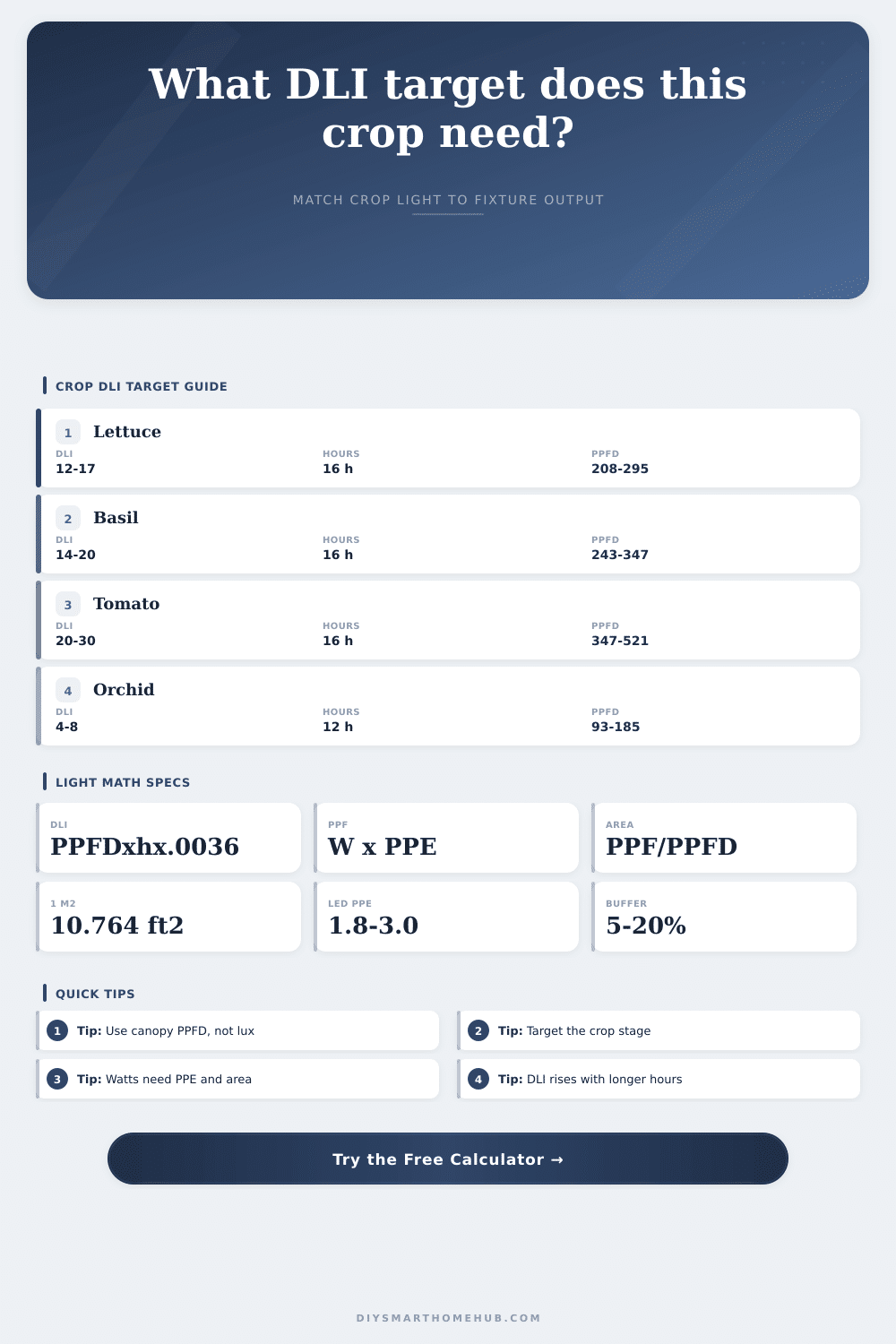
Before looking at hardware, know your crop choice: The target range is based off that. Leafy greens like lettuce only need moderate DLIs of about 12-17 moles of photons per square meter per day. These crops grows fast and do not need as much light as they reach the flowering stage.
Basil plants need slightly more light than lettuce, but still less than vine crop. And then there’s the tomato and pepper which are energy hogs; demanding 20-30 moles or more if serious yields is desired. Technically speaking, it’ll work to plant a bright-light crop beneath low-intensity fixtures, but cost in both heat and time makes it not worth the trouble.
It’s not just about how many watts; it’s also about fixture efficiency. The calculator lets you input a Photosynthetic Photon Efficiency (PPE) value, converting watts to micromoles of plant food. Newer full-spectrum LEDs are typically between 2.5-3.0 micromoles/joule (meaning you get more plant food for every watt), while older ones or less expensive panels might be closer to 1.6. If you don’t check this number, you could end up with a “powerful” sounding light panel that are actually inefficient at delivering photons into the canopy.
The plans are less effective if they’re used indoors because some of the light that’s produced is wasted: it bounces back off walls, spills out beyond edges, or otherwise misses getting absorbed by something growing. To account for this waste, the tool allows you to add a buffer which ensures you calculate a more realistic coverage area. If you assume perfect delivery, your plants at the edge of grow zone will suffer from unexpected drop-off.
Fifteen to twenty percent is typical for open shelving; reflective tents permit greater use. Measure at canopy height. The inverse square law applies; light drops rapidly as you move away from a source. That means that measurements of PPFD close to bulb can be very misleading. To get an accurate estimate of DLI, take measurements on the actual leaf surface (your crop). Average several measurement at various locations within the growing area (including center and corner areas) and use this number in calculation.
For those growing in windows or greenhouses, there’s another wrinkle: supplemental lighting. You only have to account for gap between what your plants receive via natural light and amount they’re supposed to get. This means subtracting your current daylight credit from the overall target on calculator. This saves you money and electricity while ensuring plants still reach their target growth rate even on sunny days. This little tweak has a big impact on operational costs.
For today’s full spectrum LEDs, quality of light is fairly uniform, so concentrate on quantity and distribution. After you’ve aligned your DLI to your crop stage, next is consistency. Stress happens as much from fluctuation in light level (i.e., up and down) as it does from being a bit low.
Changing the photoperiod also gives some flexibility. Using a high PPFD for a short time will reach a target DLI, while spreading that same amount of PPFD over a longer time will reaches the same DLI at a lower overall intensity. There are morphological and thermal implications for plant structure. These are variables that need to be balanced (not chased after).
There’s no magic number or spec that makes plants do anything; they’re driven by a total energy budget. When we match that to needs of the crop, and consider actual-world loss factors, then we have a system that grows predictably efficient, a system that provides optimal light. And optimal means stopping when plant stops benefitting. That precision transforms electricity into harvest, not waste heat.