Outdoor Heater Coverage Calculator
Estimate patio heating need, derated coverage, heater count, propane runtime, and hourly energy cost for covered patios, open decks, balconies, pergolas, and sidewalk seating.
Outdoor Heater Results
Propane patio
High input, portable, common 35k-48k BTU/hr. Best when electricity is limited and clearances are easy.
Electric infrared
Lower total BTU/hr but targeted radiant heat. Best for covered seating, balconies, and wall mounting.
Fire table
Comfort and ambiance near the table. Coverage is usually smaller because heat is low and less directional.
Multiple zones
Two or more heaters usually beat one oversized unit because people sit in circles, not a perfect rectangle.
| Exposure setup | Rule of thumb | Formula factor | Coverage derate |
|---|---|---|---|
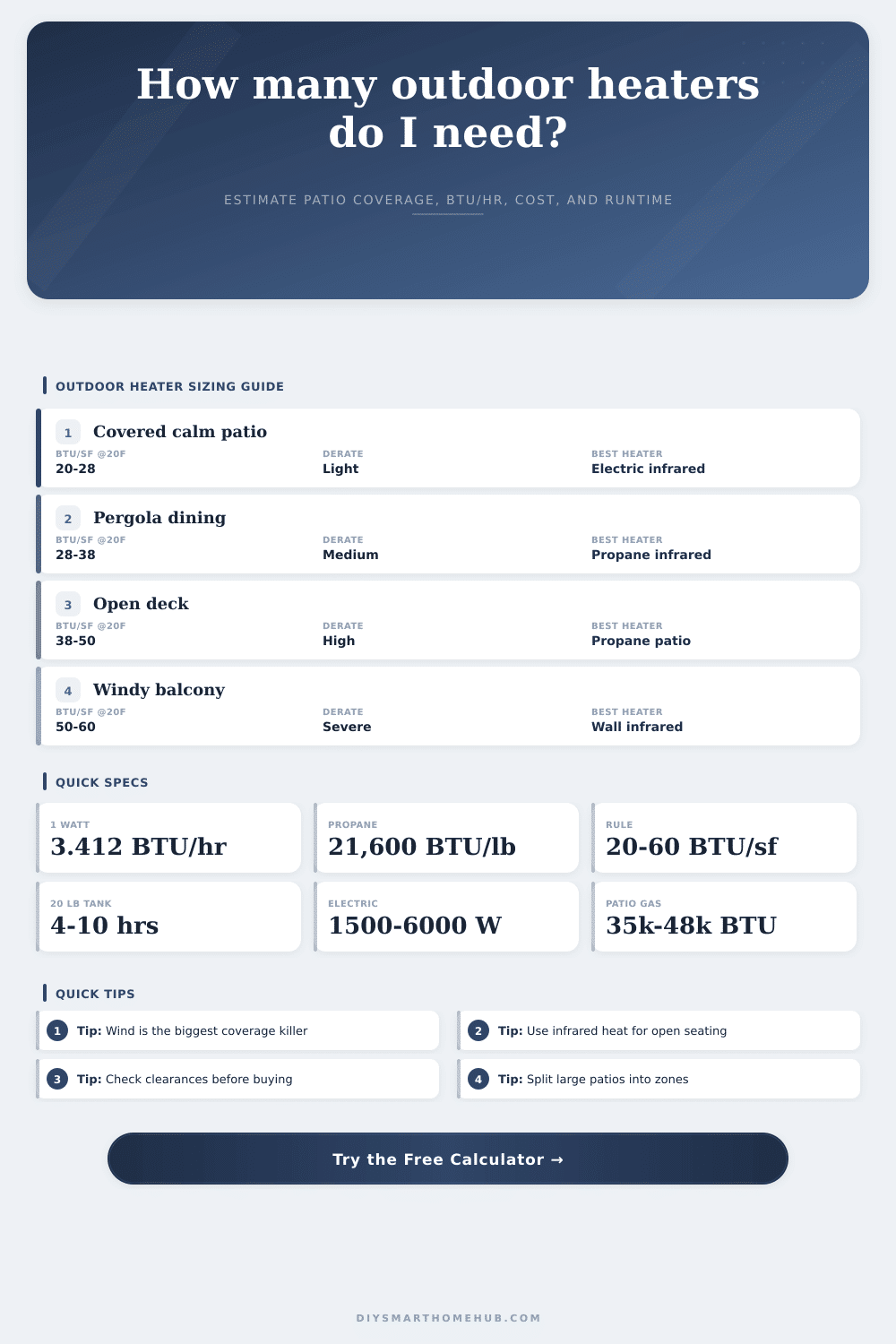
| Covered calm patio | 20-28 BTU/sq ft at 20 F rise | 1.00-1.40 BTU/sq ft/F | 0.90-0.95 |
| Covered breezy patio | 28-36 BTU/sq ft at 20 F rise | 1.40-1.80 BTU/sq ft/F | 0.78-0.86 |
| Pergola or partial roof | 34-42 BTU/sq ft at 20 F rise | 1.70-2.10 BTU/sq ft/F | 0.70-0.80 |
| Open deck | 40-50 BTU/sq ft at 20 F rise | 2.00-2.50 BTU/sq ft/F | 0.58-0.70 |
| Windy exposed edge | 50-60 BTU/sq ft at 20 F rise | 2.50-3.00 BTU/sq ft/F | 0.45-0.58 |
| Heater class | Typical output | BTU/hr equivalent | Best use |
|---|---|---|---|
| Plug-in electric infrared | 1500 W | 5,118 BTU/hr | Small covered seating |
| Hardwired electric infrared | 3000-6000 W | 10,236-20,472 BTU/hr | Covered patio zones |
| Propane fire table | 30k-50k BTU/hr | 30k-50k BTU/hr | Close lounge seating |
| Propane patio heater | 35k-48k BTU/hr | 35k-48k BTU/hr | Portable open patio heat |
| Propane infrared mounted | 25k-60k BTU/hr | 25k-60k BTU/hr | Directional outdoor seating |
| Tank size | 40k BTU/hr | 48k BTU/hr | Two 48k heaters |
|---|---|---|---|
| 5 lb | 2.7 hr | 2.3 hr | 1.1 hr |
| 11 lb | 5.9 hr | 5.0 hr | 2.5 hr |
| 20 lb | 10.8 hr | 9.0 hr | 4.5 hr |
| 30 lb | 16.2 hr | 13.5 hr | 6.8 hr |
| 40 lb | 21.6 hr | 18.0 hr | 9.0 hr |
| Heater type | Overhead clearance | Side clearance | Action |
|---|---|---|---|
| Freestanding propane patio | Usually 2-3 ft above reflector | Usually 2-3 ft from combustibles | Follow the nameplate and manual |
| Electric infrared wall mount | Often 6-18 in by rating | Keep curtains and trim outside listed clearance | Use a listed outdoor circuit |
| Propane infrared mounted | Model-specific, often larger than electric | Protect walls, soffits, and umbrellas | Vent and mount exactly as listed |
| Fire table | Keep open above flame unless rated otherwise | Keep cushions and rugs away from burner | Check wind guards and hose routing |
How many times have you paid top dollar for an outdoor heater that doesn’t heat? I mean, you go out there, stand by the burner…your toes are still cold. Why? Everyone thinks of outdoor heaters as indoor heaters. “Put one on my patio,” they say. But the physics aren’t indoors. Outdoor heat dissapears upward into atmosphere; it scatters in the wind.
Your goal is to capture that heat before it’s gone. But that’s where the calculator steps in, doing the conversion math for you. It eliminates the guesswork around conversions and coefficients. The science is rooted in temperature rise + square footage. Enter your space size. Tell it how many degrees warmer you’d like it to be. Mild? Then there is a modest rise in temperature. Really warm? More power.
How to Choose the Right Outdoor Heater
Where most other calculators fail is with exposure. An open deck will lose energy quicky. A covered patio? That blocks the wind. Less heat required. The tool will adjust the BTU required accordingly. It uses a derate factor for open ceiling/wind exposure.
What about the heater type? Propane heaters are strong and mobile. But they performs poorly in the wind. Propane heaters heat the air around you; wind blows that warm air away. Infrared heaters function differently. They emit rays straight at you and your clothing. It bypasses the chilly air. That’s why they’re better under a partially open roof or in breezy areas. You’ll see this reflected on the reference table. A balcony gets hit by wind, so more output is needed then a covered patio.
What if you mount heaters onto walls? How high should you place them? Too high and it dilute the warmth. Lower and closer to people is best.
Fuel Logistics & Cost, It’s not just about how much heat you need, but also how you get it and manage the costs. If you get an infrared unit that burns propane, the output is great and there is very little infrastructure needed. However, you will have to deal with tanks. A single 20 lb propane tank should of lasted several hours on a big heater. Unless you want to run out of heat at dinner time, you’ll have to keep track of your runtime. This calculator estimates how long you’re going to run so you know when to plan a refill.
If you go with an electric unit like this, you don’t have any fuel to carry around but you do need a dedicated circuit. Leaving it on all day can get pricey. The hourly cost estimate lets you make an honest comparison between options. Two small electric heaters in different parts of the deck may end up being more cost effective than one big propane heater.
Never skimp on safety. There is a reason for the clearances. The venting of propane produces both flame and heat. It requires spacing from dry foliage as well as eaves and umbrellas. Electric units are safer that way, but should also be grounded and ventilated.
Don’t stack your heaters. Better to space them out rather than cluster. We don’t sit in grids; we do so in circles. Space heaters out so everyone gets warmed up, without creating hot spots.
Planning ahead prevents that awkward moment when the sun goes down and the cold sets in. Be sure to measure your area. Take note of the wind direction. Select the right heater for the exposure. Let the tool do the work. You’ll step out on your patio and be warm. You won’t ask yourself what you paid big bucks for, to heat nothing.