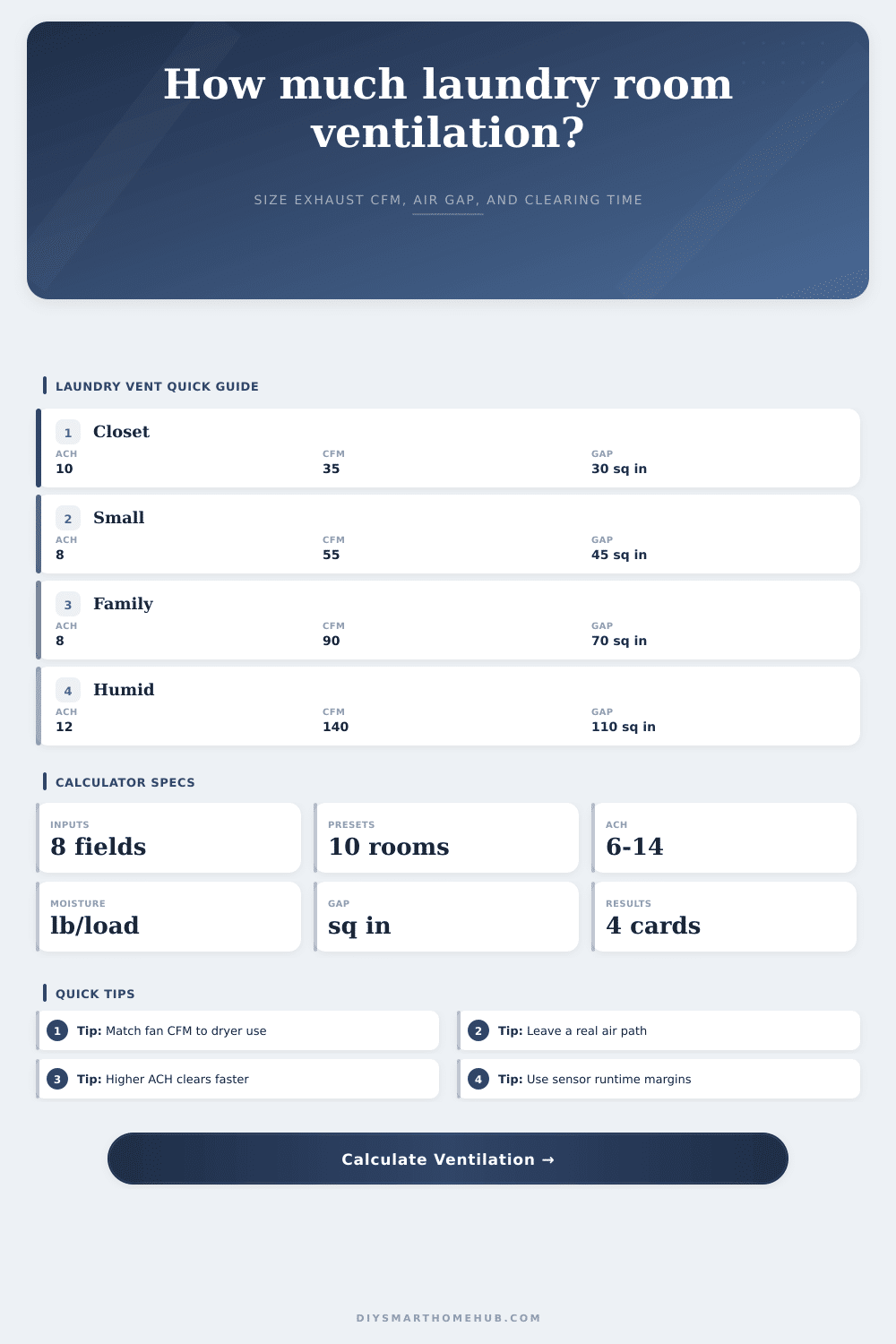
Laundry Room Ventilation Calculator
Estimate laundry room exhaust fan CFM, make-up air door gap, humidity clearing time, and fan runtime from room volume, target ACH, dryer moisture load, and sensor response.
| Step | Formula | Result | Unit |
|---|---|---|---|
| Volume | L x W x H | 0 | cu ft |
| Base CFM | volume x ACH / 60 | 0 | CFM |
| Fan target | base x margin | 0 | CFM |
| Gap area | CFM / 2 per sq in | 0 | sq in |
| Measure | Formula | Result | Unit |
|---|---|---|---|
| Moisture | lb/load x loads | 0 | lb/day |
| Pints | lb / 1.043 | 0 | pt/day |
| Clear time | 3 x volume / CFM | 0 | min |
| Runtime | loads x clear | 0 | min/day |
| Room condition | Target ACH | Best use | Watch item |
|---|---|---|---|
| Large open utility | 5-6 | Low humidity | Slow response |
| Normal laundry room | 6-8 | Daily loads | Door gap |
| Closet laundry | 9-12 | Small volume | Heat buildup |
| Humid climate | 10-14 | Wet weather | Long runtime |
| Mudroom combo | 8-12 | Damp storage | Background RH |
| Door width | 1/2 in gap | 3/4 in gap | 1 in gap |
|---|---|---|---|
| 24 in | 12 sq in | 18 sq in | 24 sq in |
| 28 in | 14 sq in | 21 sq in | 28 sq in |
| 30 in | 15 sq in | 22.5 sq in | 30 sq in |
| 32 in | 16 sq in | 24 sq in | 32 sq in |
| 36 in | 18 sq in | 27 sq in | 36 sq in |
| Space | Volume | ACH | Base CFM |
|---|---|---|---|
| Laundry closet | 240 cu ft | 10 | 40 CFM |
| Apartment room | 384 cu ft | 8 | 51 CFM |
| Standard room | 640 cu ft | 8 | 85 CFM |
| Family room | 960 cu ft | 9 | 144 CFM |
| Utility room | 1440 cu ft | 6 | 144 CFM |
| Output | Formula | Unit | Meaning |
|---|---|---|---|
| Room volume | L x W x H | cu ft | Air volume |
| Target ACH | user input | 1/hr | Air changes |
| Fan CFM | volume x ACH / 60 | CFM | Airflow |
| Make-up gap | CFM / 2 | sq in | Free area |
| Fan runtime | loads x clear time | min/day | Daily run |
Because most folks consider their laundry room a closet for folding, it becomes a box with a washer/dryer/shelf, and they’re done with it. Thing is, dryers is little steam-generating machines; each time you use one, you blast hot wet air inside that closed-off area. Without some way for that moisture to escape, it’ll saturate the drywall, the ceiling joists and slowly migrate through walls into adjacent rooms. Moisture does not care about your house’s layout; it moves, and if there’s no way out, you’re gradually paying a silent mold-cleanup fee.
Once you estimate your moisture load (the amount of water that will be added to the room) and plug your room dimensions into the calculator (above), the tool does the math, and removes the guessing game by working exclusively in air changes per hour, or ACH. This is the core of indoor air quality, and indicates how many times, in an hour, the entire volume of air in a given room are entirely replaced. Two or three changes is typically fine for a living room, but not so much for a laundry room. In fact, the tool bases its calculations around six to eight ACH as a starting point for most rooms, moving up to ten or even higher for humid climates or closets. And that’s key, because a closet fills with humidity quickly, while a large space require more inertia to move; yet they both need it to happen, just at different speeds.
How to Keep Your Laundry Room Dry and Safe
The second half of this equation is the make-up air. That’s what many people fail to think about. You can’t suck air out of a room without letting some new air in. Because fans do cause a slight negative pressure, they’ll struggle to pull air out of the room into the duct unless there’s replacement air coming into the room from the hall. The calculator takes the fan’s CFM and estimates how much space you’d need under the door to ensure enough free area. (It calculates roughly two cubic feet per minute for each square inch of open space.) If the number it spits out for your door undercut is huge, consider a dedicated transfer grille instead. Remember: Air goes where it wants; build the path of least resistance.
You also need to consider the dryer type. Traditional vented dryers move most of the moisture out to the exterior, but still deposit some residual heat and humidity into the room. Heat pump/condenser dryers recycle air (leaving more humidity in the laundry space) so you can adjust the moisture load per load in the calculator, it’ll take into account that differance. You’ll probably want to run your fan longer and target a higher ACH if you’re on a condenser unit. And again it’s not only about peak, it’s about time; a weak fan running a while might actually clear the air better then a powerful fan that turns off too quickly. The tool will estimate how long it takes for the fan to clear the air of its spike after the cycle.
As important as what kind of hardware you have is how you use it, your daily habits. What kind of loads do you run? How many loads? Do you only run synthetic loads? Wet towels? If you only run the dryer with a towel for a few minutes at most, that’s not going to clear the air quickly. Even five minutes won’t clear it very fast if you’re running three loads a day. The humidity builds up over multiple cycles. The calculator multiplies your daily load count by the clearing time to help you figure out how long you need to run the fan each day. This is where the daily number of loads come into play. The calculator will multiply your daily load count by its clearing time, which can be read from the chart. This gives you a total runtime for each day to help you figure out what timer or fan controller you should of get.
A big utility room will require a lot more rapid air exchange than a closet sized laundry area, and the reference table on the page makes that crystal clear. The condition of the ductwork is another thing that’s easy to overlook but makes all the difference. Long duct runs, elbows and restrictive grilles will eat up your CFM, but a short, straight duct move air quite efficiently. This is also reflected by the calculator via a margin factor; the messier your ducting, the more the tool compensates by increasing the target fan size. It doesn’t sound like much, but it does matter, so you don’t end up buying a fan that sounds like a jet engine simply because air got stuck in a kinked pipe. Keep the path smooth and short.
In sum: You need to take the moist air away but not so much as to pull hot air from your house (or create a draft bringing in cold air). Ultimately, it’s all about balance. Your nose tells you the final answer but the numbers is a place to start. Once you get the fan dialed-in properly, if the room still has a damp smell, then adjust the door gap. If the fan is too loud, then inspect the duct. Let the air tell you what it wants and when you let it out, let it replace itself and that’s how you’ll have clean air and dry walls.