Inverter Power Backup Calculator
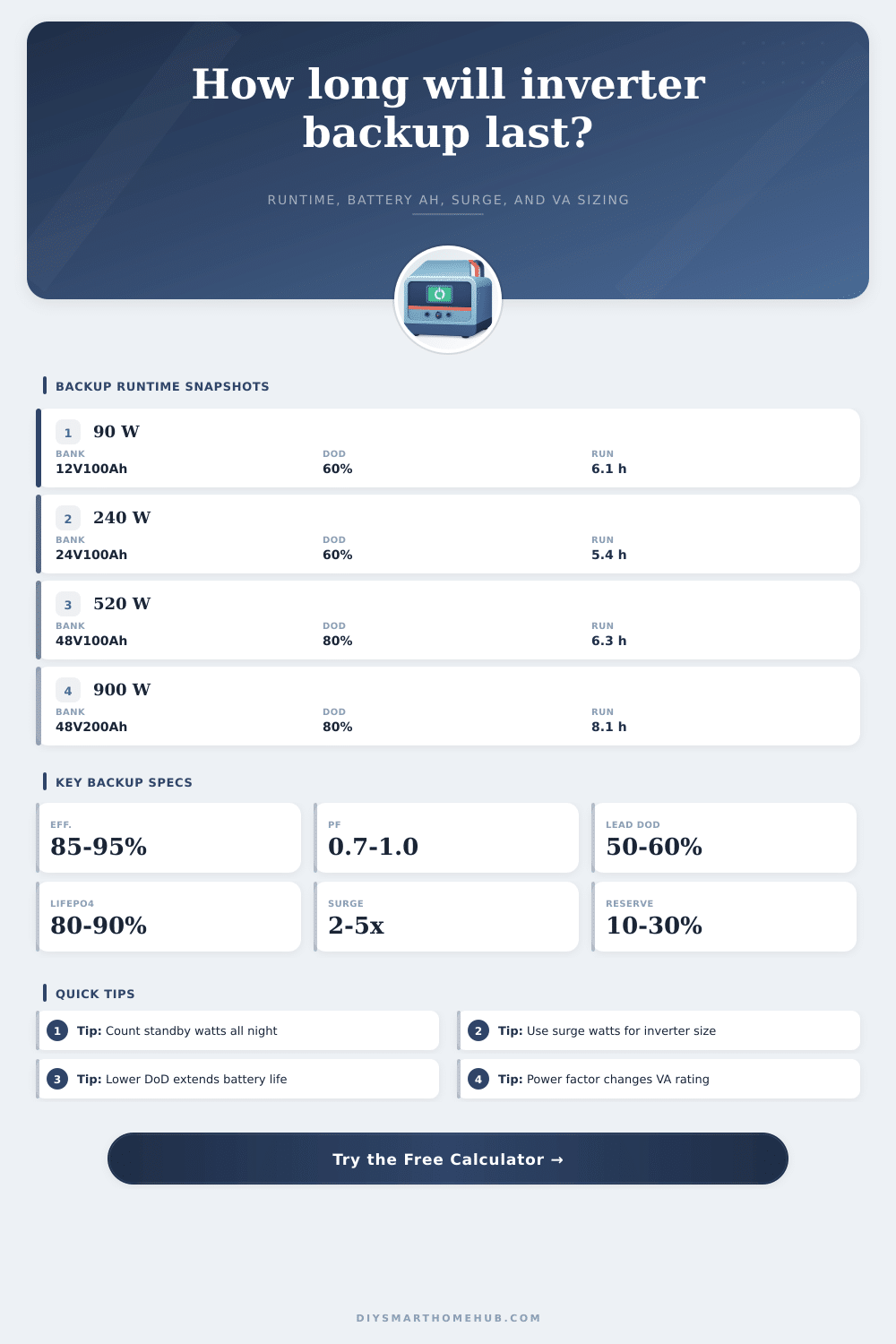
Estimate battery runtime, required amp hours, inverter watt and VA rating, surge headroom, standby draw, power factor, depth of discharge, and reserve margin for backup loads.
| Battery type | Planning DoD | Current comfort range | Backup sizing note |
|---|---|---|---|
| Flooded lead-acid | 50% | 0.10C to 0.20C | Good for maintained deep-cycle banks; high current reduces delivered runtime. |
| AGM lead-acid | 55% to 65% | 0.15C to 0.30C | Common sealed inverter bank with better high-rate behavior than flooded cells. |
| Gel lead-acid | 45% to 55% | 0.10C to 0.20C | Best for gentle discharge profiles and conservative inverter sizing. |
| LiFePO4 lithium | 80% to 90% | 0.50C or data sheet limit | High usable capacity, but the BMS must support continuous and surge current. |
| High-rate UPS battery | 50% to 70% | High-rate data sheet | Designed for short backup windows; verify watt-per-cell tables for long runtime. |
| Inverter class | Typical efficiency | Surge behavior | Best use in this calculator |
|---|---|---|---|
| Small pure sine | 88% to 93% | 2x short surge | Router, laptop, medical, and electronics backup loads. |
| Medium pure sine | 90% to 95% | 2x to 3x surge | Fridge, freezer, small pump, and mixed essential circuits. |
| Hybrid inverter | 92% to 96% | Model-specific surge | Large battery systems with sustained loads and charging integration. |
| UPS inverter | 85% to 92% | Often brief surge | Electronics backup where transfer time and VA rating matter. |
| Modified sine | 80% to 90% | Varies widely | Resistive loads only; motors and electronics may draw more VA. |
| Backup profile | Typical running watts | Surge factor | Planning detail |
|---|---|---|---|
| Router, modem, access point | 25 W to 90 W | Low | Standby draw can be a large share of total load. |
| Computer and monitors | 120 W to 450 W | Low to moderate | Use measured watts during normal work, not power supply label watts. |
| Refrigerator or freezer | 80 W to 250 W average | 3x to 6x | Size inverter surge from compressor start, not only average wattage. |
| Sump or well pump | 300 W to 1200 W | 3x to 7x | Short runtime can still require large inverter surge capacity. |
| PoE cameras and switch | 60 W to 300 W | Low | Use actual PoE budget plus switch and recorder draw. |
| Formula checkpoint | Expression used | What it answers | Common adjustment |
|---|---|---|---|
| AC energy | W x hours | Load watt-hours before inverter loss | Add standby watts over the whole runtime. |
| DC watts | Load W / efficiency + standby W | Battery-side draw | Use measured inverter idle watts when known. |
| Runtime | Usable Wh / DC W | Expected backup time from current bank | Reduce usable Wh with reserve margin. |
| Required Ah | Target Wh / V / DoD | Battery bank capacity needed | Add reserve for age, temperature, and unknown loads. |
| Inverter VA | Watts / PF | Continuous and surge VA rating | Lower PF means a larger VA requirement. |
The reality is that power failures are urgent affairs; you don’t get a warning, and suddenly you’re out of luck in the middle of something important. Suddenlly your laptop battery go flat, and your router lights have gone dim. That’s why I say it isn’t enough to hope, we should plan.
How many hours of runtime do you need for your particular gear? Odds are you’ll be off by quite a bit (and if not, good job, but most folks aren’t very good at this calculation). They’ll overestimate capacity of normal lead acid batteries; they’ll underestimate surge requirements and conversion loss.
How to Choose the Right Backup Power
When sizing backup power, the first step is to count your watts honestly. Appliance labels will show you a high peak, but appliances turns on and off. For run time, average draws is what’s important rather than spike. But don’t totally ignore the spike. Fridge motors or pumps requires a burst to get going. That “start-up” load can be 3 or 4 times the load they run at. Your inverter must be able to accommodates that surge or it trips offline before battery goes down.
Once you input your watts into the calculator, it crunches that math for you. It spares you from having to size only for average loads.
The same thing happens with battery chemistry. For flooded lead-acid batteries, they’re tough and you better not kill ’em dead, or else. To ensure longevity, you typically want to keep half their capacity full. With lithium iron phosphate cells, it’s a different story. They’ll allow you to drain more of their available charge without punishing you for it. Why is that important? It determines number of batteries required based off depth of discharge. If you treat lead-acids like they have the same amp hour label as lithium iron phosphates, your backup won’t last as long than expected.
Another way you lose battery life is through conversion inefficiency. Even the most efficient inverters, though not all of them are, do not perfectly convert battery DC power to AC outlet power. Some energy is lost as heat along the way. So, if your device pulls a hundred watts, your battery will only supply about 111 watts if it’s a 90% efficient unit. And the more hours you run it without charge, the more that inefficiency compounds.
Another problem that sneaks up on you is standby draw. Most inverter continue to sip power while they’re off but waiting for something to plug in. Over a dozen hours while you sleep, that standby power drain can gobble up a significant part of your reserve.
Here’s how various inverter classes behave at full load (table). That reserve margin serves as insurance for the reality of batteries getting older and colder weather decreasing their charge. Additionally, loads changes over time while you’re using them. It’s practical engineering to add a twenty percent buffer. It’s not pessimism. Otherwise your calculated runtime will be a best-case scenario that rarely occurs in reality. That’s what you’re trying to achieve: bridging the gap from theoretical specs to reality.
Size also relates to application. If your goal is to power a home office, it won’t have the same requirements as powering a storm-driven sump pump. One is a low-current, continuous draw for several hours. The other is a large, quick burst of current that requires a lot of surge capacity from the inverter and heavy cabling capable of carrying the amperage. Mismatching the two (without setting things right) results in buying a huge battery bank but pairing it with an undersized inverter that trips immediately upon the pump’s kick-on.
Managing expectations is half the battle when it comes to backup power. There’s no such thing as unlimited runtime on a limited budget. Know what your critical loads are. Measure their actually demand. Choose parts capable of delivering just enough. And when the grid goes down, you don’t want flashing lights; you want peace-of-mind. That means knowing you’re covered. Plan well and it becomes little more than an annoyance. You could of kept your most important systems up and running while the rest of the neighborhood waits in darkness.