Inverter Battery Bank Calculator
Estimate inverter backup runtime, AC load watts, surge margin, battery amp-hours, series and parallel layout, and maximum DC discharge current for home backup banks.
⚡Inverter backup presets
🔌Load and inverter inputs
🔋Battery bank inputs
Inverter bank breakdown
⚙Inverter and battery spec grid
📊DC bus voltage selection table
| DC bus | Typical inverter size | Current at 1,500 W AC | Best fit |
|---|---|---|---|
| 12 V | 300 W to 1,200 W | About 136 A at 92% efficiency | Router, lights, small fridge, short cable runs |
| 24 V | 800 W to 2,400 W | About 68 A at 92% efficiency | Office loads, freezers, RV-style inverter banks |
| 48 V | 1,500 W to 8,000 W | About 34 A at 92% efficiency | Critical panels, pumps, long runtime banks |
🔋Battery type reference table
| Battery type | Planning DoD | Efficiency behavior | Bank sizing note |
|---|---|---|---|
| AGM lead-acid standby | 45% to 55% | Higher voltage sag at heavy current | Use more Ah for long life and surge stability |
| Flooded deep-cycle lead-acid | 40% to 50% | Peukert losses rise on high discharge | Works best with conservative current per string |
| Gel lead-acid | 45% to 55% | Gentler discharge and charge profile | Avoid aggressive surge-heavy inverter loads |
| LiFePO4 deep-cycle | 75% to 90% | Flat voltage and strong cycle efficiency | Check BMS current against inverter surge demand |
| Lithium NMC pack | 70% to 85% | High power density, chemistry-specific limits | Use pack-rated continuous and peak current limits |
💡Backup load planning table
| Backup use | Typical AC watts | Duty cycle | Surge concern |
|---|---|---|---|
| Network and smart hub | 25 W to 120 W | 100% | Low, mostly electronics |
| Camera NVR system | 60 W to 250 W | 100% | Low unless displays are included |
| Refrigerator or freezer | 120 W to 450 W | 25% to 50% | Medium compressor startup |
| Sump or well pump | 700 W to 2,200 W | 5% to 25% | High motor startup surge |
| Critical circuit panel | 800 W to 4,000 W | 40% to 80% | Depends on motors and appliances |
🔧Battery layout comparison table
| Layout | Example | What changes | Design caution |
|---|---|---|---|
| Series only | 4 x 12 V 100 Ah = 48 V 100 Ah | Voltage rises, Ah stays the same | All batteries should match age and capacity |
| Parallel only | 2 x 12 V 100 Ah = 12 V 200 Ah | Ah rises, voltage stays the same | Balance cables and fuse each string |
| Series-parallel | 4S2P 12 V 100 Ah = 48 V 200 Ah | Voltage and Ah both rise | Keep parallel strings equal and monitored |
| Single module | 1 x 48 V 100 Ah = 48 V 100 Ah | Simple wiring, fixed BMS limit | BMS must support inverter peak current |
✅Inverter bank sizing tips
Plan for peak demand; starting surge of a refrigerator compressor, for example, is much larger than its overall load. Surge is more important then total battery capacity. Melted cables and a failed inverter won’t be helped by a huge reserve of watt-hours. You’re concerned with how long they last. It is not about how hard you pull on them.
Enter your loads and the calculator does math. It breaks out motor loads from steady state electronics. A router runs 24/7. A fridge motor might run for half an hour. Treat these like separate drains (and save battery life!). Know their duty cycle. If compressor runs only 40% of the time, then size for that percentage. This adjustment will shrink physical batteries you purchase.
How to Size Your Battery Bank
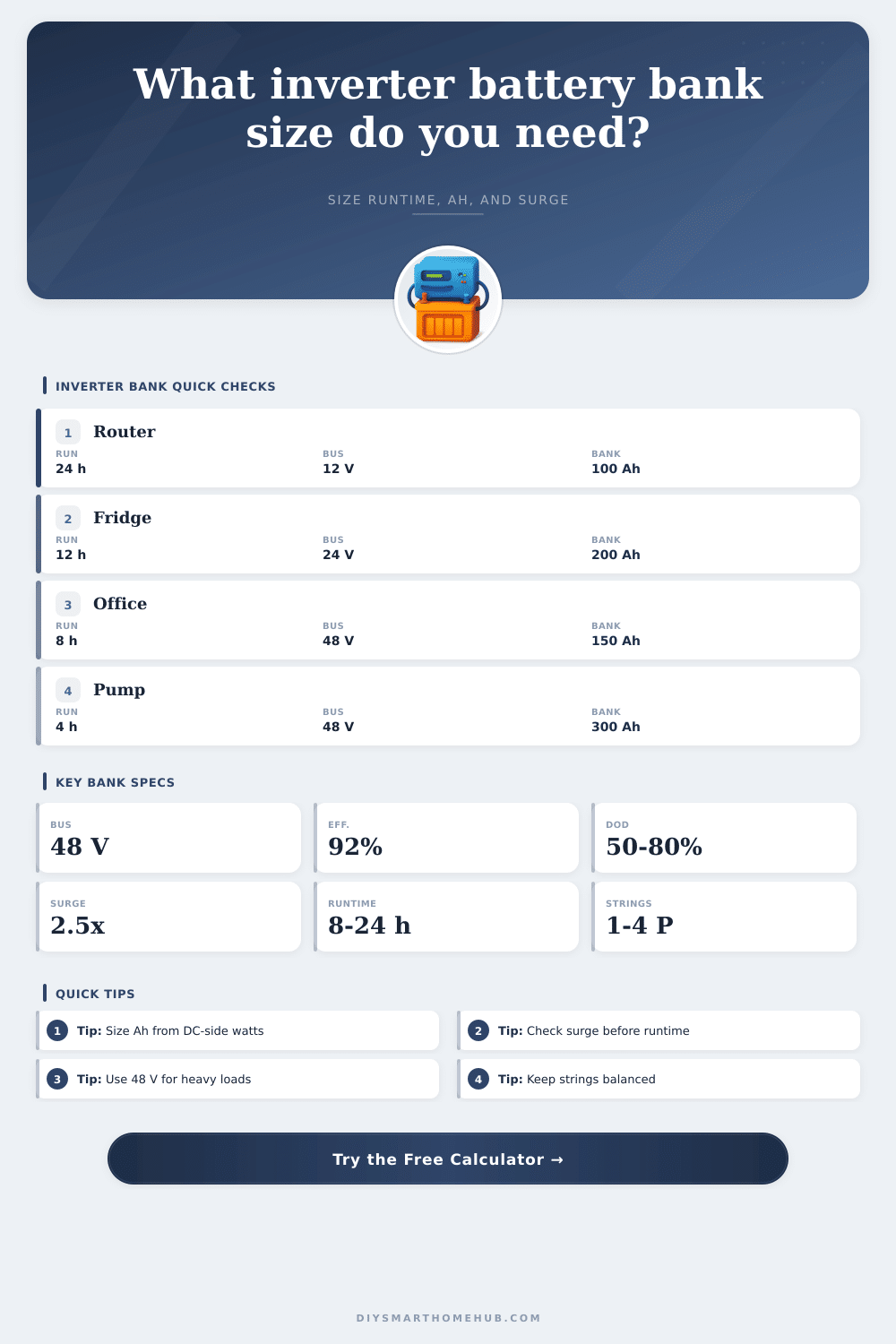
What else? The rest of the system operate on voltage. Twelve-volt systems mean big currents. Big currents mean big thick cables. Big currents means wasting energy through heat. Less current means higher voltage. An inverter rated for four thousand watts draw more than three-hundred amps on a twelve volt system. On a forty-eight volt system it draws about seventy-five amps. That’s why moddern backups run on forty-eight volts. They balance efficiency and safety.
How far can you push that reserve? That depends off battery chemistry. If you run lead acid batteries, don’t let it go below half. They will not live long with that kind of abuse. With a cell like lithium iron phosphate, you’re good to go to eighty percent or better.
Sizing the bank is really about balancing these competing constraints. Less storage means more runtime with lithium. Still, you want to keep an eye out for battery’s continuous discharge limit. Your inverter require only so many amps at one time and if it’s asking for more than what the battery can supply, your system shuts down. This margin is checked by tool. The tool compares the surge load to maximum discharge rating of your units. Balance those constraints to size the bank.
Don’t buy so much capacity that the cost outweighs the benefit of keeping a few lights on. Don’t run out of power during an outage. How big should it be? Motor loads determines the cable requirements. They also drive the inverter sizing. Add electronics that stay on all the time. What’s the runtime requirement? Eight to twelve hours is good for most storms. Most storms are covered by an eight-to-twelve-hour window. That will cover them. That allows ample time for your food. Balance the string lengths. Match the voltages. If you’re concerned about a few extra hours of backup, check surge number first. When the details work out, the juice flows.