18650 Battery Bank Calculator
Build an 18650 pack layout from target voltage, usable energy, cell capacity, discharge depth, reserve, load current, peak current, and BMS rating.
Calculation breakdown
| Pack Class | Series Count | Nominal Voltage | Full Voltage | Typical Use |
|---|---|---|---|---|
| 1S lithium-ion | 1S | 3.6 to 3.7 V | 4.2 V | USB bank cores, tiny sensors, flashlights. |
| 3S lithium-ion | 3S | 10.8 to 11.1 V | 12.6 V | Router backup packs and 12 V converter inputs. |
| 4S lithium-ion | 4S | 14.4 to 14.8 V | 16.8 V | 12 V class DC equipment with buck regulation. |
| 7S lithium-ion | 7S | 25.2 to 25.9 V | 29.4 V | 24 V class portable power stations and UPS shelves. |
| 10S lithium-ion | 10S | 36.0 to 37.0 V | 42.0 V | 36 V class e-bike and scooter modules. |
| 13S lithium-ion | 13S | 46.8 to 48.1 V | 54.6 V | 48 V class packs where equipment supports Li-ion voltage. |
| Step | Formula | Why It Matters | Output |
|---|---|---|---|
| Series count | ceil(target V / cell V) | Sets nominal and full pack voltage. | S count and charger voltage. |
| Gross Wh target | usable Wh x reserve / DoD / efficiency | Converts usable energy into required cell energy. | Minimum nominal Wh. |
| Target Ah | gross Wh / pack V | Translates energy target into pack amp-hours. | Required Ah. |
| Parallel groups | ceil(target Ah / cell Ah) | Selects enough cell groups to meet capacity. | P count. |
| Cell count | S x P | Final number of 18650 cells in the pack. | Total cells. |
| Pack current | load W / pack V | Checks continuous and peak current stress. | BMS and cell current check. |
| Cell Type | Common Capacity | Continuous Current | Best Fit | BMS Note |
|---|---|---|---|---|
| High-energy 18650 | 3200 to 3500 mAh | 4 to 8 A | Low-current backup and long runtime banks. | Use more parallel cells for peak loads. |
| Balanced 18650 | 2800 to 3200 mAh | 8 to 12 A | Router, camera, and small UPS packs. | Moderate BMS ratings usually fit well. |
| High-drain 18650 | 2000 to 2600 mAh | 15 to 25 A | Tools, motors, and higher surge applications. | BMS and nickel links need real surge margin. |
| Reclaimed mixed cells | Varies by test | Use tested limit | Low-risk stationary projects after grading. | Derate heavily and avoid high-current packs. |
| Scenario | Target Wh | Likely Layout | Cell Count | Design Focus |
|---|---|---|---|---|
| Router backup | 80 Wh usable | 3S3P with 3000 mAh cells | 9 cells | Small current and easy charging. |
| Camera mini UPS | 150 Wh usable | 3S5P with 3000 mAh cells | 15 cells | Longer runtime at low DC load. |
| PoE shelf | 280 Wh usable | 4S7P with 3200 mAh cells | 28 cells | More parallel groups for current sharing. |
| Power station core | 600 Wh usable | 7S8P with 3500 mAh cells | 56 cells | Higher voltage lowers pack current. |
| E-bike module | 650 Wh usable | 10S6P with 3500 mAh cells | 60 cells | BMS peak and cell current dominate. |
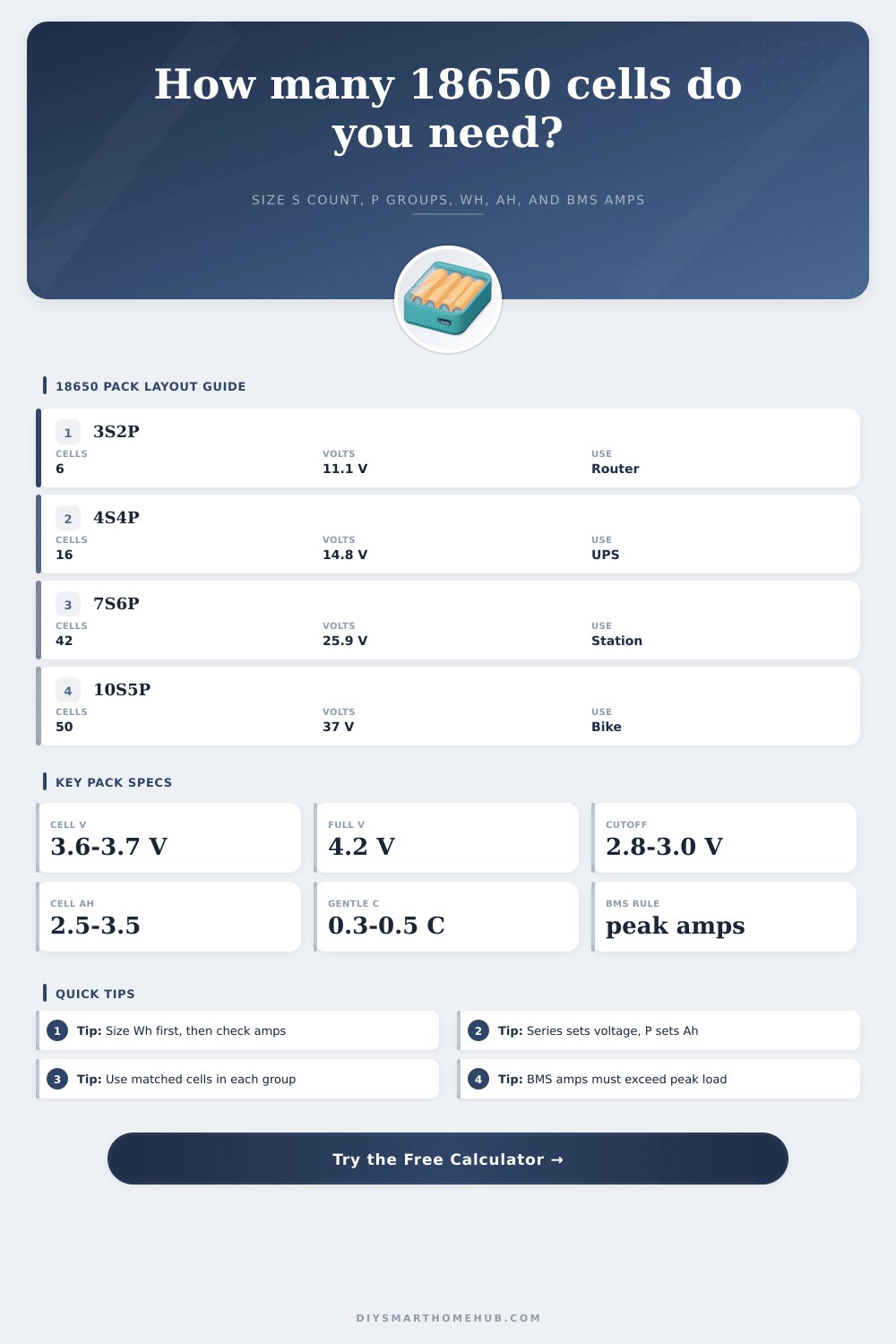
Start with usable Wh, then use voltage and cell capacity to determine S and P. A pack can have enough Ah and still fail the peak-current check.
Use the same number of matched cells in each group, then select a BMS for the exact series count, full voltage, continuous amps, and surge amps.
How do I build an 18650 battery pack? For most, it starts with a stack of batteries and asking yourself “how many do I need?” Chances are good that your first thought will be: How much voltage do I need? That’s the wrong question. You’ll also want energy, a quantity called amp-hours (Ah) for batteries. Mixing these two quantities is where most DIY builds go awry, ending up either overpowered and risky or underpowered and frustrating.
With this calculator, you can simply enter your cell specs and desired run time, and let the calculator do the math. You won’t have to second-guess conversions and coefficients or pray that it works.
How to Build an 18650 Battery Pack
First thing you do is configure the series. Voltage adds in series. So if your four-cell string are fully charged, it’s about 14.8 volts. That’s the starting point for how much DC load/inverter you can handle. Adding extra cells in parallel doesn’t affect this number, there is no way to increase height of the bank by adding width! There’s a reason they do it like this. Wanting to use the backup router at 12 volts? Depending on your nominal goal, you’re stuck with either three or four series. The calculator will round up based on your chosen volt requirement and tell you exactly how many. This keeps you from ending up with pack that reaches capacity but still has sag left until it gets low enough to be unusable.
Setting voltage is the easy part. From there, building out the parallel groups are the meat and potatoes. That’s where you create capacity. More amps-hours per column of cells mean more runtime. Most people put in how many watt-hours they want as usable. Few realize there are losses that eat away at that figure. You need to leave a reserve buffer to keep batteries happy. This also extends cycle life. Lithium cells (both standard Li-ion and lithium iron phosphate) die quickly if drained to zero percent depth of discharge. Efficiency losses due to BMS drag and wiring is included in the calculation. This produces a total energy target, which is higher than your net requirement. Small, yes. But important if you’re trying to calculate for one night vs. This matters if you are calculating for one night versus a week-long off-grid run.
Projects die quietly because they can’t draw enough power. Even though your battery may have enough capacity for ten hours of runtime, it doesn’t necessarily mean it has the current capability to supply current once heater comes on or a motor engages. Motor starting is particularly hard on batteries. They can experience many times there average continuous draw during the startup phase. Unless your BMS can manage this peak load, it will shut down immediately.
The calculator compares your peak wattage against each cell limit and the BMS rating. High capacity cells with slow drain rates requires more parallel strings to divide up this load. It’s not an issue of adequate electrons, but rather getting the electrons through at a rapid rate without melting the nickel strips inside or popping the protection circuit.
No compromises: you must match cells. Each cell has different amounts of internal resistance, and using a mix of old recycled cells with new will throw your pack off balance. Its weakest link becomes the whole pack’s limit, and that weak point gets worse and worse over time as it charges at different rates. When recycling used batteries, rely on test results instead of what the label says, because labels do not show their real capacity. When building new packs, buy them all from one manufacturing lot so they are more likely to be matched.
On the page, a handy table plots standard configurations such as 3S2P for smaller backup batteries or 7S6P for bigger station battery arrays. This illustrates how geometry changes based off current and voltage needs. Until thermal management becomes an issue, nobody cares about it. But lithium cells gets warm when charged or discharged, and they build up heat in a closed environment. If you let the pack get warm enough, the heat sensors will cause the BMS to shut down the battery before the amps do. Space and air flow are not just extras; they are safety factors. You don’t want a tightly packed plastic box without ventilation holes, and you don’t want modules crammed together either. Electricity creates waste heat, but many forget that fact until it’s too late.
All in all though, constructing a battery bank isn’t really about figuring out how many cells to use as much as it’s about adhering to their limitations. Begin by considering how much energy you’ll need rather than which batteries you already have. Then use the voltage to decide its height and the amp hours to decide its width. Look at the current ratings before making assumptions about a high-capacity cell’s ability to manage a high-drain load. If you line up those factors, the others will sort themselves. Mostly it’s a matter of knowing what you’re measuring. A well sized pack doesn’t just endure longer, but remains safe throughout. And that’s precisely why we want it to do so when there are no lights on and we require power to stand firm.