Hydroponic Reservoir Refill Calculator
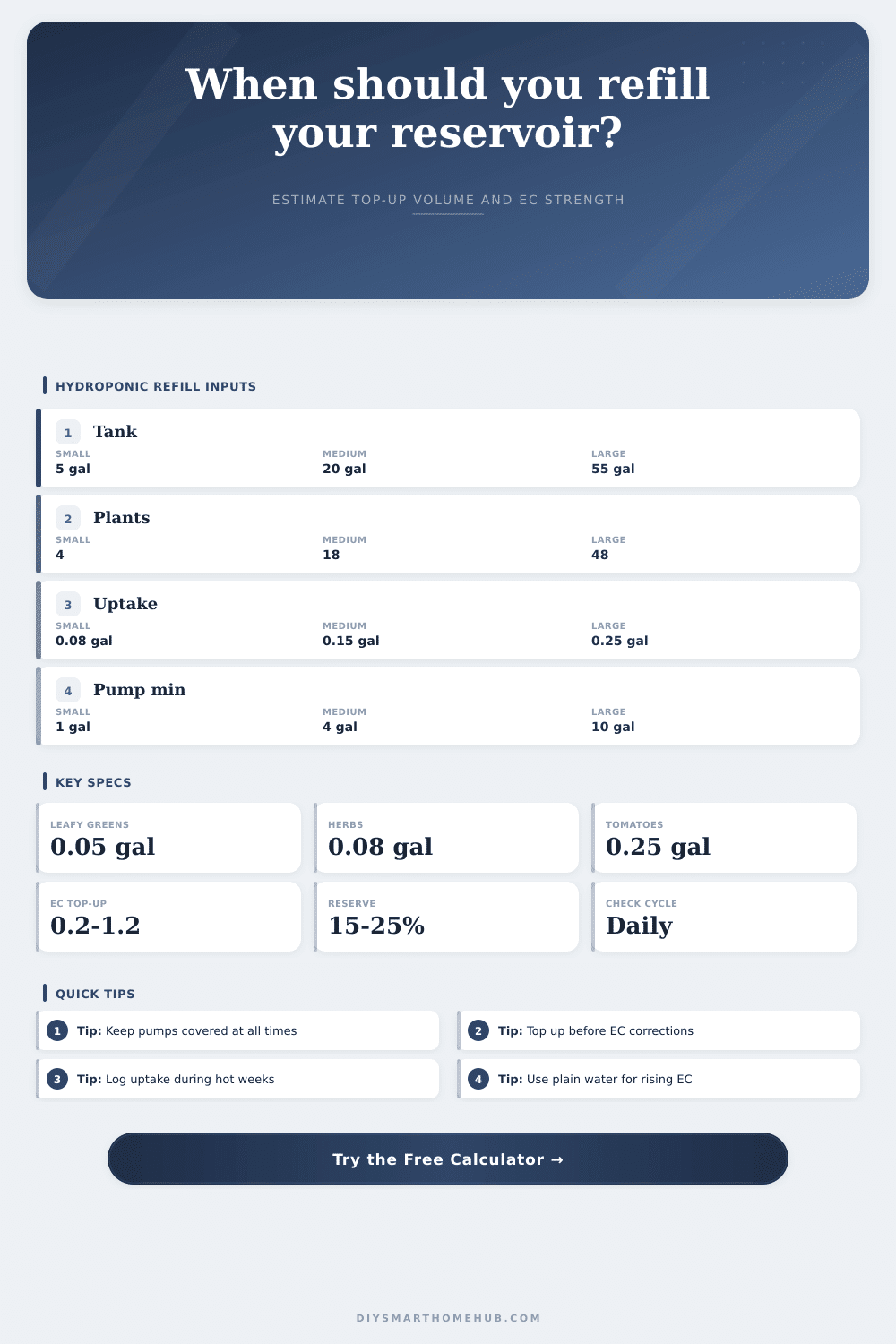
Estimate refill volume, daily plant uptake, evaporation loss, EC drift response, minimum pump depth, refill trigger volume, and top-up nutrient strength.
| Crop or stage | Typical uptake per plant | Use when | Reservoir note |
|---|---|---|---|
| Seedlings and clones | 0.01-0.03 gal/day | Small roots and low light. | EC changes can still happen fast in tiny tanks. |
| Lettuce and leafy greens | 0.04-0.08 gal/day | Raft, NFT, or compact indoor systems. | Many plants add up quickly in shallow channels. |
| Basil and soft herbs | 0.06-0.12 gal/day | Warm, bright herb benches. | Watch level drop during long light cycles. |
| Peppers and cucumbers | 0.15-0.25 gal/day | Fruit set or heavy canopy growth. | Keep a wider pump reserve. |
| Tomatoes in production | 0.20-0.35 gal/day | Large vines under strong light. | Daily checks are normal in warm tents. |
| Reservoir setup | Working volume | Good plant range | Refill behavior |
|---|---|---|---|
| Countertop herb tank | 1-3 gal / 4-11 L | 3-8 small plants | Fast EC drift and frequent top-ups. |
| DWC bucket | 3-5 gal / 11-19 L | 1 large plant | Pump reserve is usually a big share of volume. |
| Storage tote reservoir | 12-27 gal / 45-102 L | 8-30 plants | Stable enough for daily or two-day checks. |
| NFT or rail sump | 15-35 gal / 57-132 L | 20-80 small plants | Keep extra reserve for channels and returns. |
| Greenhouse reservoir | 55-100 gal / 208-379 L | 40-120 plants | Large losses can still appear during heat waves. |
| EC pattern | What it suggests | Calculator response | Top-up note |
|---|---|---|---|
| Current EC above target | Water is leaving faster than salts. | Top-up EC trends toward 0.0 mS/cm. | Use water first, then re-test after mixing. |
| Current EC near target | Plants and water are balanced. | Top-up EC stays close to target. | Gentle maintenance mix is usually enough. |
| Current EC below target | Nutrients are being consumed faster. | Top-up EC rises above target. | Use a stronger top-up within crop limits. |
| Very low tank volume | Dilution math becomes sensitive. | Calculator caps suggested strength at 2.5. | Consider refilling first, then fine tuning. |
| No top-up needed | Reservoir is already at capacity. | Top-up EC equals target for reference. | Wait for level drop before adding solution. |
| Pump or pickup style | Typical minimum volume | Why it matters | Trigger setting |
|---|---|---|---|
| Small fountain pump | 0.5-2 gal / 2-8 L | Short intake can uncover quickly. | Use pump minimum plus reserve. |
| DWC air stone only | 1-3 gal / 4-11 L | Roots need submerged lower mass. | Set by root and bucket geometry. |
| Submersible NFT pump | 2-6 gal / 8-23 L | Air draw can interrupt channel flow. | Add margin for return-line lag. |
| External pump pickup | 5-15 gal / 19-57 L | Vortexing can pull bubbles into lines. | Use a taller reserve when possible. |
| Greenhouse sump | 10-25 gal / 38-95 L | Large plumbing loops hold solution. | Reserve should cover pump cycling. |
| Scenario | Inputs | Daily loss | Refill rhythm |
|---|---|---|---|
| Six lettuce heads | 5 gal, 0.06 gal each | 0.40 gal/day | Check every 2-3 days. |
| Herb rail | 10 gal, 0.08 gal each | 0.90 gal/day | Top up several times weekly. |
| Pepper tote | 18 gal, 0.20 gal each | 1.12 gal/day | Daily visual level check. |
| Tomato tent | 27 gal, 0.28 gal each | 1.93 gal/day | Plan refill before weekends. |
| Greenhouse row | 65 gal, 0.16 gal each | 7.00 gal/day | Use a larger trigger reserve. |
In an indoor grow reservoir, you frequent notice the water level has dropped. The pump starts sucking air; no more water. It’s starting to sputter, plants becomes thirsty, and the pump is gasping for air. To rescue the system, you run around with a jug of water. With some planning, this is avoidable.
Reservoir management are a matter of organization. It’s not just a matter of gardening. It’s a miniature chemical plant, and it use up its raw materials. The trick is to know what the water level mean in that plastic tote. We all know most growers are thinking about nutrients; nobody think about the water, which is what plants actualy drink.
How to Manage Your Water Reservoir
As the water drips down into their leaves or evaporates from the growing medium, it concentrate the rest of the solution. That solution has a different electrical conductivity (EC), known as its “drift”, based off the concentration of those dissolved substances. The goal is to achieve your desired EC strength, and the calculator above tell you precisely how much plain water versus nutrient-rich solution you need to add to hit your target strength.
It sounds easy, but the dilution effect can be tricky. For example, if your existing EC is greater than your target, don’t increase nutrients. Instead, you must dilut. The tool will calculate specific gravity for you; you won’t have to do the math.
Another crucial figure is pump reserve. All submersible pumps has a minimum depth they must be immersed. Below this mark, they pull air, overheat and fail. Ouch! That’s costly. So you’d better know your setup’s number before water level reaches it. Pump requirements is listed in the reference table.
To prevent cavitation, common pump types range from one-half of a gallon (for small fountain pumps) to as much as ten gallons (in larger systems). But the reserve is needed for more than keeping the pump cool. It keeps the roots fed, too. When water movement stop, oxygen in the root zone drop. Root rot follows starved roots, and that’s hard to reverse once it takes hold.
How much do you think evaporates? That depends heavily on where it’s stored. Water evaporates quicker from a warm greenhouse during the summer different than a cool basement over the winter. Enter an approximate % of evaporation rate into the calculator and see how long that water is going to last you right now.
Notice, don’t panic. Learn when it is time to act before it is too late. Go from being in a reactive scramble mode to being in proactive scheduling mode. Set a reminder to check back 2-days ahead of the trigger point so you’ll always have a buffer.
Each crop take up water differently. One head of lettuce might take a while to drink, but a full-on tomato plant may consume upward of half a gallon a day. If you’re guessing the wrong amount, it’ll throw off when you think the reservoir need refilling. The tool has some preset estimates based off common setups: large totes, vertical towers, etc. Use those as a starting point.
Check how much you actualy go through, too. Do you find yourself filling faster than expected? Your environment’s probably wetter/hotter than expected. Tweak the inputs, reconfigure the settings.
Consistency. A consistent water level mean a consistent oxygen supply and consistent nutrient concentration. This ensures there are no surprises for the plants. No surprises for you. Go check the tank calmly, not nervously. You’ll know when it reaches the bottom, and you’ll know how high it is at any given moment. That’s peace of mind, and it’s not too much time to spend plugging some numbers into a calculator.
Cover the pump. Maintain a constant water level. Allow the plants to grow uninterrupted.