Harvest Date Estimator Calculator
Estimate first harvest, peak picking date, harvest window, and succession finish from planting date, maturity days, transplant age, GDD progress, variety speed, and temperature stress.
Harvest estimate
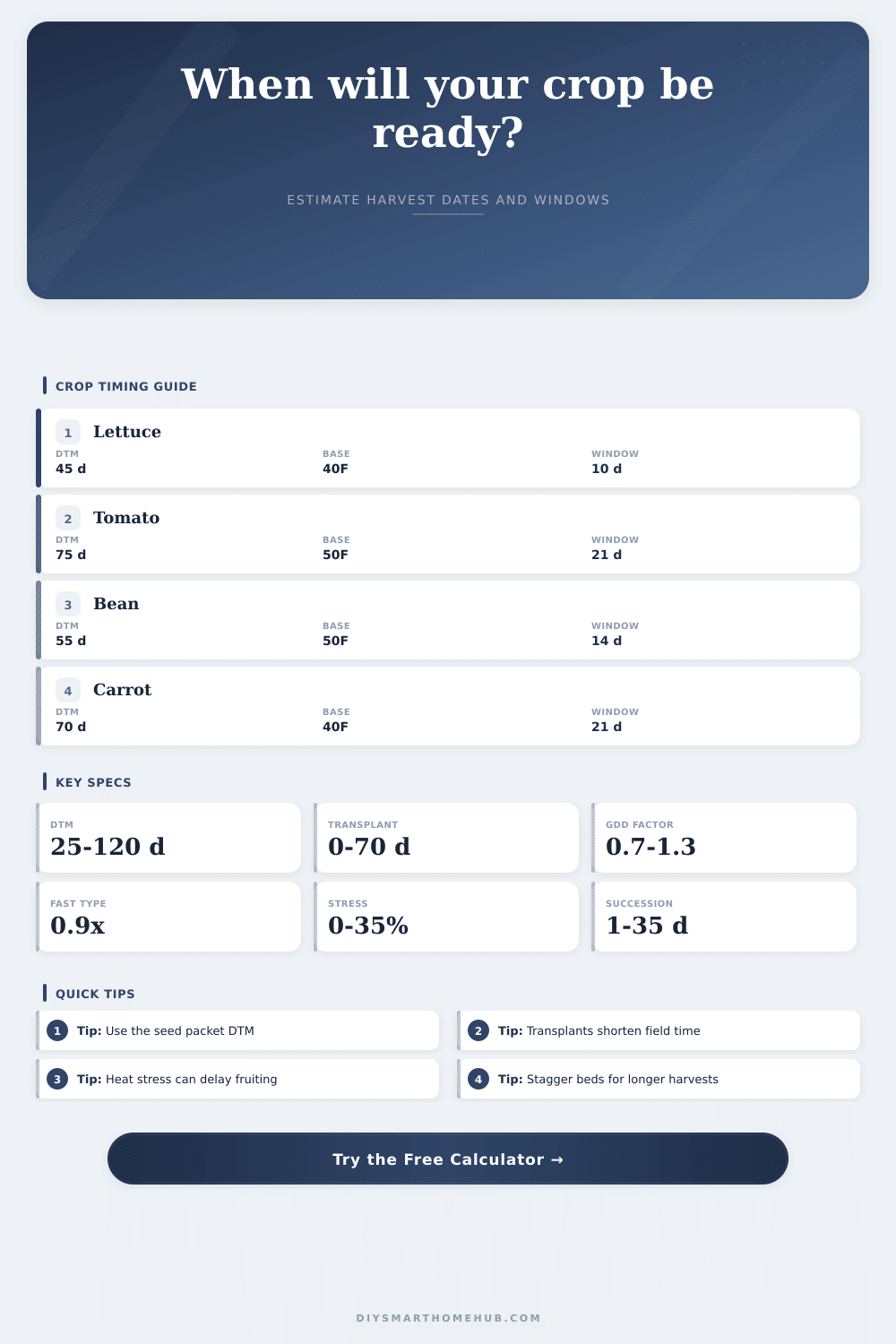
| Crop | Typical DTM | Base temp | Normal window |
|---|---|---|---|
| Leaf lettuce | 40-50 days | 40°F | 7-14 days |
| Tomato transplant | 65-85 days | 50°F | 14-28 days |
| Bush bean | 50-60 days | 50°F | 10-18 days |
| Carrot | 65-80 days | 40°F | 14-30 days |
| Cucumber | 50-65 days | 50°F | 14-28 days |
| Pepper transplant | 70-90 days | 50°F | 21-35 days |
| Progress factor | Use when | Effect | Example |
|---|---|---|---|
| 0.70x | Very cool | Longer calendar | Early spring |
| 0.85x | Cooler season | Mild delay | Cloudy stretch |
| 1.00x | Normal weather | Packet timing | Average season |
| 1.12x | Warm steady | Faster finish | Warm soil |
| 1.25x | Fast warm | Shortest time | Protected bed |
| Plan type | Plantings | Gap | Best fit |
|---|---|---|---|
| Single bed | 1 | None | One harvest |
| Weekly greens | 4-8 | 7 days | Salad crops |
| Biweekly rows | 3-6 | 14 days | Beans, carrots |
| Monthly blocks | 2-4 | 21-30 days | Sweet corn |
Packet DTM
Fastest baseline when planting date and seed packet days are known. Best for normal weather and direct sowing.
Transplant adjusted
Subtracts part of seedling age from maturity days so older starts are not treated like new seed.
GDD corrected
Uses a progress factor to shrink or stretch field days when the season is warmer or cooler than average.
When you look at your calendar and see that it’s already three weeks past tomato time, do you gets panicky? You did everything right: you planted them on recommended date and followed the packet’s directions to the letter. But they’re just green vines, and nobody cares what you want to eat tomorrow or next week.
That’s when the tomato harvest date estimator calculator turns from a planning device to a converter, changing unpredictable elements of weather and soil conditions into an actual date you can plan around. After entering your climate factors and planting date (above), let the calculator do the math, so you don’t have to guess if it’s too late to make up for starting out on wrong foot.
How to Use the Tomato Harvest Calculator
The first big change is age of your transplants. Seedpacks state their days to maturity as measured from point at which the seed swells up in darkness. But most home gardeners don’t sow until after several weeks indoors under grow lights; the plants is then called plugs or starts. If you’re like me and assume day one in soil equals 20-day old starts, you’ve doubled-up on time. The calculator take into account how long they grew indoors before being moved outside. That’s a little math trickery, but it is important. Otherwise, you’ll be disappointed by thinking you’ll get a crop next month when it won’t realy happen for another. When most folks count back from some date on the calendar, they forget about that.
Then comes the climate reality check. The clock doesn’t run on weather; weather run on energy. To take that into account, growing degree day factor changes the time line based off how warm it’s been. If it was a cool, cloudy spring, that means a delay; if you had a hot, sunny June, that meant an acceleration. The idea is that you choose a progress factor that fits what’s happening lately. Increase it if you’re having a mild year, or reduce it after a cold snap. It’s not precision forecasting. It’s recognizing that biology slows down when it’s cold and speeds up when it’s warm.
There’s more: variety, speed, and stress all makes a difference. A carrot that stores well is different than an early-ripening heirloom tomato (though both may have been started side-by-side). You’ll be able to include those genetics with the tool. Stress factors includes common garden problems: A heat wave? Transplanting during a drought? That will slow things down. Tack on a small stress delay, to keep your hopes reasonable. It is better to plan for things taking longer and succeeding than to hope for the best and be disappointed.
For serious growers, though: That’s where the tool is realy most helpful. You don’t plant all at once, hoping it will be enough. You stagger sowings, to make sure there’s a constant stream of food coming in. The calculator figure out what happens with a series of plantings: When would the first one come in? When would the peak picking period be? What about the last finish? Would you have a gap, or a glut of harvest? If the last succession planting finished too soon for the next crop to be ready, oops, that’s a gap. And the output tells you right when that gap opens up.
To anchor those inputs into reality, there is reference tables on the page. There’s a table of base temperatures and typical days to maturity for popular vegetables. Those tables don’t replace your own custom inputs; they provide an anchor so what you input won’t be outlandish. Growing lettuce? You know the baseline. Growing peppers? You know how long it’ll take for it to go from seed to fruit. It adds onto that baseline, not replaces it.
This is an estimator (of all estimators), ultimately a planning tool, not a promise. Rain has its part; so do pests and the quality of the soil. No algorithm can anticipates that. But having a sense of where you ought to be is a helpful reference point. It is a reminder of what to look for: roots or fruit. It is an indication of whether something’s worth giving a little longer, or needs pulling out by the roots.
That’s the trick with any such calculation. You need to know what you’re realy tracking. You are tracking more than just days; you are tracking accumulated potential for growth. Line up your calendar against that fact and the panic subsides. Instead of spending hours in front of the clock, you begin to watch the plants. You let your tomato get red. This continues.