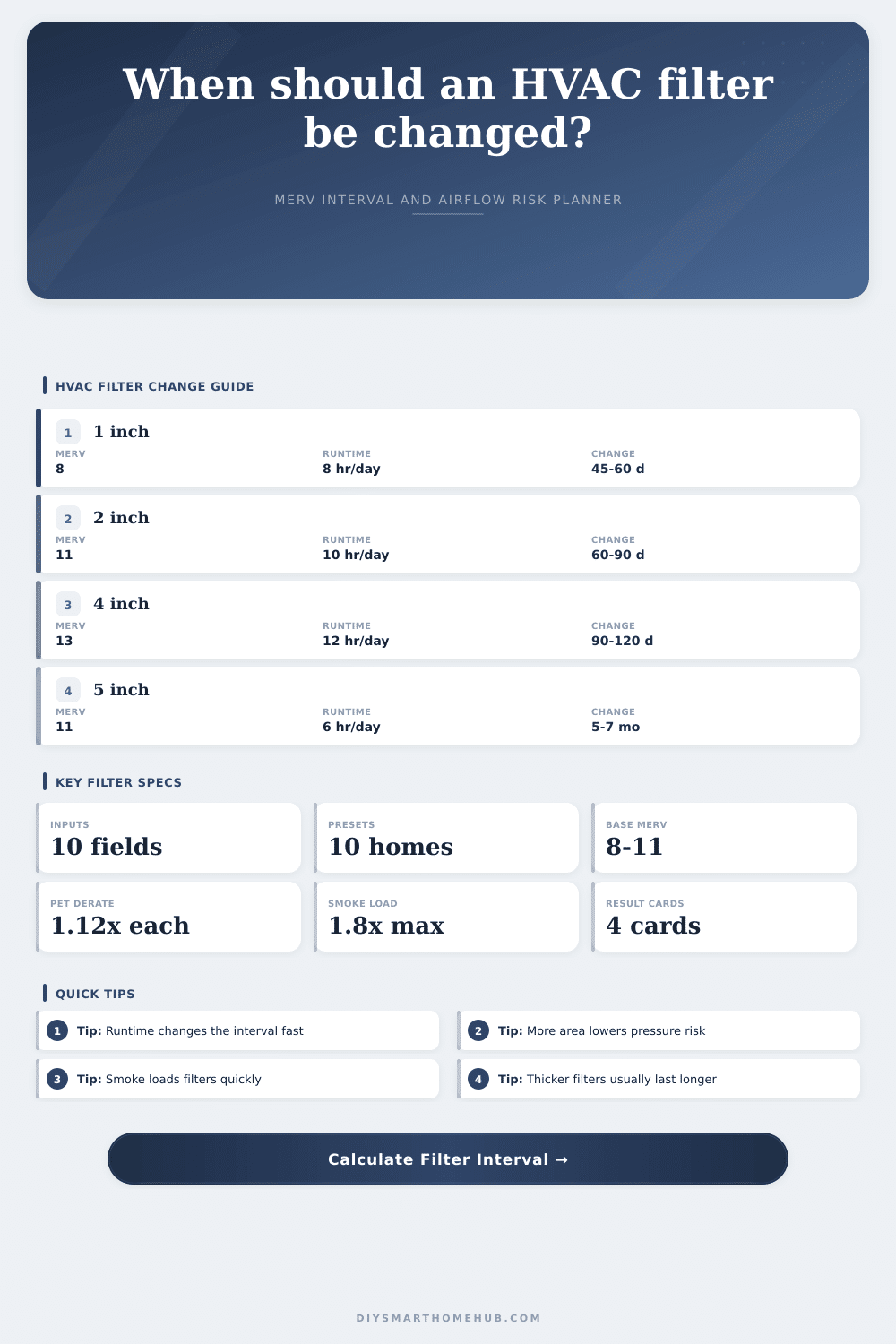
HVAC Filter Change Interval by MERV Calculator
Estimate a realistic HVAC filter replacement interval from filter thickness, MERV rating, blower runtime, pets, dust, smoke, occupancy, filter area, airflow, and filter cost.
| Factor | Input | Multiplier | Effect |
|---|---|---|---|
| Thickness | 1 inch | 60 d | base |
| MERV | 8 | 1.00x | base |
| Runtime | 8 hr/day | 1.00x | load |
| Dust | Average | 1.00x | load |
| Scenario | MERV | Runtime | Interval |
|---|---|---|---|
| Current | 8 | 8 hr | 60 d |
| Thickness | Base days | Typical use | Holding capacity |
|---|---|---|---|
| 1 inch | 60 days | Common return grille | Lowest |
| 2 inch | 90 days | Upgraded slot | Moderate |
| 3 inch | 120 days | Media cabinet | Good |
| 4 inch | 150 days | Deep media filter | High |
| 5 inch | 180 days | Large media box | Highest |
| MERV range | Interval factor | Drop factor | Planning note |
|---|---|---|---|
| 4 to 6 | 1.10x | 0.80x | Low capture, low restriction |
| 7 to 8 | 1.00x | 1.00x | Common basic pleat |
| 9 to 11 | 0.90x | 1.25x | Better fine dust capture |
| 12 to 13 | 0.72x | 1.55x | Allergy and fine-particle use |
| 14 to 16 | 0.55x | 1.90x | High restriction watch zone |
| Driver | Low | High | Formula role |
|---|---|---|---|
| Runtime | 4 hr/day | 18 hr/day | hours divided by 8 |
| Pets | 0 pets | 4+ pets | 1 + pets x 0.12 |
| Dust | 0.90x | 1.60x | direct load factor |
| Smoke | 1.00x | 1.80x | direct load factor |
| Occupancy | 1 person | 8 people | adds particle load |
| Risk score | Band | Main causes | Calculator signal |
|---|---|---|---|
| 0 to 30 | Low | Large area, low MERV | Normal interval |
| 31 to 55 | Moderate | Average area, MERV 11 | Watch airflow |
| 56 to 75 | High | High MERV or high CFM | Shorten interval |
| 76 to 100 | Very high | Small area and high MERV | Check system limits |
Homeowners forget about replacing the HVAC filter until they get that nagging reminder (or something goes wrong). This can work when you live in a neat environment. But this isn’t a clean home, we have cooking smoke, pollen, hair, etc trapped in there.
The reality is that a one-size-fits-all replacement schedule rarely matches the actual load on your specific system. Changing it too frequently mean wasting money on unnecessary filters. On the flip side, you could allow a blocked filter to choke off airflow to the blower motor.
How to Find the Right Filter Replacement Time
So what does a dirty filter mean? Does it matter how it looks? Or more importantly, how much resistance does the filter create against air flowing through ductwork?
After you plug in your filter’s dimensions (and how many hours per day it runs), the calculator do the rest. No need to guess about conversion factors and coefficients. You can look at what went into it and understand why.
Let’s begin with filter thickness. If your filter is an inch thick, there’s just not much space inside that will be filled with dust until its a wall of solids. On the other hand, a 4- or 5-inch media filter are like a sponge. It can traps quite a bit of particulate matter before pressure drop rises to become a problem. The tool gives thicker filters a longer initial interval because they has more depth and surface area. There’s nothing magical here; this is basic geometry.
People are confused by the MERV rating; they assume that higher is always better. Yes, higher MERV captures smaller particle, but it also reduces airflow more aggressively right out of the gate. High-MERV filters has a reduction factor applied via the tool. Running a MERV 13 in a thin frame means you’re asking the filter to do a lot of work with very little volume. It’ll clog faster. There’s a tradeoff between air cleanliness and filter life, you gotta balance those two.
That’s where the runtime comes into play. The rating can change daily. How many hours a day do you run the fan? All 24 hours a day if it runs all day every day? Or do you run it just during heating or cooling? For example, your fan kicks in when AC or heater is running. The default of the tool assumes an eight-hour runtime average. That’s probably good enough for most people. But if you don’t operate like that, tweak the runtime to reflect how much you actualy run the fan.
Then there are pets. Every animal in the house adds to the amount of dander and shedded hair in the air. This means the filter will get loaded faster. The tool has a pet derating factor. You aren’t running one house with three dogs, so adjust your calculation to match.
The other wild cards are smoke and remodel dust. Fine particles (from any kind of smoking, even outdoors, or indoor construction like sanding) burrow deeply into the filter media, increasing its resistance fast and making it hard to remove. A high level of smoke can choke even a deep filter. A high level of smoke can choke even a deep filter. When you select smoke or project dust, the tool sharply cuts the recommended interval as a protective step. So the system doesn’t strain itself.
Don’t discount the pressure-drop risk score. This indicates whether your existing set-up is asking too much of your blower. If it’s high even if your filter appears clean, you may want to reduce your change interval. You can’t see airflow but when your system struggles, it becomes inefficient and noisy.
Run the calculator until you discover that sweet spot. You get clean air and a happy blower. There is no wasted money and no harm to the blower. Yes, a filter is a consumable; but a consumable you should of respect.