Carpet Shampoo Solution Calculator
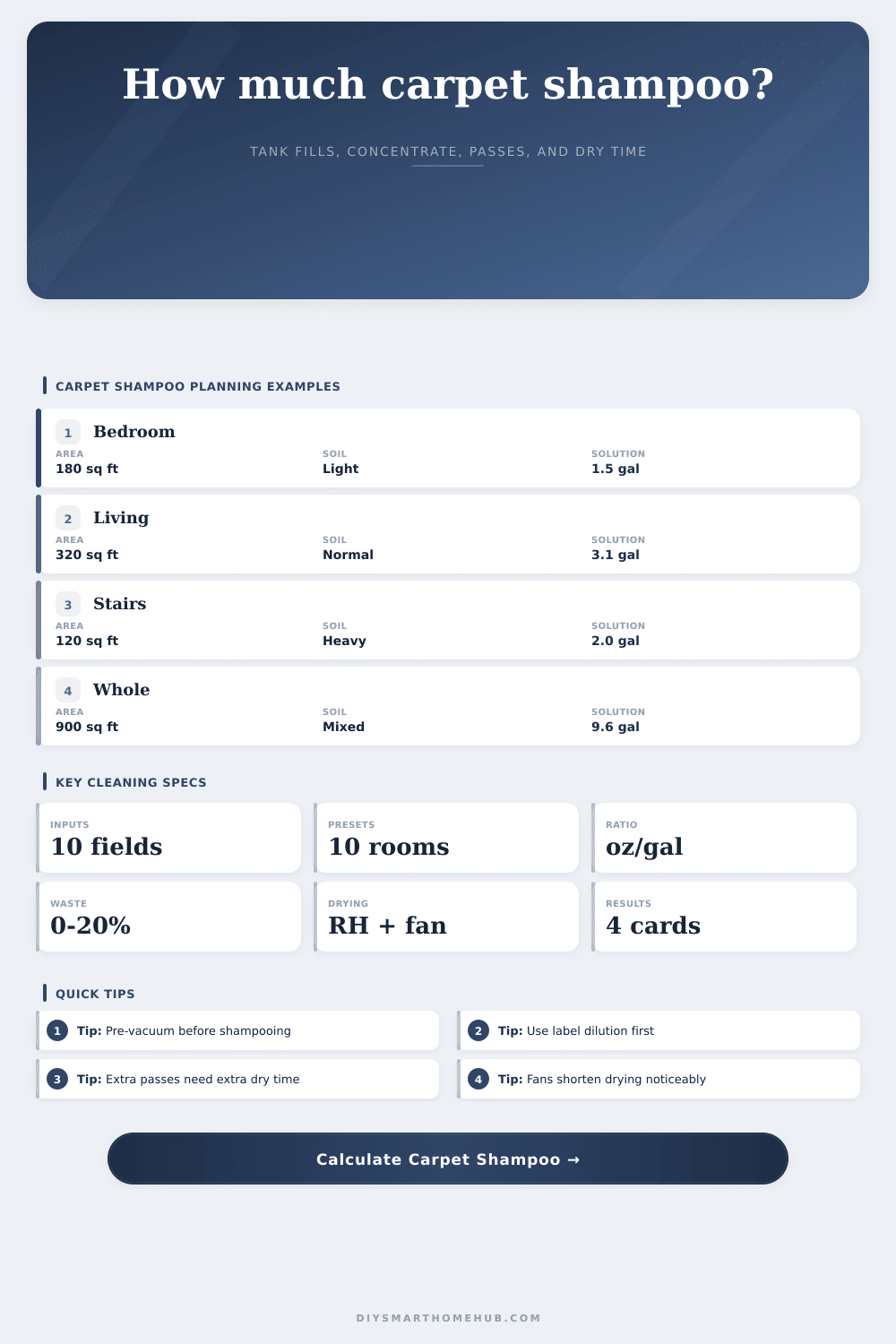
Estimate mixed solution gallons, tank fills, concentrate ounces, recommended passes, and drying time from carpet area, machine tank size, coverage, dilution, soil level, waste, humidity, and fan airflow.
Room and solution settings
Calculation breakdown
| Soil level | Suggested passes | Coverage per tank | Dry-time effect |
|---|---|---|---|
| Light maintenance | 1.0 pass | 140-180 sq ft | Shorter, low moisture |
| Normal traffic | 1.5 passes | 110-150 sq ft | Standard drying |
| Mixed household | 2.0 passes | 95-130 sq ft | Add several hours |
| Heavy traffic or pets | 2.5 passes | 75-115 sq ft | Plan longer airflow |
| Spot treatment focus | 3.0 passes | 60-100 sq ft | Localized damp zones |
| Condition | RH range | Airflow | Multiplier used |
|---|---|---|---|
| Fast dry | 35-45% | High fan | 0.55x to 0.75x |
| Typical dry | 45-60% | Medium fan | 0.85x to 1.10x |
| Slow dry | 60-75% | Low fan | 1.25x to 1.55x |
| Very slow | 75%+ | No fan | 1.70x to 2.40x |
| Project | Area | Passes | Solution estimate |
|---|---|---|---|
| Small bedroom | 120 sq ft | 1.0 light | 0.9-1.1 gal |
| Primary bedroom | 220 sq ft | 1.5 normal | 2.4-3.0 gal |
| Living room | 320 sq ft | 1.5 normal | 3.5-4.4 gal |
| Hall and stairs | 150 sq ft | 2.5 heavy | 3.4-4.5 gal |
| Whole apartment | 650 sq ft | 2.0 mixed | 10-14 gal |
If you’ve ever mixed up a cleaning solution incorrectly, you know what I’m talking about… That certain smell of cleaner that just doesn’t come out no matter how long you wait. That’s what happens when homeowners decides to do their own carpet shampoo. They buy a huge jug of concentrate and guess how much water to add. Then they wonder why their carpets takes three days to dry or still feel sticky.
Mixing up a shampoo solution isn’t rocket science, but there are variables that is easy to miss without a solid game plan first. A few minutes of planning now will save hours of waiting and prevent mold from growing under the fibers of your rugs.
How to Clean Your Carpet Correctly
When it comes to carpet, clean more by chemistry and less by scrubbing: Apply sufficient solution to loosen soil from the carpet fiber without applying too much to soak into the pad beneath. Soaking the pad provides a habitat for bacteria to thrive. Consequently, how much carpet you can cover per pass matter, along with knowing the volume of water your tank holds.
Once you input your machine specs and room sizes, the calculator above crunches the numbers for you. It removes the guesswork, converting what’s physically present (your room) into exact fluid amounts (the amount needed).
Consider how many gallons of water are in your rental/your tank. How much space does it cover? If your machine says it covers one hundred square feet per gallon, and your living room is two hundred square feet, then you will need two full tanks just for one pass. Yet most rooms require multiple passes.
For example, high traffic area (or areas where there are pet accidents) typically require at least two slow passes (sometimes three) to really suck up the grime. The second/third pass increase the moisture. And this is where people go wrong; they only consider the detergent but not the amount of water.
Another thing I have found that has a surprisingly big effect on drying time: humidity. A freshly cleaned carpet in a humid summer stretch will take longer then a carpet shampooed in a dry winter climate. Evaporation happens slowy in humid weather.
You can turn the fan on high and even leave it running. However, if there is seventy percent or more relative humidity in the air, that air is already fully saturated with water. It isn’t going to suck up very much more off your carpet. This knowledge makes for better planning of cleaning chores. Why would you put furniture back down on a still-damp floor just because you’re done spraying?
For other reasons, the concentrate of the shampoo is important. Not enough shampoo and you’re paying for washing dirty hair with straight water (which won’t remove sticky residue or oil). Too much shampoo and in a few days you’ll have a sugary coating that attracts more dirt (and you’ll need to clean it again soon).
Most pros’ labels includes their recommended “ounce per gallon” ratio of shampoo to clean. If you keep that number in the right range, you’ll have all the cleaning effect but no sugary coating. You don’t want the latter because it attracts more grime. This means you’ll be stuck cleaning more often than necessary which accelerates fiber wear.
I included a calculator on this page that scales up the “ounce per gallon” ratio based off how many gallons you intend to make. That way you’ll know exactly how much you should of use and never waste your time or money.
Pre-vacuuming is an important part of good carpet cleaning that goes unsung. What’s on top of the carpet pile will not get shampooed. Leaving behind surface pet hair and other dust results in a muddy slurry that won’t be entirely sucked up by your machine. The slurry remains in the carpet until it dries, stiffly. Spend the extra time vacuuming well before lifting a finger to reach for the shampoo bottle. It cuts down on the soil load, so you’ll need fewer passes (and oftentimes any at all).
Balance is what a good carpet cleaning job boils down to. You need the correct amount of air movement. The correct amount of water. And there is the correct amount of chemical. Each one supporting the other in a system.
Get all those lined up and you come out the door smelling like it was just cleaned and looking fresh, no more that dreaded wet smell clinging to the carpet. You will come out feeling confident that the pad is dry and the fibers are healthy.