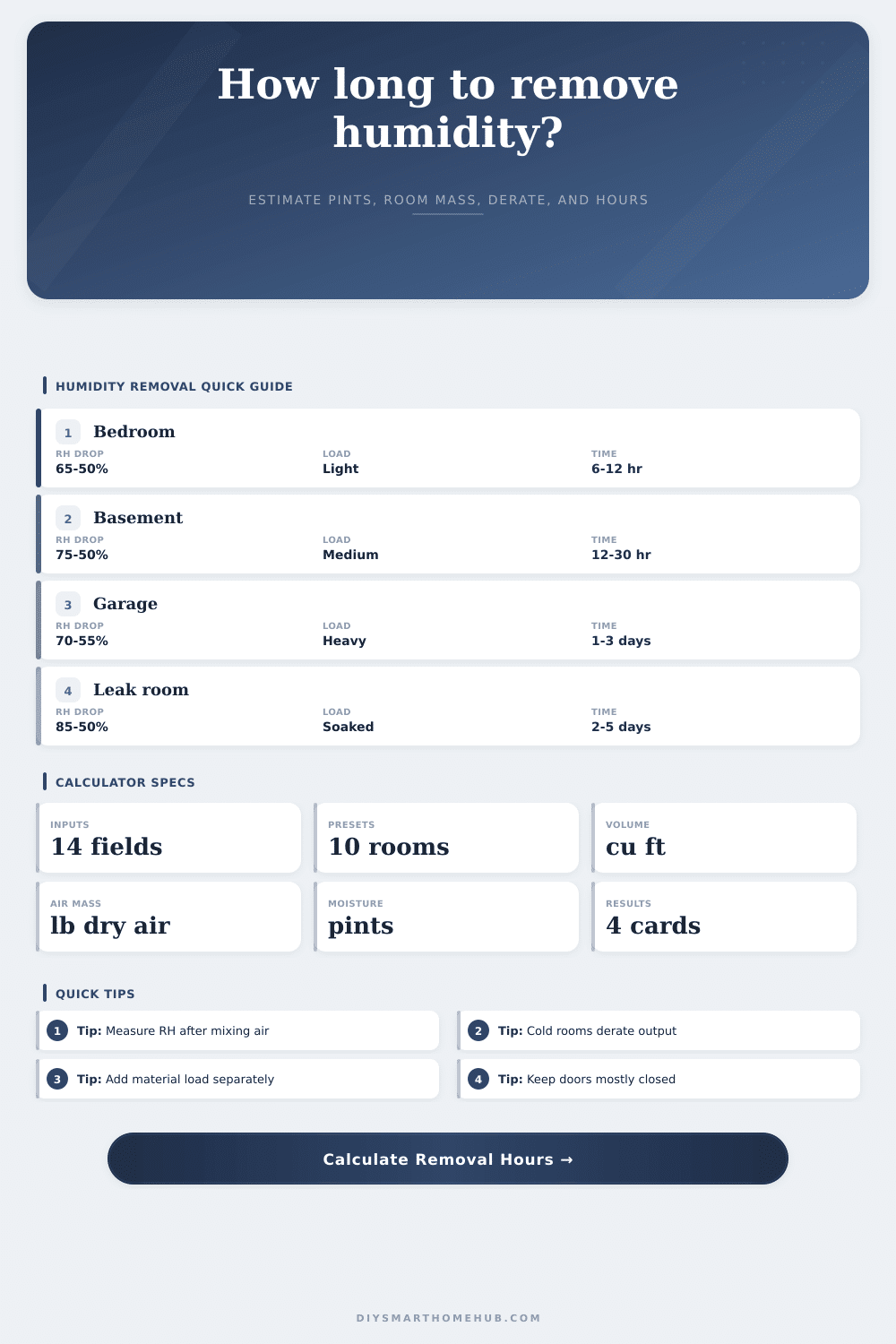
Humidity Removal Hours Calculator
Estimate how many hours a dehumidifier needs to pull a room from current RH to target RH, including room cubic feet, air mass, material moisture load, temperature derate, RH derate, and circulation.
| Step | Formula | Result | Unit |
|---|---|---|---|
| Room volume | length x width x height | 2,400 | cu ft |
| Air mass | volume x dry air density | 180 | lb |
| RH moisture | humidity ratio drop x air mass | 1.4 | pints |
| Hours | total pints / derated pt/day x 24 | 8.5 | hours |
| Condition | Temperature factor | RH factor | Planning note |
|---|---|---|---|
| Cold room | 0.42 to 0.60 | varies | Output slows sharply below 60°F |
| Cool basement | 0.78 | 0.65 to 1.00 | Typical medium derate zone |
| AHAM-like room | 1.00 | 1.00 | Near common 80°F / 60% rating point |
| Warm damp room | 1.05 | 1.12 to 1.20 | High vapor pressure supports higher output |
| Low target RH | temp-based | 0.48 to 0.82 | Final stretch gets slower as RH drops |
| Material selection | Recoverable pints per cu ft | Best input area | When to use it |
|---|---|---|---|
| Air only | 0.00 | 0 sq ft | Humidity event with no damp surfaces |
| Painted drywall | 0.45 | Wall area | Condensation or splash dampness |
| Carpet and pad | 0.95 | Floor area | Wet traffic areas or minor leaks |
| Wood framing | 0.70 | Exposed surface | Subfloor, studs, or trim holding water |
| Concrete or masonry | 0.28 | Floor or wall | Basement slab or block moisture |
| Stored contents | 0.38 | Footprint area | Boxes, shelves, and stored items |
| Room scenario | Typical volume | Common RH target | Likely control limit |
|---|---|---|---|
| Bedroom after humid weather | 1,300 to 1,800 cu ft | 48% to 55% | Air moisture only |
| Basement with slab moisture | 3,500 to 7,000 cu ft | 45% to 55% | Concrete release |
| Laundry or bath zone | 700 to 2,000 cu ft | 45% to 55% | High starting RH |
| Garage after wet vehicle | 3,000 to 6,000 cu ft | 50% to 60% | Cold derate |
| Minor leak cleanup | 1,500 to 4,000 cu ft | 45% to 50% | Material pints |
When you walk into a basement, there’s always something about the air that feel wet, as if you’re stepping into a warm bath and you know what’s coming: It needs drying out. So you go buy biggest dehumidifier you can find and plunk it down, waiting for the air to dry out. A few days later it feels a bit better, but no, it doesn’t get crisp and dry.
The issue isnt typically the appliance. It’s never the appliance. It’s almost always just math. You’re attempting to pull water out of air, while forgetting the moisture hiding within the walls.
Why Your Basement Is Still Wet
Here’s how the calculator works. You plug in numbers and the calculator do all the work. But knowing what’s going on makes using the tool more effective.
Humidity is not simply a number on a dial. It is actualy a measurement of the water vapor contained in a certain volume of gas. By reducing the relative humidity, you’re forcing that vapor to condense on a cold coil.
Building materials contain far more water than air. Your typical bedroom may contain several pints of moisture in the air alone. That doesn’t sound so bad. Here’s the problem: Furnitures, drywall and carpet are sponges. They absorbs hundreds of pints of water.
If you calculate just the air moisture, you’ll find yourself thinking “this job will be done in six hours.” Once the air has dried, however, the carpet will still be wet. Moisture will flow back out from the carpet and in to the room, keeping the humidity high.
Why does the tool ask for the material load? Because it forces you to take into account this unseen reservoir. And it depends on temperature. Dehumidifiers tend to be rated under optimal conditions (warm). Your basement, by contrast, tends to be cool. When temperatures drop, so does machine’s capacity to extract moisture. What was rated at fifty pints per day may reach only ten in a cool environment.
Why? Because the device is derating, that is, losing capacity when conditions turn worse. You can see that chart here; it indicates exactly what happens as conditions get worse. That’s not a flaw with the machine. It’s physics. Vapor doesn’t hold well in cold air; therefore the condensing cycle slow down. Fail to account for this and your timeline would of been too optimistic.
You also need to consider airflow. You can’t expect a dehumidifier to dehumidify the immediate area surrounding it. So if you have boxes piled up on the wall, or other items like chairs, tables, etc., the air in that space will not flow. What does this mean? Moisture will be trapped there. It never makes its way into the dehumidifier.
Installing a fan isn’t for comfort only. It also pushes the moist air from under couch and inside the carpet towards the dehumidifier. Stagnant air in tiny pockets throughout your room is what you’re fighting when you don’t have airflow. It’s like cooking a stew. Turn up the heat. Don’t stir? The bottom burns while the top stay cold.
Got the correct capacity? Yes. But without knowing about the hidden water and moving air, it doesn’t work. That’s why most people only buy the machine. Don’t forget the temperature. Forget the materials. The job takes so long because of that.
Estimate the pints using the tool. And then be patient with the timeline. Three days instead than three hours. That’s just how long water takes to leave solid materials.
First, you’ll notice that the air feels lighter. The rest requires patience. Remember: You’re not just drying air. You’re removing water from the room.